
If you have a packed schedule but still want to build muscle and get lean, a full body workout plan is one of the most effective tools you can have. The whole idea is to train all your major muscle groups in a single, efficient session. By doing this just 2-3 times per week, you can kickstart a powerful calorie burn and trigger the hormonal response needed for real growth.
Why Full Body Workouts Get the Job Done
Think about the classic strongmen and old-school bodybuilders. Their powerful, balanced physiques were built on the foundation of full body training. This isn't some new fitness fad; it’s a proven method that's been around forever because it works. Instead of splitting your week into "chest day," "leg day," and so on, you hit your entire body at once.
This approach has some serious advantages over the traditional body-part split. If you're only hitting chest once a week, that muscle gets seven full days of rest. With a full body routine, you can stimulate your legs, back, chest, and arms multiple times in that same seven-day window. That increased frequency is a massive catalyst for getting stronger and building muscle faster.
The Efficiency is Backed by Science
When you do big, compound exercises like squats, deadlifts, or an overhead press, you're not just working a single muscle in isolation. You’re calling on dozens of smaller stabilizer muscles and lighting up your entire central nervous system. This team effort creates a much bigger metabolic effect than, say, a few sets of bicep curls.
Here's what that actually means for your results:
- Bigger Calorie Burn: Hitting more muscle at once demands more energy. This means you burn more calories not just during the workout, but for hours afterward, too.
- A Natural Hormonal Boost: Training large muscle groups together triggers a more potent release of anabolic hormones like testosterone and growth hormone—the very ones responsible for repairing and building new muscle.
- Real-World Strength: Full body movements are functional. They mimic things you do in everyday life, like lifting a heavy box or pushing a car. This builds practical strength you can actually use.
This style of training isn't new. It has roots going back centuries, but it really took shape when people's lifestyles changed. During the Industrial Revolution in the early 19th century, many people moved from physically demanding farm work to more sedentary factory jobs. This created a new need for structured exercise. Pioneers like Friedrich Jahn, known as the 'Father of Gymnastics', created programs based on the same kind of dynamic, compound movements that are the ancestors of today's full body routines. You can delve into the fascinating history of physical fitness to learn more.
A Classic Method for Modern Life
The principles may be old, but their application is perfectly suited for our busy lives. It’s easy to fall into the trap of thinking that more hours in the gym equals better results. But a smartly designed full body workout proves that the quality and intensity of your training matter far more than the sheer time you put in.
The goal isn't to obliterate one muscle group and then leave it alone for a week. The goal is to stimulate all of your muscles frequently enough to keep them adapting and growing, all without having to live at the gym.
I like to think of it this way: a body-part split is like writing one chapter of a book each day. A full body workout is like reviewing and editing the entire manuscript three times a week. The second approach gives every part of the project consistent attention, leading to a stronger, more polished final product much faster. This is what makes the full body workout plan such a killer strategy for anyone who wants to get the most out of their time.
Getting a Grip on the Big Lifts in Your Workout Plan
The real engine behind a great full-body workout isn't some secret, complicated exercise list. It's all about mastering a handful of foundational movements—what we call compound lifts. These are the big-ticket exercises that give you the most bang for your buck, building real-world strength and muscle from head to toe.
Instead of hitting one tiny muscle at a time, compound lifts force large muscle groups to work together in one powerful, coordinated effort. This teamwork not only sculpts a balanced, athletic frame but also sends your calorie burn through the roof. Nail these core movements, and you've built the foundation for all your future gains.
The Squat: King of Lower Body Exercises
When you think of building strong legs, the squat is almost always the first thing that comes to mind. It's a primal human movement that hammers your quads, hamstrings, glutes, and core all at once. But a good squat isn't just about moving weight; it's about owning the movement with control, stability, and total-body tension.
A classic mistake I see all the time is letting the knees collapse inward on the way down. To fix this, think about actively pushing your knees out. Imagine you're trying to spread the floor apart with your feet. That one simple cue fires up your hip abductors and helps you keep a solid, joint-friendly alignment.
The Deadlift: The Ultimate Full-Body Movement
If the squat is king, then the deadlift is the undisputed emperor of total-body strength. Seriously, no other exercise recruits more muscle, from your traps all the way down to your calves. It’s the ultimate builder of raw power, a rock-solid posterior chain (that’s your glutes, hamstrings, and back), and a grip that could crush stone.
The biggest hurdle for most people starting out? Keeping a flat back. Letting your lower back round under a heavy load is a one-way ticket to injury. A great mental trick is to "pull the slack out of the bar" before you even start the lift. Engage your lats by imagining you're trying to squeeze an orange in each armpit. This creates a ton of tension through your upper back and helps lock your spine into a safe, neutral position.
A well-executed deadlift is more than just a lift; it's a testament to proper mechanics and total-body integration. It teaches you how to generate force from the ground up, a skill that translates into virtually every athletic endeavor.
This idea of using big, compound movements for overall power isn't new. Full-body routines have a long and storied past, evolving from ancient training methods into the programs we use today. As societies developed, so did the need for structured fitness, with weightlifting officially joining the modern Olympics in 1896 and cementing the role of these core barbell lifts. You can dive into the rich history of physical training to see just how timeless these principles are.
This simple process is what makes these lifts so effective.
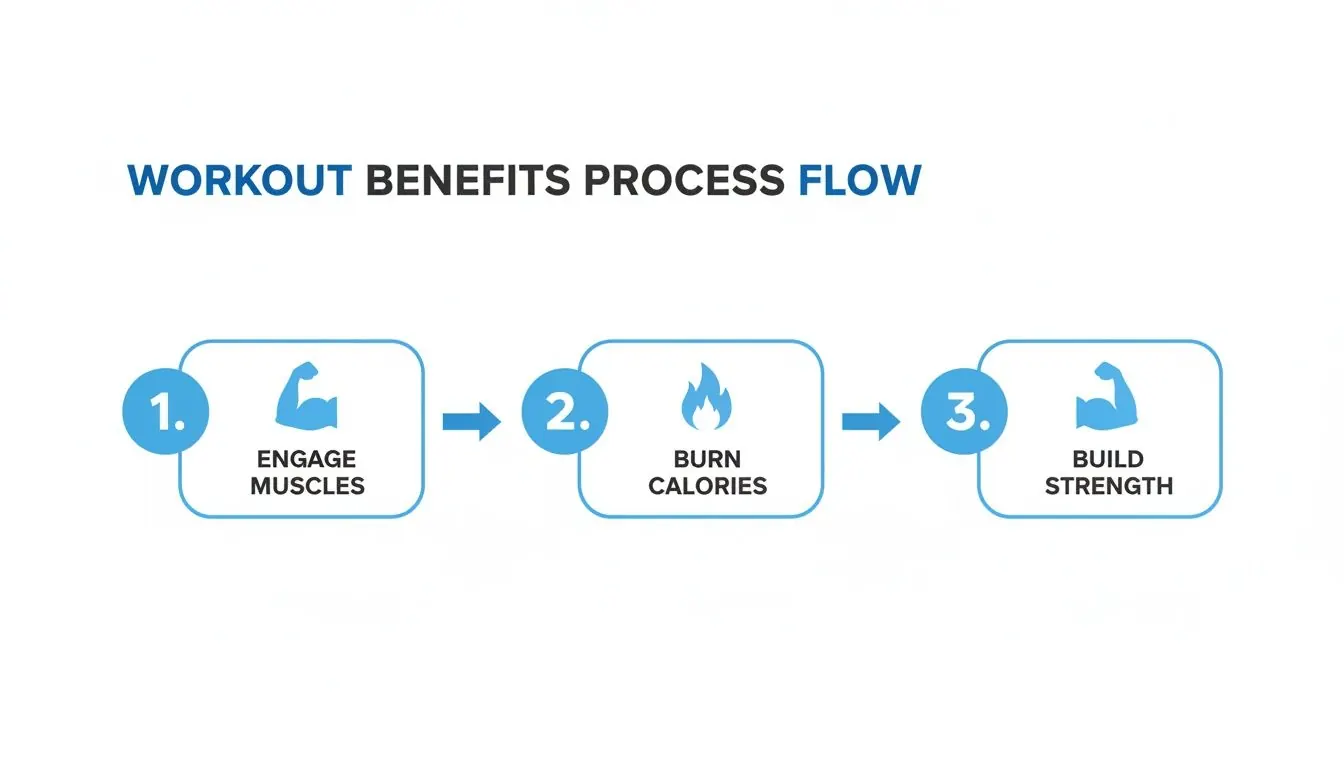
As the graphic shows, engaging more muscle groups burns more calories, which is the direct path to building overall strength.
The Bench Press: Building Upper-Body Push Power
The bench press is the classic benchmark for upper-body pushing strength, hitting the chest, front of the shoulders, and triceps hard. But to do it safely and get the most out of it, your setup is everything. So many lifters make the mistake of flaring their elbows out to a 90-degree angle, which puts a ton of unnecessary stress right on the shoulder joint.
Try this instead:
- Tuck Your Elbows: Bring your upper arms in to about a 45- to 60-degree angle from your torso.
- Arch Your Back: Create a small, natural arch in your lower back, but keep your glutes glued to the bench.
- Use Your Legs: Plant your feet firmly on the floor and think about driving them through the ground as you press the bar up.
This approach turns the bench press from an isolated chest exercise into a much more stable and powerful full-body effort.
The Overhead Press and Row: The Push-Pull Balance
Finally, a truly complete full-body plan needs to balance all that pushing with some serious pulling. The overhead press and the barbell row are the perfect duo for forging strong, healthy shoulders and building a thick, powerful back.
The Overhead Press (OHP)
This lift is incredible for building impressive shoulders and a bulletproof core. The secret is to resist the urge to lean back and use your spine to cheat the weight up. Before you press, squeeze your glutes tight and brace your abs like you’re about to take a punch. This creates a solid foundation to press from, keeping your back safe.
The Barbell Row
This is your go-to horizontal pulling movement, and it’s fantastic for your lats, rhomboids, traps, and biceps. Just like the deadlift, keeping a neutral spine is non-negotiable. Hinge at your hips, maintain a straight back, and pull the bar toward your sternum. The key is to really focus on squeezing your shoulder blades together at the top—that's what ensures your back is doing the work, not just your arms.
Actionable Full Body Workout Plan Templates
Alright, this is where theory hits the gym floor. A good plan is the difference between showing up and just going through the motions versus training with intention and purpose. Think of these templates as your personal roadmap, designed to help you walk in, get straight to work, and actually see the results you're after.
I've broken these routines down by experience level, from a rock-solid starting point for beginners to a more demanding schedule for experienced lifters. The most important thing to remember is that the "best" workout is the one you do consistently. Be honest about where you are right now and choose the plan that fits your life and current fitness level.
H3: The Beginner Foundation Plan (2 Days Per Week)
If you're brand new to lifting or getting back into it after some time off, this is exactly where you should start. The goal is simple: build a solid base of strength and get comfortable with the fundamental human movements.
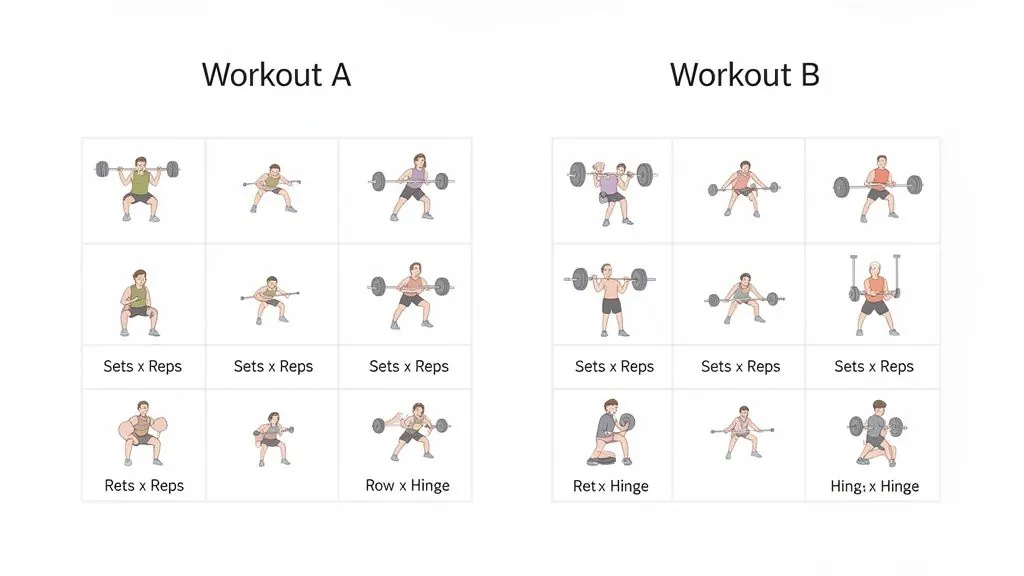
Training just twice a week on non-consecutive days—say, Monday and Thursday—gives your body plenty of time to recover and adapt, which is critical in the early stages. We’ll use an A/B split, meaning you’ll do Workout A on your first day and Workout B on your second. This keeps things interesting and makes sure you're working your muscles in slightly different ways.
- Workout A: Will focus on core strength and stability movements.
- Workout B: Will introduce some variations to challenge your body and mind.
For the first 4-6 weeks, your only job is to nail your form. Seriously. Don't even think about lifting heavy; concentrate on slow, controlled, perfect reps. Quality over quantity is the name of the game here.
My Two Cents: Logging your workouts is a non-negotiable, especially now. Jot down the weight you used for every exercise. Each week, your mission is to add a tiny bit more weight (even 2.5 lbs is a win!) or squeeze out just one more rep with the same weight. That, right there, is progressive overload in action.
H3: The Intermediate Strength Plan (3 Days Per Week)
After a few months of consistent training, you'll likely notice your progress on the beginner plan starting to slow down. That’s your cue to level up. This intermediate plan bumps your training up to three days a week, giving you more volume to spark new muscle growth. A Monday, Wednesday, and Friday schedule works perfectly.
You’ll continue with an A/B split, but now you’ll alternate it across the week. It looks like this:
- Week 1: Workout A, Workout B, Workout A
- Week 2: Workout B, Workout A, Workout B
This smart rotation means you're hitting your main lifts about three times every two weeks, which is a fantastic way to break through plateaus and speed up your strength gains. The exercises get a bit more demanding, and you'll be pushing the intensity.
H3: The Advanced Performance Plan (3 Days Per Week)
For those of you who've been in the iron game for a while and are comfortable under a heavy bar, this plan is designed to provide the robust stimulus you need to keep moving forward. The volume and intensity are kicked up a notch, and the exercise selection assumes you have your technique dialed in.
At this stage, you can't just slap more weight on the bar every week. Instead, we get more strategic by playing with different rep ranges and intensities throughout the week. For example, Monday might be your heavy, low-rep day, while Friday is geared more toward muscle-building with moderate weight and higher reps.
A Look at an Advanced Week:
- Monday (Heavy Day): Main lifts are all about pure strength in the 4-6 rep range.
- Wednesday (Volume Day): Use moderate weights for more reps, like 4 sets of 8-12.
- Friday (Accessory/Light Day): Go lighter, really focusing on the mind-muscle connection and shoring up any weak points.
This method, often called daily undulating periodization, is incredibly effective for advanced lifters. It helps you manage fatigue while pushing your limits, leading to much more sustainable progress over the long haul.
To make this crystal clear, here are some sample weekly schedules based on these plans.
Beginner to Advanced Weekly Full Body Workout Schedules
The table below outlines how you can structure your week, whether you're just starting out or are a seasoned pro. Notice how the complexity and volume increase with each level.
| Level | Frequency | Workout A (e.g., Monday) | Workout B (e.g., Wednesday) | Workout C (e.g., Friday) |
|---|---|---|---|---|
| Beginner | 2x / week | Goblet Squat: 3×10-12 Push-Ups: 3xAs Many As Possible Dumbbell Rows: 3×10-12 Plank: 3×30-60 sec |
Romanian Deadlift: 3×10-12 Overhead Press: 3×8-10 Lat Pulldowns: 3×10-12 Glute Bridge: 3×15 |
Rest or Active Recovery |
| Intermediate | 3x / week | Barbell Squat: 3×8-10 Dumbbell Bench Press: 3×8-10 Bent-Over Rows: 3×8-10 Face Pulls: 3×12-15 |
Deadlift: 3×5-8 Pull-Ups: 3xAMRAP Seated Shoulder Press: 3×10-12 Leg Press: 3×10-12 |
Repeat Workout A (following week starts with B) |
| Advanced | 3x / week | (Heavy) Squat: 4×4-6 Bench Press: 4×4-6 Pendlay Rows: 4×6-8 |
(Light/Accessory) Front Squat: 3×8-10 Incline DB Press: 3×10-12 Chest-Supported Row: 3×10-12 Lateral Raises: 4×12-15 |
(Volume) Deadlift: 4×5 Overhead Press: 4×8-10 Chin-Ups: 4xAMRAP Bulgarian Split Squat: 3×10 |
Use these as a starting point. Feel free to swap exercises based on what equipment you have, but try to keep the main movement pattern (squat, hinge, push, pull) the same.
How to Progress and Adapt Your Workout Plan
Think of your workout plan as a starting point, not the final destination. Your body is incredibly smart—it adapts. If you keep doing the exact same routine, it gets good at it, and the results start to slow down. To keep making gains, you have to consistently give your body a new reason to get stronger.
This core concept is called progressive overload, and it's the single most important principle for long-term success. It sounds technical, but it just means you need to gently push past what you did last time. Without it, you’re just going through the motions.
Simple Ways to Apply Progressive Overload
Progress isn't just about piling more weight onto the bar every week. That's a quick way to hit a plateau or get hurt. There are smarter, more sustainable ways to keep the challenge fresh.
Here are a few of the most effective methods:
- Add More Weight: This is the most obvious one. If you hit all your reps and sets (say, 3 sets of 10) with solid form, try adding a small amount of weight next time. Even just 2.5-5 lbs is progress.
- Do More Reps: Can't quite jump up in weight yet? No problem. Stick with the same weight but aim for one or two extra reps in each set. Once you can comfortably hit the top of your target rep range (like 12 reps), then it’s time to add weight.
- Cut Your Rest Time: This is a great way to increase the intensity without touching the weights. If you normally rest for 90 seconds between sets, try cutting it down to 75 seconds. Your muscles will have to work harder to recover, creating a powerful new stimulus for growth.
Making the Workout Plan Your Own
Life is rarely perfect. An old knee injury might flare up during squats, or maybe you’re working out at home with nothing but a pair of dumbbells. A good workout plan has to be flexible.
Treat the workout templates in this guide like a blueprint, not a rigid set of rules. You should absolutely make smart swaps based on your body, your equipment, and how you feel on any given day.
The best program is the one you can stick to safely and consistently. Never force an exercise that causes pain or that you can’t perform with good technique.
Here are a few common scenarios and their solutions:
- Knee Pain with Squats? Try swapping them for Goblet Squats, which help you stay more upright. Another great option is the Bulgarian Split Squat, which places less stress on your lower back.
- No Barbell for Deadlifts? Dumbbell Romanian Deadlifts (RDLs) are an incredible substitute. They will still thoroughly work your hamstrings and glutes.
- Can't Do a Pull-Up Yet? No one starts out banging out sets of 10. Use a resistance band to give yourself a boost, or work on building your back strength with Inverted Rows.
Listening to Your Body Is Key
Progress is never a straight line up. Some days you’ll feel unstoppable in the gym, and other days you’ll feel tired before you even start. Learning to tell the difference between "I don't feel like it" and "My body genuinely needs a break" is a skill you'll develop over time.
If you’re feeling rundown, it’s not just okay to take it easy—it’s smart. Have a "de-load" day where you reduce the weight or the number of sets to give your body a chance to recover. This is especially true as we get older; knowing when to push and when to pull back is essential for staying in the game long-term, something we cover in our guide on how to build muscle after 40.
Trying to power through true fatigue is a recipe for injury or burnout. That will derail your progress far more than one lighter workout ever will.
Fueling Your Body for Peak Performance and Recovery
The work you do in the gym is only half the story. Honestly, the other half—the part that truly determines your results—happens in your kitchen and while you sleep. Think of your body as a high-performance engine. Your workouts are the driving, but food is the premium fuel it needs to run, repair, and get stronger.
This isn't about getting bogged down in complicated diets. It's about grasping a few core principles that will seriously amplify the results of your hard work, helping you build muscle and shed fat much more effectively.
The Building Blocks: Macronutrients
Let's keep this simple. Your diet really boils down to three main "macros": protein, carbohydrates, and fats. Each one plays a critical, unique role in getting you closer to your goals, and getting the balance right is what separates good results from great ones.
-
Protein: This is your non-negotiable for muscle repair and growth. After a tough full-body session, you've created tiny micro-tears in your muscle fibers. Protein delivers the amino acids needed to patch them up, making them bigger and stronger. Think lean meats, fish, eggs, and Greek yogurt.
-
Carbohydrates: Forget the carb-phobia. Carbs are your body's number one energy source. Eating them before a workout tops off your fuel tank (glycogen stores), giving you the power to push through every last rep. After you train, they help replenish that energy and drive nutrients into your muscles. Stick with complex sources like oats, brown rice, and sweet potatoes.
-
Fats: Healthy fats are absolutely essential for hormone production (including the ones that build muscle) and overall health. They also provide a slow, steady stream of energy. Good choices here include avocado, nuts, seeds, and olive oil.
The best full-body workout plan on the planet will fall flat without proper nutrition. You simply can't out-train a bad diet. What you eat is just as important as any exercise you do.
And while we're on the topic of support, don't overlook what you wear. For optimal comfort and movement during your sessions, it's worth finding the best gym clothes for women that let you perform without restriction.
Timing Your Nutrition for Maximum Impact
While your total daily intake is king, you can definitely get a performance edge by being a bit strategic with your pre- and post-workout meals. It’s all about giving your body what it needs, right when it needs it.
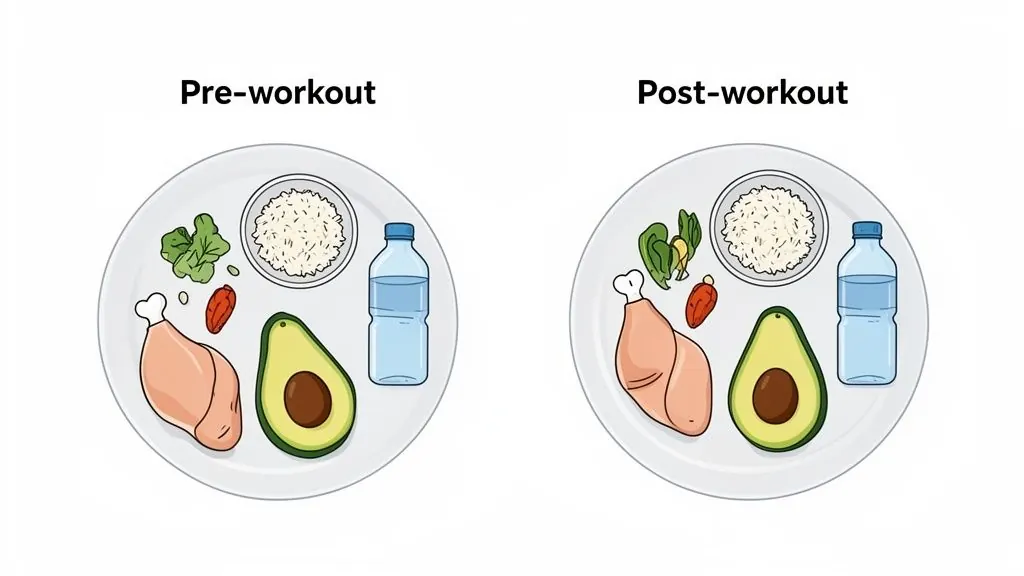
Pre-Workout Fuel (1–2 Hours Before)
The goal here is sustained energy. You want a meal with plenty of complex carbs and a moderate amount of protein. This combo gives you the horsepower to perform without feeling sluggish or bloated in the middle of a set.
A classic example is a bowl of oatmeal with a scoop of protein powder, or a simple plate of chicken breast with a small sweet potato. It’s a perfect setup for a killer workout.
Post-Workout Recovery (Within 1–2 Hours After)
Right after your workout, your muscles are like sponges, primed to soak up nutrients to kickstart the repair process. This is the ideal window to get in some fast-digesting protein and carbs. A protein shake with a banana is a go-to for a reason—it’s quick, easy, and gets the job done.
If you want to build a more structured approach, our guide on meal planning for muscle gain lays out a clear framework to help you create an eating strategy that actually works for you.
Recovery Beyond the Plate
Nutrition is a huge piece of the puzzle, but it's not the only one. Two other things have a massive impact on your results: sleep and how you manage stress.
The Power of Sleep
This is where the real magic happens. During deep sleep, your body releases a major surge of growth hormone, which is absolutely vital for muscle repair. Consistently hitting 7-9 hours of quality sleep a night is one of the most powerful things you can do to speed up your progress. Don't skip it.
Managing Stress
Life gets stressful, but chronic stress spikes a hormone called cortisol. High cortisol levels can actually break down muscle tissue and encourage your body to store fat, especially around your stomach. Finding healthy ways to decompress—whether it's meditation, a walk outside, or just unplugging from your phone—can directly improve your body composition and how you feel in the gym.
Your Full Body Workout Questions Answered
Starting a new fitness plan always kicks up a few questions. When it comes to full-body workouts, getting the details right helps you train smarter, recover faster, and actually stick with it. Let's tackle some of the most common things people wonder about.
How Long Should a Full Body Workout Take?
Aim for 45 to 75 minutes. The goal here is efficiency, not spending half your day in the gym. If you're new to this, you'll probably be on the shorter end of that range, and that's perfect. Your main focus should be on learning the movements and getting your form dialed in.
As you get stronger and more experienced, your sessions might creep toward the longer end of that spectrum. This isn't because you're adding tons of new exercises; it's usually because you're lifting heavier weight, which demands more rest time between sets to keep your performance high and prevent injuries.
Can I Do a Full Body Workout Every Day?
That's a hard no. It’s a classic rookie mistake to think more is always better, but your muscles don't actually get stronger during the workout. The real magic happens when you rest.
Training the same muscles every single day denies them the recovery time they desperately need to repair and grow. Pushing through without rest is a fast track to overtraining, seeing your progress stall, and getting hurt. For almost everyone, hitting it 2-3 times per week on non-consecutive days (think Monday, Wednesday, Friday) is the sweet spot. This gives your body at least 48 hours to bounce back.
A full body workout plan is potent because of its frequency and its built-in recovery. Respecting your rest days is just as important as crushing your training days. It’s during this downtime that all your hard work actually translates into strength and muscle.
Is a Full Body Plan Better Than a Split Routine?
The "best" routine is the one that fits your life and your goals. There's no single right answer.
That said, for anyone new to lifting, tight on time, or focused on general strength and fat loss, a full-body plan is almost always the better choice. You get to stimulate every major muscle group multiple times a week, which is a huge driver for building a solid foundation and seeing results quickly.
Split routines—where you train different body parts on different days—are great for competitive bodybuilders or very advanced lifters. They often need massive training volume for specific muscles and can dedicate 4-6 days a week to the gym. For the rest of us, the full-body approach is a more practical and efficient way to build a strong, balanced physique. And as you get leaner, you might be interested in our guide on how to measure body fat percentage to track your progress accurately.
When Should I Switch to an Intermediate Plan?
Your body will tell you when it's time to level up. After 3-6 months of consistent effort, you’ve likely built a great base, and you'll start noticing a few tell-tale signs.
Keep an eye out for these signals:
- Your form is locked in. You can perform the big lifts like squats, deadlifts, and presses with good technique without even thinking about it.
- Your progress has stalled. You’re stuck at the same weights and reps for a few weeks, even though you're eating and sleeping well.
- You're just not feeling challenged. The beginner workouts feel more like a warm-up than a real session.
When you hit that plateau, it's not a bad thing. It's your body telling you it has adapted and is ready for a new challenge. That's your green light to find a more demanding program.
At Lindy Health, we build personalized workout and nutrition plans that evolve as you do, ensuring you never hit a plateau. Our expert coaches provide the daily guidance and accountability needed to reach your goals. Take the first step and learn how our integrated coaching can transform your results.
Further reading
- Maximizing Muscle Hypertrophy: A Systematic Review of Advanced Resistance Training Techniques and Methods.Int J Environ Res Public Health 2019.PubMed 31817252 · doi:10.3390/ijerph16244897
- Effects of Resistance Training Frequency on Measures of Muscle Hypertrophy: A Systematic Review and Meta-Analysis.Sports Med 2016.PubMed 27102172 · doi:10.1007/s40279-016-0543-8
- The Resistance Training Dose Response: Meta-Regressions Exploring the Effects of Weekly Volume and Frequency on Muscle Hypertrophy and Strength Gains.Sports Med 2026.PubMed 41343037 · doi:10.1007/s40279-025-02344-w
- American College of Sports Medicine position stand. Progression models in resistance training for healthy adults.Med Sci Sports Exerc 2002.PubMed 11828249 · doi:10.1097/00005768-200202000-00027
- American College of Sports Medicine position stand. Progression models in resistance training for healthy adults.Med Sci Sports Exerc 2009.PubMed 19204579 · doi:10.1249/MSS.0b013e3181915670
- Resistance training prescription for muscle strength and hypertrophy in healthy adults: a systematic review and Bayesian network meta-analysis.Br J Sports Med 2023.PubMed 37414459 · doi:10.1136/bjsports-2023-106807
- Concurrent training: a meta-analysis examining interference of aerobic and resistance exercises.J Strength Cond Res 2012.PubMed 22002517 · doi:10.1519/JSC.0b013e31823a3e2d
- How many times per week should a muscle be trained to maximize muscle hypertrophy? A systematic review and meta-analysis of studies examining the effects of resistance training frequency.J Sports Sci 2019.PubMed 30558493 · doi:10.1080/02640414.2018.1555906
Literature retrieved from PubMed on October 16, 2026, favouring human studies and reviews. Numbered markers in the text show which paper supports which statement; uncited entries are background reading.