If you've got a constantly arched back, you know it's more than just a cosmetic issue. It’s that nagging ache in your lower back after a long day on your feet, the frustration of hitting a plateau in your squats because your form just feels off, and that persistent stiffness that greets you after a few hours at your desk.
This condition, often called an anterior pelvic tilt or hyperlordosis, is incredibly common. But that doesn't mean you have to live with it. The good news is that it’s usually the result of a muscular tug-of-war—and you have the power to restore balance.
Why Your Arched Back Is More Than Just Bad Posture
This isn’t some rare, complex condition. In fact, you're in good company. Fixing an arched back is one of the most common postural challenges people face, and it's a growing problem that affects hundreds of millions of adults around the world.
Just look at the numbers from the Global Burden of Disease study: in 2020, an estimated 619 million people were living with low back pain. Experts project that number to swell to 843 million by 2050. While not every case is caused by posture, the study repeatedly points to modifiable factors like prolonged sitting and weak core and hip muscles—the exact culprits behind an arched back. You can dive into the full research on global back pain trends00098-X/fulltext) to see just how widespread this has become.
This postural pattern isn't just about discomfort. It's a performance killer, holding you back in the gym and compromising your ability to move efficiently through daily life.
What This Guide Will Do for You
Forget about random stretches you found online. This is a structured system designed to bring your body back into alignment. Think of it as hitting the reset button on your posture, guiding you away from chronic pain and toward foundational strength.
Here's the blueprint for what we're going to tackle together.
Your Three-Part Plan to Fix an Arched Back
Here's a quick overview of the core strategies we'll cover. This is the blueprint for realigning your posture and building a stronger foundation.
| Strategy Pillar | What It Means | Why It Works |
|---|---|---|
| Releasing Tension | Stretching the overactive muscles that are constantly pulling your pelvis forward, like your hip flexors and lower back. | This creates the necessary "slack" in the system, allowing your pelvis to return to a more neutral position without resistance. |
| Building Strength | Activating and strengthening the underactive muscles—specifically your glutes and deep core—that are meant to stabilize your pelvis. | Strong glutes and core muscles act as an anchor, holding your pelvis in the correct position and preventing it from tilting forward again. |
| Improving Awareness | Learning to recognize and maintain a neutral spine and pelvis position throughout your day, not just during your workout. | This is where the changes stick. By retraining your body's default posture, you make the corrections automatic and long-lasting. |
By addressing all three pillars, you create a powerful, sustainable solution. It's not just about doing exercises; it's about re-educating your body to move and hold itself differently.
The core principle is simple: You can't just stretch your way out of an arched back, and you can't just strengthen it away. You need a combined approach that addresses both sides of this muscular tug-of-war.
Following the steps in this guide will give you the tools to fix your arched back for good. If you're looking for more direct support, working with an online personal trainer and nutritionist can provide the accountability and customized programming to make sure you’re getting it right and making progress faster.
The Real Reasons Your Back Is Arched
Let's get straight to the point about that nagging arch in your lower back. For the vast majority of people, this issue, often called anterior pelvic tilt, isn't something you were born with. It's the result of a muscular tug-of-war that modern life has completely rigged against you.
I like to use a simple analogy with my clients: imagine your pelvis is a bucket full of water. When your posture is balanced and neutral, that bucket sits perfectly level. But when certain muscles get tight and others get lazy, the bucket gets yanked out of position, spilling water everywhere.
The Great Muscular Tug-of-War
Take a second to think about your daily routine. Many of us spend a huge portion of our day sitting—at a desk, in the car, or unwinding on the couch. All that sitting forces the muscles at the front of your hips, your hip flexors, into a shortened position, making them chronically tight.
While that's happening, the muscles on the backside of your body—specifically your glutes and hamstrings—are basically taking a nap. They become inactive and weak. Your deep core stabilizers, the muscles that act like a natural corset for your spine, also tend to "switch off."
This creates a powerful, predictable imbalance:
- Tight Hip Flexors: These overactive muscles pull down on the front of your pelvis.
- Weak Glutes & Core: These underactive muscles can no longer pull up on the back of your pelvis to counteract that force.
The end result? The front of your "bucket" tips forward and down. To keep you from falling on your face, your lower back has to over-arch to compensate, creating that tell-tale curve and the constant tension that comes with it.
How Your Workouts Might Be Making It Worse
Now, it's not just sitting that's the enemy here. Sometimes, our own workout habits can pour fuel on the fire, even with the best intentions. Many popular training programs are incredibly front-body dominant.
Think about it: a routine heavy on squats, leg presses, and leg extensions builds powerful quadriceps. While strong quads are great, you're just reinforcing the existing imbalance if you aren't putting just as much, if not more, effort into your posterior chain—your glutes and hamstrings. Your already dominant quads and tight hip flexors just keep winning the tug-of-war.
The Key Takeaway: An arched back is almost never about simply "standing up straight." It's a physical symptom of a specific imbalance: some muscles are too tight, and others are too weak. To actually fix the arch, you have to attack both sides of that equation.
Identifying the root causes of an arched back is crucial; for many, poor ergonomics at the workstation play a significant role. It's well worth learning how to select the best ergonomic office chairs for back pain, as your chair can either help or hinder your progress.
This guide breaks down the process into three simple stages: from recognizing the pain, to understanding the cause, and finally, taking corrective action.
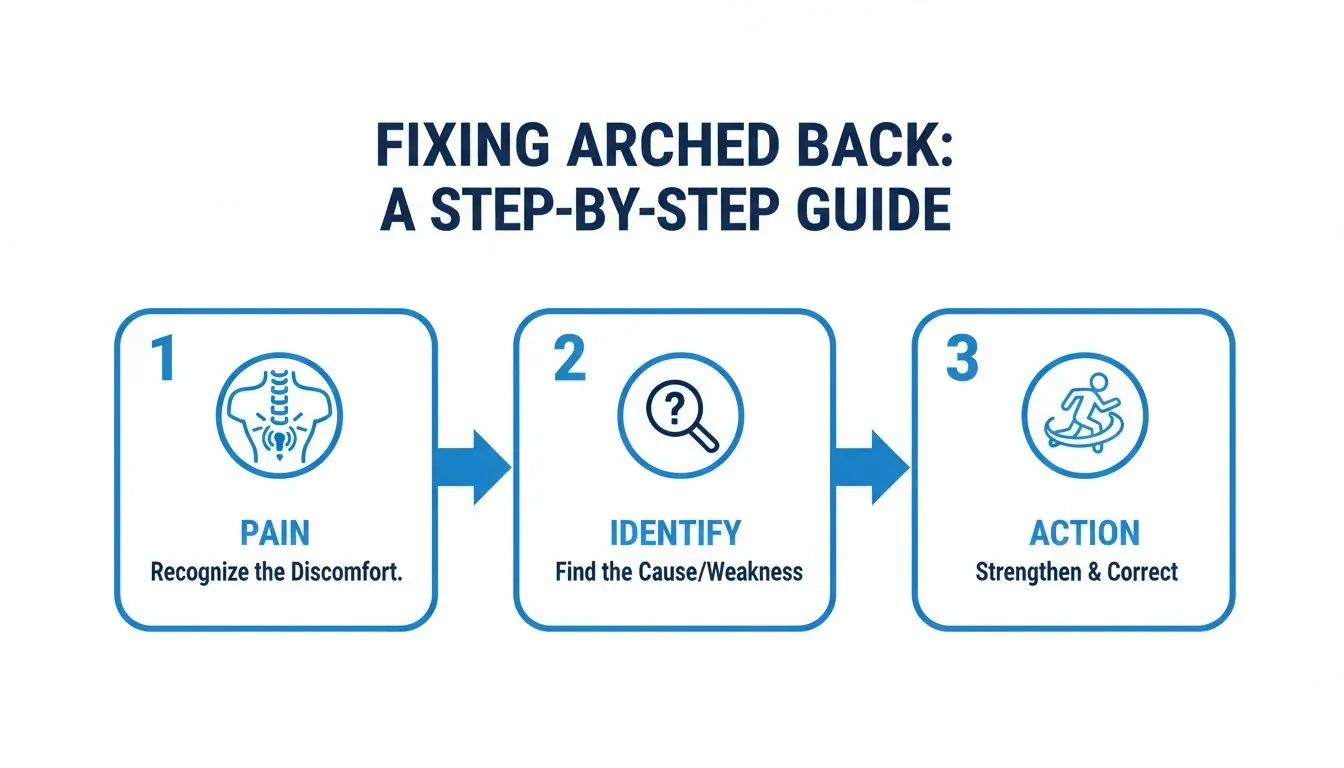
The path to a healthier back involves more than just wishful thinking. It requires pinpointing the specific imbalances and following a clear plan to correct them.
Sedentary Lifestyles and Postural Habits
Our bodies are built to move, but our world often demands we stay still. Those long hours locked into a chair are probably the single biggest driver of the muscle patterns that create an arched back.
When you sit, your hip flexors are literally held in a shortened state. Over time, your body just adapts, and they become chronically tight. Meanwhile, your glutes are completely shut off—a state some coaches call "gluteal amnesia." They essentially forget how to fire properly. This combination is the perfect recipe for the pelvic tilt that forces your back to arch.
Getting a handle on these underlying causes is the most critical first step. Without addressing the source of the problem, any stretches or exercises you do will only be a temporary band-aid.
Simple Tests to Check Your Posture at Home
Before you can start fixing an arched back, you need a clear picture of where you’re starting from. Think of it as creating a "before" snapshot. These quick self-assessments aren't about diagnosing an injury, but they're fantastic for confirming your postural habits and giving you tangible feedback.
They help you connect the dots between how your body feels and how it's actually aligned. Once you have this baseline, you can track your progress and see the real-world impact of the exercises and stretches you'll be doing.
The Wall Test for Spinal Alignment
This is a classic for a reason—it’s one of the fastest ways to see just how deep that curve in your lower back really is. All you need is a flat wall.
- Stand with your back flat against the wall. Your heels should be about two to four inches away from it.
- Make sure your head, shoulder blades, and butt are all touching the wall.
- Now, try to slide your hand into the space between your lower back and the wall.
So, what are you looking for? In a well-aligned posture, you should just barely be able to slide your flat hand through that gap.
If there's a ton of extra room—enough to easily fit a clenched fist or your whole forearm—that's a pretty clear sign of an exaggerated lumbar curve (hyperlordosis). This is the tell-tale sign of an arched back posture.
This simple check gives you instant, objective feedback on your standing posture. It’s a powerful tool for building the mind-body connection needed to correct your alignment throughout the day.
The Thomas Test for Hip Flexor Tightness
I've seen it time and again with clients: tight hip flexors are one of the biggest culprits behind an arched back. They physically pull the top of your pelvis forward and down, forcing your lower back to curve. The Thomas Test is a go-to assessment for checking hip flexor length, and you can easily do it at home. Just find a sturdy table or bed.
- Start by sitting right on the edge of the table.
- Lie back, pulling both knees up toward your chest to flatten your spine against the surface.
- Hold one knee firmly against your chest with both hands.
- Now, slowly lower the other leg, letting it hang off the edge as far as it will naturally go. Don't force it.
Pay close attention to what that hanging leg does. Does it drop down easily, or does it seem to float in mid-air?
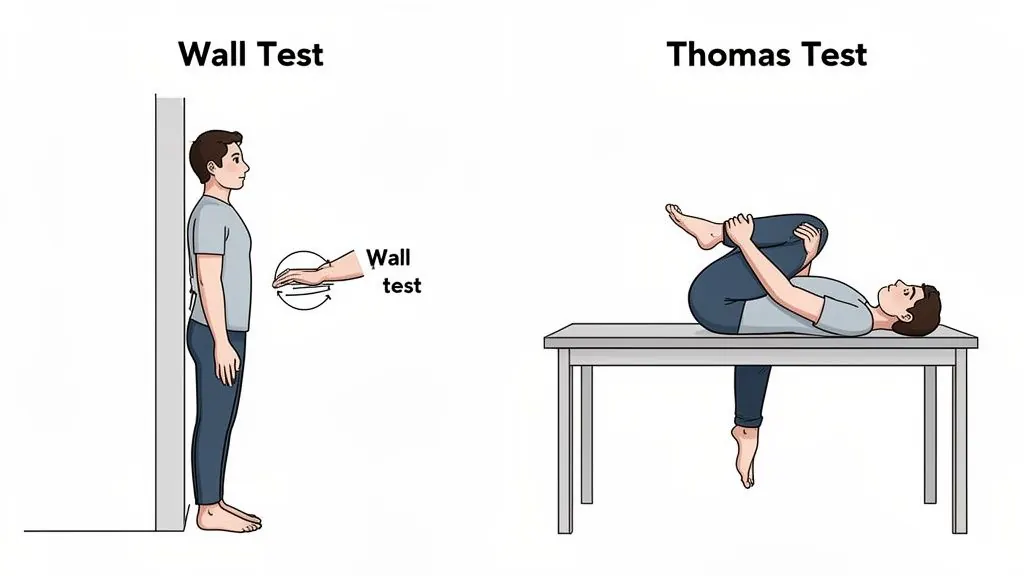
The image above gives a perfect example of what we call a "positive" Thomas Test, meaning tightness is present. See how the thigh is lifted off the table? That’s a classic sign of short, restricted hip flexor muscles.
Ideally, the back of your hanging thigh should rest completely flat on the table. If it lifts up, or if you notice your lower leg kicking out instead of hanging straight down toward the floor, you've pinpointed significant tightness in your hip flexors and possibly your quads. This is a crucial piece of the puzzle you'll need to address.
Key Stretches to Release Lower Back Tension
Before we even think about strengthening a single muscle, we need to create some slack in the system. When you have an arched back, your tight hip flexors and lower back muscles are locked in a relentless tug-of-war, yanking your pelvis forward. The very first step is to get them to release their grip.
This initial phase is all about lengthening those chronically overactive muscles. By doing this, you're giving your pelvis the freedom it needs to tilt back into a more neutral, comfortable position. Think of it like untying a stubborn knot before you can straighten the rope. It’s a non-negotiable first step.
Kneeling Hip Flexor Stretch
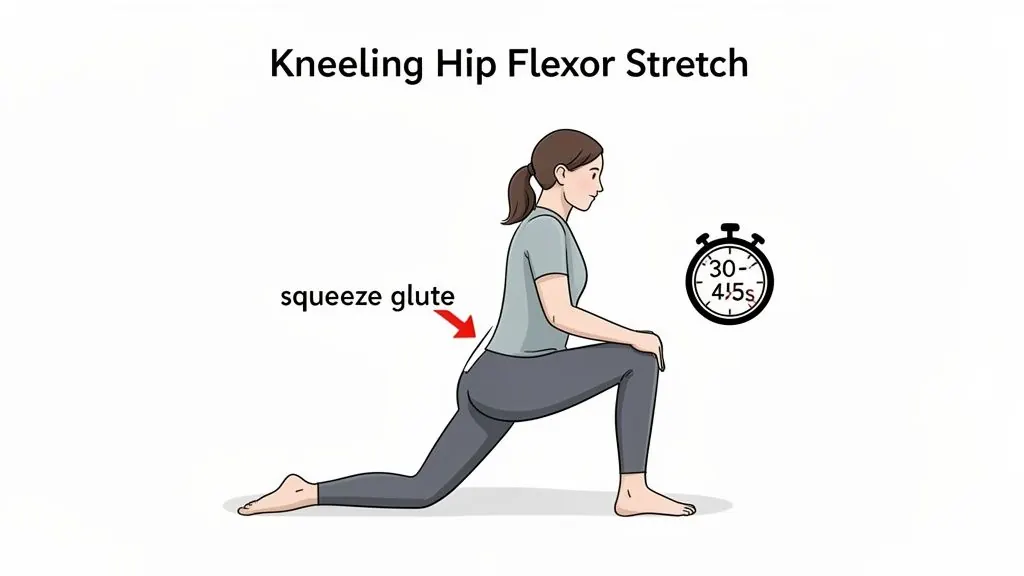
If there’s one stretch you absolutely must do, this is it. It’s the cornerstone for anyone dealing with an anterior pelvic tilt because it directly targets the psoas and iliacus—the main hip flexors that get incredibly short and tight from all the sitting we do.
Start by getting into a half-kneeling lunge position. Put a pad under your back knee if you need it. Your front foot should be flat on the floor, creating a 90-degree angle at the knee.
Now, before you even think about lunging forward, tuck your tailbone under, as if you’re trying to point your belt buckle up toward your chin. This tiny adjustment is the secret sauce—it isolates the stretch right where you need it.
The real game-changer? Squeeze the glute of your back leg. Hard. This single action physically pushes your hip forward and dramatically deepens the stretch in the front of your hip. From there, gently shift your body forward until you feel a good, solid stretch. Don't arch your back to get deeper; that just cheats the movement.
Hold the stretch for a solid 30-45 seconds while breathing deeply. Switch legs and repeat, aiming for two sets on each side.
Cat-Cow Mobility Drill
While the hip flexor stretch opens up the front, the Cat-Cow gets to work on the stiffness in your back. This isn't a static hold; it's a dynamic drill that helps your spine remember how to move through its full, intended range of motion.
Get on all fours, with your hands stacked directly under your shoulders and knees under your hips.
- Cow Pose: As you inhale, let your belly drop towards the floor. Lift your chest and tailbone up, creating a gentle arch in your back.
- Cat Pose: As you exhale, press the floor away with your hands and round your spine up towards the ceiling. Tuck your chin and your tailbone to really feel the counter-stretch.
Flow smoothly between these two positions for 10-12 slow and deliberate repetitions. The goal isn't speed; it's about feeling each individual vertebra move. This builds crucial spinal awareness.
An exaggerated lumbar arch is often linked to deconditioned trunk muscles, stiff hip flexors, and altered movement patterns. Evidence-informed guidelines now prioritize exercise therapy and education over passive treatments. Supervised programs focusing on the lumbar spine and hips have been shown to reduce pain and disability scores by a clinically meaningful 20–40% over 8–12 weeks in trials. You can explore more on these WHO guidelines for chronic low-back pain.
Supine Hamstring Stretch with a Band
Chronically tight hamstrings can also play a role in pelvic tilt. They might not be the primary cause of the arch, but they often become tight as a result and can restrict the pelvis from moving freely. Using a band gives you far more control than just grabbing your leg.
Lie on your back with both legs straight. Loop a resistance band, a towel, or even a belt around the ball of one foot. Gently pull that leg up toward the ceiling until you feel a comfortable stretch along the back of your thigh. Make sure to keep a tiny bend in your knee to protect the joint.
Hold here for 30 seconds per leg, and complete two sets on each side. If you're new to using bands, our resistance bands FAQ is a great resource for getting started safely.
Your Go-To Stretching and Mobility Routine
Here's a simple table to use as your daily checklist. The goal is to release those tight muscles and get your pelvis moving correctly.
| Movement | Target Muscle | Sets & Duration | Key Cue |
|---|---|---|---|
| Kneeling Hip Flexor Stretch | Hip Flexors (Psoas, Iliacus) | 2 sets of 30-45 sec per side | Squeeze the glute of your back leg. |
| Cat-Cow Drill | Spinal Erectors, Core | 2 sets of 10-12 reps | Move slowly and breathe with each motion. |
| Supine Hamstring Stretch | Hamstrings | 2 sets of 30 sec per side | Keep your lower back pressed to the floor. |
Consistency with this simple routine is your ticket to the next phase. By performing these movements daily, you are laying the groundwork for the strengthening exercises that will lock your new, healthier posture in place.
Exercises to Build a Stronger Core and Glutes
Stretching is what gives you the potential for better posture, but strength is what locks it in and makes it your new normal. Now that you’ve created some slack in those tight, overactive muscles, it’s time to build a solid foundation from the ground up.
This means we need to wake up and strengthen the muscles that are supposed to be holding your pelvis in a neutral, stable position: your glutes, hamstrings, and deep core.
This isn’t about chasing a six-pack or hitting a new squat PR in the gym—not yet, anyway. Right now, the goal is purely about activation and control. We’re re-establishing the mind-muscle connection with these often-neglected "anti-arch" muscles.
Starting with Activation Drills
Before you can strengthen a muscle, you have to be able to find it. "Gluteal amnesia," a condition where your glutes literally forget how to fire properly, is incredibly common, especially if you spend a lot of time sitting. These first two exercises are designed to wake them up and teach your core how to stabilize your spine.
1. Glute Bridges
This is the quintessential glute activation exercise. To start, lie on your back with your knees bent, feet flat on the floor about hip-width apart, and your arms resting by your sides.
Before you even think about lifting, gently press your lower back into the floor to set your pelvis in a neutral position. From there, squeeze your glutes first, then lift your hips toward the ceiling until your body forms a straight line from your shoulders to your knees. The key is to avoid arching your back at the top; all the work should come from your glutes, not your spine.
Hold that peak contraction for a solid 2-3 seconds, really focusing on the squeeze, then lower back down with control. Aim for 3 sets of 12-15 repetitions.
2. Dead Bugs
The Dead Bug is a fantastic drill for teaching your deep core muscles how to stabilize your pelvis and spine while your arms and legs are in motion. This skill translates directly to just about every movement you do, from walking to lifting.
Lie on your back with your arms extended toward the ceiling and your knees bent at a 90-degree angle directly over your hips (often called the "tabletop" position). Again, press your lower back flat into the floor—there should be no gap.
Slowly lower your right arm and left leg toward the floor at the same time. Only go as low as you can without letting your lower back arch off the ground. Exhale as you lower, then inhale as you return to the start with control. Repeat on the other side. That's one rep. Focus on 3 sets of 10-12 total reps.
Pro Tip: If you're struggling to keep your back flat during Dead Bugs, try placing a rolled-up towel under your lower back. Your goal is to maintain light, constant pressure on that towel throughout the entire movement.
Building Foundational Strength
Once you can reliably activate your glutes and brace your core, you can move on to more challenging movements that build real-world strength. With these exercises, the number one priority is an unwavering focus on maintaining a neutral spine. Form is everything.
An arched back often develops over years of sitting in an anterior pelvic tilt, a common issue for many desk-bound professionals. Globally, low back pain accounts for tens of millions of disability-adjusted life years (DALYs), a number that has climbed from roughly 43.4 million to 70.2 million between 1990 and 2021. For driven individuals, this means lost work days and inconsistent training. A smart plan that combines ergonomic adjustments and progressive strength training can slash the frequency of flare-ups and keep you performing at your best. You can find more insights on the global impact of low back pain on public health.
3. Romanian Deadlifts (RDLs)
The RDL is one of the best exercises out there for strengthening your entire posterior chain—the glutes and hamstrings—which work together to pull your pelvis back into a neutral position.
Start by standing with a light dumbbell in each hand, feet about hip-width apart. With a soft bend in your knees, hinge at your hips, pushing your butt back as if you're trying to shut a car door with it. Keep your back perfectly flat and your spine long from your head to your tailbone.
Lower the weights until you feel a good stretch in your hamstrings, which is usually just below your knees. Then, powerfully squeeze your glutes to drive your hips forward and return to a standing position. Think "hips forward," not "lift with your back." Complete 3 sets of 8-12 reps.
Of course, beyond these specific exercises, a truly holistic approach involves a mix of effective posture correction exercises and habits.
4. Plank
The plank is a classic for a reason: it builds isometric core strength and endurance, teaching your body to maintain a rigid, stable torso against gravity.
Get into position on your forearms and toes, with your elbows stacked directly under your shoulders. Your body should form a perfectly straight line from your head to your heels.
To get the most out of it, you need to be active, not passive. Squeeze your glutes, brace your abs like you're about to take a punch to the gut, and tuck your tailbone slightly to keep your hips from sagging. Hold for 30-60 seconds, for 3 sets. The moment your form breaks, the set is over. Quality over quantity is the absolute rule here.
Common Questions About Fixing Your Posture
When you start working on a long-standing posture issue like an arched back, a ton of questions pop up. It's totally normal. Knowing what to expect, how to manage your training, and when to get a professional set of eyes on you is key to staying on track and seeing real, lasting change.
Let’s get into some of the most common things people ask.
How Long Does It Take to Fix an Arched Back?
This is always the big one, and the honest answer is: it depends. There’s no magic timeline. Factors like how long you've had the posture, how good your body awareness is, and—most importantly—your consistency are all part of the equation.
That said, you can expect to see progress in stages. Most people feel a big difference in awareness and less muscle tension within the first 2-4 weeks of consistent work. This means hitting your stretches and activation drills at least three to five times a week.
But making that neutral spine your new normal? That's the long game. We're talking about building new neuromuscular habits that stick, which often takes anywhere from 3-6 months. The real goal isn't just to check off exercises; it's to change how your body naturally holds itself.
Can I Still Lift Heavy While Correcting My Posture?
Absolutely—and you should. The idea isn't to stop training but to train smarter. Strength training is one of your best tools for fixing an arched back, as long as you approach it with intention and a laser focus on form.
You might need to dial back the weight on your big lifts, like squats and deadlifts, for a bit. Don't think of this as a setback. It's a strategic move to master the movement with a neutral spine. Leave the ego at the door and use this time to perfect your hip hinge and core bracing.
Make the activation drills from this guide a non-negotiable part of your warm-ups. A few sets of glute bridges and dead bugs before you even look at a barbell will prime your glutes and core to fire correctly, making it so much easier to hold good form when the weight gets heavy again.
As your control and stability get better, you'll gradually add weight back to the bar. I've seen countless clients come back even stronger because they're finally moving with efficient, powerful mechanics.
What Are the Best Cues to Remember Throughout the Day?
Your 30 minutes in the gym can't undo the other 23.5 hours of the day. The real magic happens when you build awareness and make tiny corrections as you go about your life. Forget trying to remember complex anatomical terms—simple, actionable cues are what work.
Here are three of my go-to cues that you can use anywhere, anytime:
- "Tuck your tailbone slightly." Think about your belt buckle moving just a tiny bit up toward your chin. This simple move immediately helps level out your pelvis.
- "Pull your ribs down." This cue is fantastic for engaging your abs and stopping your chest from puffing out, which almost always comes with an arched back.
- "Squeeze your glutes." Give your glutes a quick squeeze whenever you're standing around—waiting in line at the coffee shop, brushing your teeth, or talking on the phone. It's a simple reminder of their job as pelvic stabilizers.
These little check-ins help reprogram your posture from the inside out. Over time, these conscious thoughts become subconscious habits. If you want to dive deeper into building these routines, understanding the principles of how to make movement and exercise stick can be a huge help for long-term success.
When Should I See a Physical Therapist?
While this guide gives you a powerful framework that works for most people, it can't replace professional medical advice. Doing it yourself is great, but there are definitely some red flags that mean it's time to book an appointment with a qualified physical therapist.
It’s time to see a pro if you’re experiencing:
- Sharp, shooting, or radiating pain that travels down your leg.
- Numbness or tingling sensations in your legs or feet.
- Pain that's severe enough to mess with your sleep or daily life.
- You're just not getting better after several weeks of consistent, dedicated effort with this program.
A physical therapist can run a detailed assessment to pinpoint any specific underlying problems, give you a precise diagnosis, and build a program that's completely customized to you. When you're dealing with persistent pain or hitting a wall, they are your best resource.
At Lindy Health, we believe in a fully integrated approach to health and performance. If you're ready to move past nagging pain, optimize your posture, and build a stronger, more resilient body, our team of experts—including personal trainers and physical therapists—is here to build a personalized plan just for you. Learn more at https://lindyhealth.com.
Further reading
- Sagittal balance of the spine.Eur Spine J 2019.PubMed 31332569 · doi:10.1007/s00586-019-06083-1
- Hamstring strain injuries: factors that lead to injury and re-injury.Sports Med 2012.PubMed 22239734 · doi:10.2165/11594800-000000000-00000
- Functional abdominal bloating.J Clin Gastroenterol 1994.PubMed 7930428 · doi:10.1097/00004836-199407000-00007
- Effectiveness of Physiotherapeutic Scoliosis-Specific Exercises on 3-Dimensional Spinal Deformities in Patients With Adolescent Idiopathic Scoliosis: A Systematic Review and Meta-analysis.Arch Phys Med Rehabil 2024.PubMed 38719166 · doi:10.1016/j.apmr.2024.04.011
- [Biomechanics of scoliosis].Chir Narzadow Ruchu Ortop Pol 2004.PubMed 15751726
- Malunion of post-traumatic thoracolumbar fractures.Orthop Traumatol Surg Res 2018.PubMed 29191468 · doi:10.1016/j.otsr.2017.04.018
- The relationships between low back pain and lumbar lordosis: a systematic review and meta-analysis.Spine J 2017.PubMed 28476690 · doi:10.1016/j.spinee.2017.04.034
- Spinopelvic Parameters: Lumbar Lordosis, Pelvic Incidence, Pelvic Tilt, and Sacral Slope: What Does a Spine Surgeon Need to Know to Plan a Lumbar Deformity Correction?.Neurosurg Clin N Am 2018.PubMed 29933800 · doi:10.1016/j.nec.2018.03.003
Literature retrieved from PubMed on October 16, 2026, favouring human studies and reviews. Numbered markers in the text show which paper supports which statement; uncited entries are background reading.