When you're ready to get serious about shedding fat, the first step is figuring out your daily calorie target. From there, you'll break that number down into specific gram targets for protein, fat, and carbs. The whole game is to keep protein high to protect your muscle, get enough fat to keep your hormones happy, and then use carbs to make up the rest. This is miles more effective than just blindly slashing calories.
Why Macros Are Your Secret Weapon for Fat Loss
Forget the generic "eat less, move more" advice you hear everywhere. Yes, a calorie deficit is non-negotiable for fat loss, but where those calories come from is what determines whether you're losing hard-earned muscle or just unwanted body fat.
This is exactly why learning to calculate your macros for a cut is a total game-changer. It forces you to stop thinking only about the quantity of food and start focusing on the quality and composition of your fuel.
By managing your macronutrients—your protein, carbs, and fats—you get surgical control over your body composition. Think of it like this: just cutting calories is a sledgehammer approach. It works, but it often causes a lot of collateral damage like muscle loss, tanked energy, and a slower metabolism. Dialing in your macros is like using a scalpel. It’s precise, targeting fat while preserving the lean tissue you've busted your ass to build.
The Problem with Calorie Counting Alone
Just focusing on a calorie number can backfire, big time. If you don't get enough protein, your body will start breaking down muscle tissue for energy. This is the fast track to looking "skinny-fat" instead of lean and defined. Cut your fats too low, and you risk messing with hormone production, which can wreck everything from your energy to your mood.
The real goal of a successful cut isn't just weight loss; it's fat loss. By making protein a priority and getting enough healthy fats, you're telling your body to burn stored fat for fuel while keeping your metabolism humming.
A Smarter Path to a Leaner Physique
Learning how to calculate your macros for a cut gives you a clear, actionable roadmap. It takes the guesswork out of the equation and empowers you to make food choices that actually move you closer to your goal. Instead of seeing food as the enemy, you start to see it as a tool to build the body you want.
This approach has some serious advantages:
- Muscle Preservation: A high protein intake is the foundation. It’s your best defense against muscle loss when you're in a deficit.
- Keeps You Full: Protein and fats are way more filling than carbs. This helps you manage hunger and actually stick to your plan without feeling miserable.
- Stable Energy: A balanced macro intake helps you avoid the nasty energy crashes that come with most restrictive diets.
- Hormonal Support: You need dietary fat to produce crucial hormones like testosterone. Don't skip it.
In this guide, I'm going to break down the entire process for you, step-by-step. I'll show you exactly how to build a personalized macro plan that fuels your body the right way, speeds up fat loss, and helps you get sustainable, impressive results.
Nailing Your Calorie Target: The Foundation of a Successful Cut
Before we even touch on protein, carbs, or fats, we have to figure out your total energy budget. This is the bedrock of your entire cutting plan. Get this number wrong, and you'll be spinning your wheels in frustration instead of seeing results.
The first mission is to find your Total Daily Energy Expenditure (TDEE). Think of this as the total number of calories your body burns over a 24-hour period. It’s not just your gym session; it’s everything from breathing and digesting your food to walking to your car.
This whole process follows a simple, logical flow: first, set your calorie budget, then divide it into your macros. That's how you fuel real results.
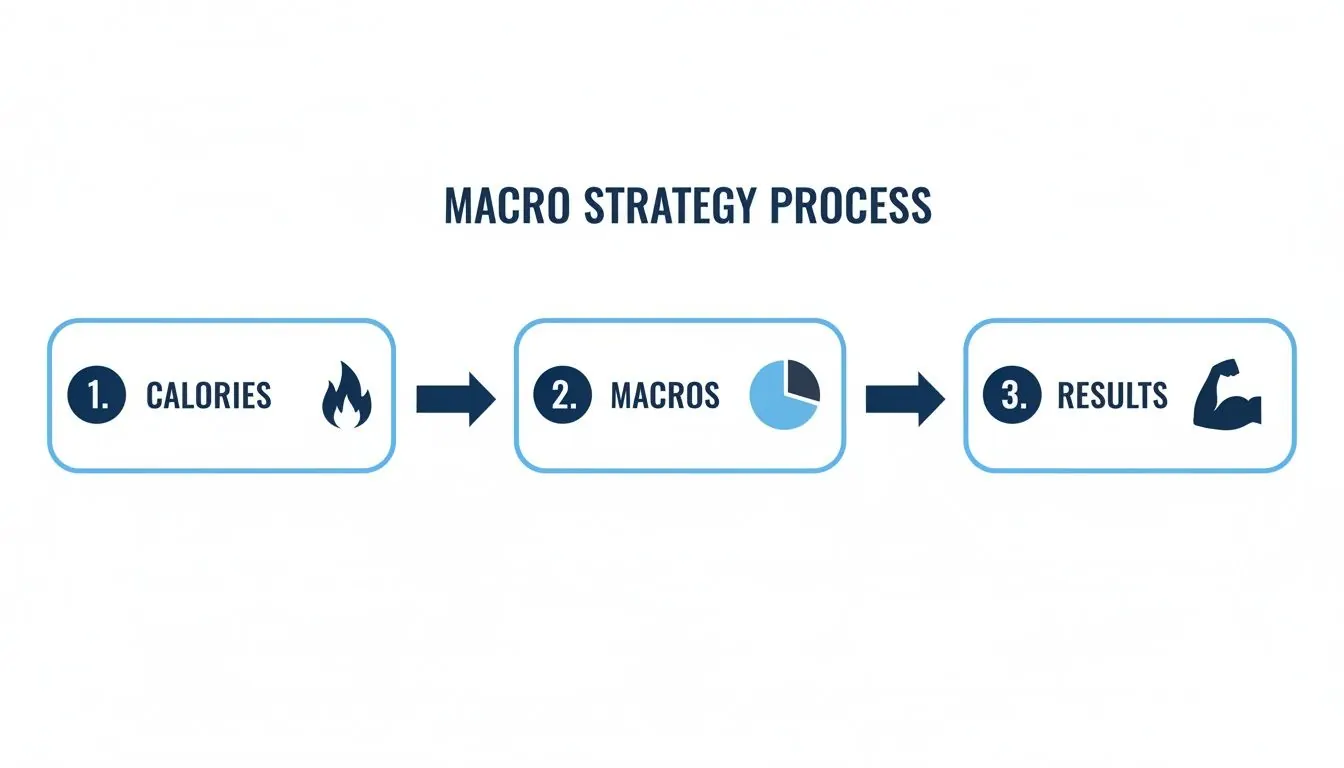
As you can see, the calorie target is the starting line. It dictates every macro decision you'll make and leads directly to the physique you're chasing.
Calculating Your Maintenance Calories
First up is calculating your Basal Metabolic Rate (BMR). This is basically your "coma-calories"—the energy your body needs just to stay alive if you were to lie in bed all day and do absolutely nothing.
We're going to use the Mifflin-St Jeor formula, which is widely considered the gold standard over older, less accurate equations.
- For Men: (10 × weight in kg) + (6.25 × height in cm) – (5 × age in years) + 5
- For Women: (10 × weight in kg) + (6.25 × height in cm) – (5 × age in years) – 161
With your BMR in hand, the next step is to multiply it by an activity factor to find your true TDEE. You need to be brutally honest with yourself here. One of the most common mistakes I see is people overestimating their activity level, which throws off the entire calculation from day one.
Be real with yourself when choosing your activity multiplier. Picking a higher level because it sounds better will only sabotage your cut by setting your calorie target way too high.
Activity Level Multipliers for TDEE Calculation
Find your activity level in the table below to accurately multiply your Basal Metabolic Rate (BMR) and calculate your Total Daily Energy Expenditure (TDEE). This table will help you match your daily life and training schedule to the right number.
| Activity Level | Description | Multiplier |
|---|---|---|
| Sedentary | You have a desk job and do little to no formal exercise. | 1.2 |
| Lightly Active | You exercise lightly (e.g., walking, light jogging) 1-3 days per week. | 1.375 |
| Moderately Active | You perform moderate exercise (e.g., weight training, sports) 3-5 days per week. | 1.55 |
| Very Active | You engage in hard exercise or sports 6-7 days per week. | 1.725 |
| Extremely Active | You have a physically demanding job and also perform hard exercise daily. | 1.9 |
Once you’ve multiplied your BMR by the right activity factor, you have your TDEE. This is your "maintenance" number—the calories you need to eat to stay at your current weight. Understanding this is non-negotiable for changing your body composition, and you can learn more by reading our guide on how calorie intake impacts weight.
Creating a Smart, Sustainable Calorie Deficit
Now that you know your maintenance level, it's time to create the deficit. This is where the "cut" happens. But hold on—a bigger deficit isn't always better. Going too low too fast is a recipe for disaster.
A smart, sustainable deficit is typically 15-20% below your TDEE. This is the sweet spot. It's aggressive enough to drive consistent fat loss but conservative enough to help you hold onto your hard-earned muscle, manage hunger, and avoid a major metabolic slowdown.
Let's walk through a real-world example.
- Meet Mike: He's 30, weighs 200 lbs (90.7 kg), stands at 6'0" (183 cm), and hits the gym 4 days a week.
- Mike’s BMR: (10 × 90.7) + (6.25 × 183) – (5 × 30) + 5 = 1,906 calories.
- Mike’s TDEE: He lifts 4 days a week, so his multiplier is 1.55. TDEE = 1,906 × 1.55 = 2,954 calories. This is his maintenance.
- Mike’s Cutting Calories: We'll use a 20% deficit. 2,954 × 0.80 = 2,363 calories per day.
That final number, 2,363 calories, becomes the target Mike will use to build his entire macro plan.
The science is clear: a calorie deficit is what drives weight loss, period. A massive 2020 review of 121 studies confirmed that people lost weight on 14 different popular diets, regardless of the macro splits. The crucial takeaway, though, was that while the deficit caused the weight loss, the specific macro splits determined what kind of weight was lost—fat versus precious muscle. This is exactly why our next step is to strategically break Mike's 2,363 calories down into the right amounts of protein, fat, and carbs.
Setting Your Protein and Fat for Muscle Retention
Once you have your daily calorie target, the real work begins. We need to figure out how to best spend that calorie budget across protein, fats, and carbs. When you're cutting, the order you do this in matters. A lot. We always start with protein.
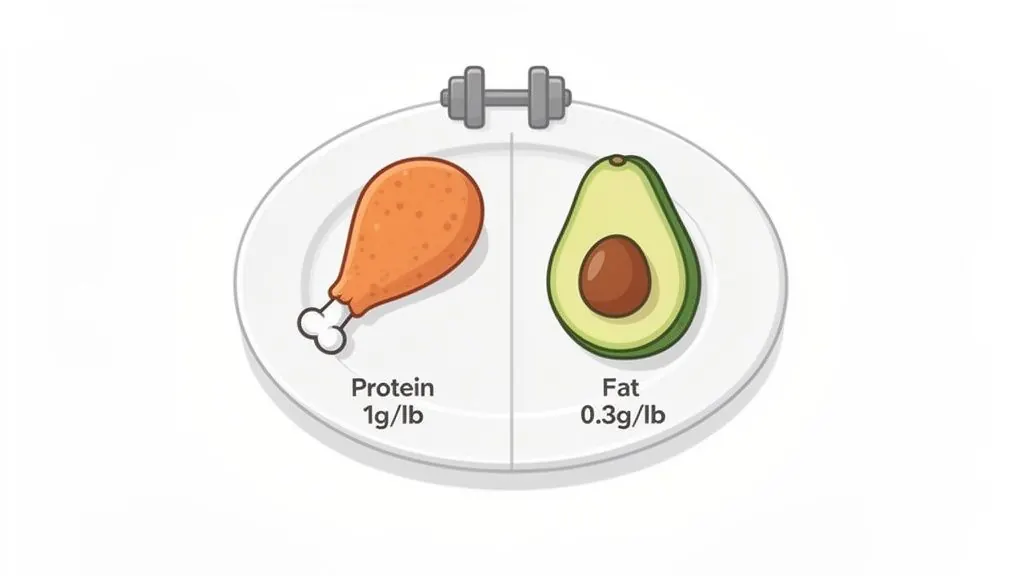
Think of protein as the scaffolding that protects your physique during a diet. A calorie deficit is, by its very nature, catabolic—it’s a state of breakdown. Without enough protein, your body will have no problem breaking down your hard-earned muscle for energy right along with body fat. Making protein the priority is your single best defense against muscle loss.
Locking in Your Protein Target
For anyone serious about losing fat while keeping muscle, a high protein intake isn't just a suggestion; it's a non-negotiable part of the plan. The science is clear on this. Most experts now recommend a protein target far higher than what the average person might need because it provides your body with a constant stream of amino acids to repair and hold onto lean tissue.
For a cutting phase, the gold standard is simple and incredibly effective: set your daily protein intake at 1 gram per pound of your current body weight. If you are significantly overweight, a better approach is to aim for 1 gram per pound of your goal body weight.
This isn't some arbitrary number. It’s backed by a mountain of evidence showing that higher protein diets are superior for body composition during a deficit. It helps preserve your metabolic rate, holds onto lean mass, and keeps you feeling fuller than other macros. If you want to dive deeper into the research, a great resource is learning about cutting-phase macro calculations on IIFYM.com.
Let’s get back to our example, Mike, who weighs 200 lbs and is cutting on 2,363 calories.
- Mike's Protein Target (grams): 200 lbs × 1 g/lb = 200 grams of protein per day.
Now, let's see how much of his calorie budget that uses. Protein has 4 calories per gram.
- Mike's Protein Calories: 200 g × 4 kcal/g = 800 calories.
Just by setting this one macro, Mike has already assigned 800 of his 2,363 daily calories. He's built a solid foundation that puts muscle retention first.
Establishing Your Essential Fat Intake
With protein set, we turn our attention to dietary fat. Fats often get a bad rap, but they are absolutely critical for your health and the success of your cut. A classic rookie mistake is to slash fat intake to the bone, which can backfire spectacularly.
Dietary fats are crucial for:
- Hormone Production: Key hormones, like testosterone, are built from fat. Dropping fat intake too low can mess with your hormone levels, leading to low energy, poor recovery, and a tanked sex drive.
- Nutrient Absorption: Your body can't properly absorb vitamins A, D, E, and K without dietary fat.
- Satiety: Fats digest slowly, which helps you feel full longer. This is a huge psychological win when you're in a deficit and fighting off hunger.
While they're essential, fats are also the most calorie-dense macro, packing 9 calories per gram. This means we have to be smart, setting a floor that supports good health without eating up too much of our calorie budget.
Calculating Your Fat Target
A solid, time-tested guideline for a cutting phase is to set fat intake somewhere between 0.3 to 0.4 grams per pound of body weight. This range gives you enough for all those essential functions without going overboard. For Mike, we'll stick to the lower end of that range to leave more room for carbohydrates, which will fuel his workouts.
Let’s calculate Mike’s fat target.
- Mike's Fat Target (grams): 200 lbs × 0.3 g/lb = 60 grams of fat per day.
Next, we translate that into calories.
- Mike's Fat Calories: 60 g × 9 kcal/g = 540 calories.
So, where does that leave Mike's budget?
| Macronutrient | Grams | Calories per Gram | Total Calories |
|---|---|---|---|
| Protein | 200 g | 4 kcal | 800 kcal |
| Fat | 60 g | 9 kcal | 540 kcal |
| Total Set | 1,340 kcal |
With protein and fat locked in, we’ve built a framework that protects muscle and supports hormonal health. This is the core of an effective cutting plan. All the remaining calories in his budget will be filled by our final macronutrient: carbohydrates.
Calculating Carbs and Finalizing Your Plan
Alright, you've nailed down your protein and fat targets. The last piece of the macro puzzle is carbohydrates, and thankfully, this is the easy part.
Think of carbs as the "filler" nutrient. Whatever calories you have left in your daily budget after accounting for protein and fat? That’s what you get for carbs. They're your primary fuel source, powering you through those grueling workouts and keeping you mentally sharp.
Finding Your Carb Budget
Let’s go back to our example with Mike. We figured out his cutting calories are 2,363 per day. We also set his protein and fat.
- Protein Calories: 800 kcal
- Fat Calories: 540 kcal
Add those together, and you get 1,340 calories dedicated to protein and fat.
Now, we just do some simple subtraction to see what's left for carbs.
Mike's Carb Calorie Budget: 2,363 (Total) – 1,340 (Protein + Fat) = 1,023 calories
Boom. That’s it. Mike has 1,023 calories left to spend on carbohydrates. This is the energy that's going to make the difference between a sluggish, painful cut and a productive one.
From Calories to Grams
The final step is converting those carb calories into a daily gram target. Just like protein, carbohydrates provide 4 calories per gram. So, we just divide.
- Mike's Carb Target (grams): 1,023 kcal ÷ 4 kcal/g = 255.75 grams
Let's round that to a nice, even 256 grams of carbs per day. And just like that, we're done. We have a complete, actionable macro plan ready to go.
If you'd rather not do the math yourself every time, a good calculator can save you a ton of hassle. We built our own free bodybuilding macro calculator to handle all these numbers for you.
Your Complete Daily Macro Plan
Let's lay it all out. Here is Mike’s final daily blueprint for his cut. This is what he'll track every single day to burn fat while holding onto his hard-earned muscle.
| Macronutrient | Daily Grams | Daily Calories | Percentage of Total Calories |
|---|---|---|---|
| Protein | 200 g | 800 kcal | ~34% |
| Fat | 60 g | 540 kcal | ~23% |
| Carbohydrates | 256 g | 1,024 kcal | ~43% |
| Total | 2,364 kcal | 100% |
This table is your road map. It’s no longer some vague calorie goal; it's a precise plan designed for muscle retention, hormonal balance, and energy. With these numbers, you're officially ready to start building your meals and putting this plan into action.
Putting Your Macro Plan into Action
You've done the math and have your target macros. That’s the easy part. The real work begins now, turning those numbers on a screen into actual food on your plate. This is where theory gets real, and where most people either succeed or fail.
The goal isn't to follow a rigid, joyless diet. It's to build a sustainable system for eating that fuels your body, helps you shed fat, and doesn't make you want to quit after three days.
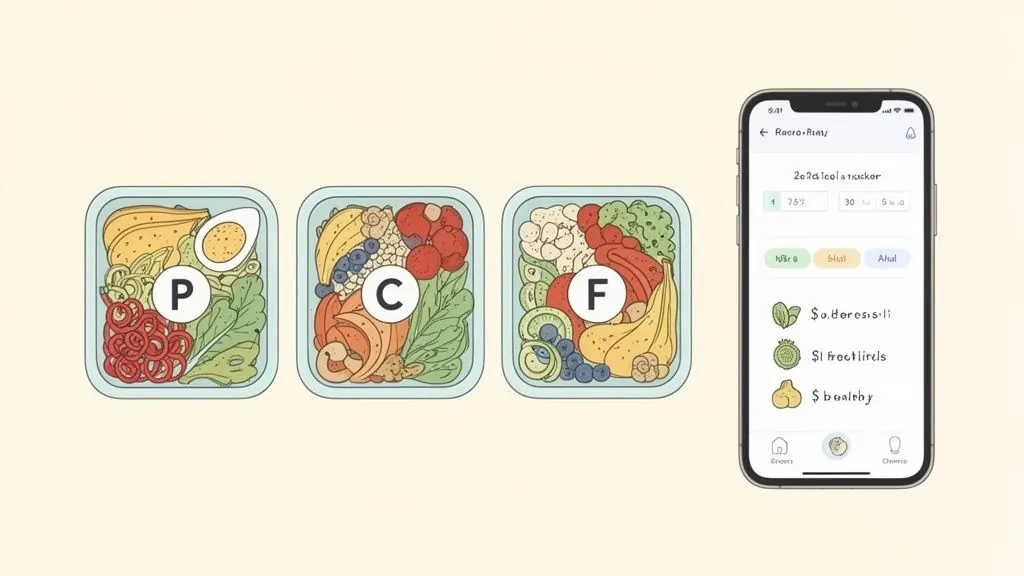
Consistent execution is everything. It's about making the process so routine that hitting your numbers becomes second nature, freeing you from constantly stressing about what to eat next.
From Numbers on a Page to Food on a Plate
So, what does this look like in the real world? Let's go back to our example, Mike, who needs to hit 2,364 calories from 200g Protein, 60g Fat, and 256g Carbs.
A huge mistake I see people make is assuming they have to eat bland, "clean" food all day. The magic of tracking macros is its flexibility. As long as you nail your targets, you have a ton of freedom.
Here’s just one way Mike could structure his day:
- Breakfast (7:00 AM): A big protein shake with two scoops of whey, a cup of oats, a spoonful of peanut butter, and water. It’s quick, easy, and gets a solid dose of protein and complex carbs in right away.
- Lunch (12:00 PM): 8 ounces of grilled chicken breast, 1.5 cups of brown rice, and a heap of steamed broccoli. This is a classic bodybuilding meal for a reason—it’s perfectly balanced and simple to prep ahead of time.
- Pre-Workout (4:00 PM): A large apple and another scoop of whey protein mixed with water. This gives him fast-acting carbs for energy and amino acids to help preserve muscle during his workout.
- Dinner (7:00 PM): 8 ounces of 93/7 lean ground turkey served with a large sweet potato and a side salad drizzled with a light vinaigrette.
- Evening Snack (9:00 PM): A cup of plain Greek yogurt with a handful of berries. This is a great way to top off his protein goal before bed.
This is just an example, of course. The real takeaway is seeing how different meals, each with its own macro profile, are pieced together like a puzzle to hit the daily total.
Why Food Quality Is Still King
You’ve probably heard of "If It Fits Your Macros" (IIFYM), the idea that you can eat whatever you want as long as it fits your numbers. While technically true, it's a terrible long-term strategy. Food quality directly impacts your energy, hunger levels, and overall results.
Prioritizing whole, nutrient-dense foods will make your cut feel a thousand times easier.
Hitting your numbers is the primary goal, but filling those numbers with high-quality food sources is what makes the process sustainable. Nutrient-dense foods keep you fuller for longer, provide essential micronutrients, and support better energy and performance.
It goes beyond just calories, too. The type of food you eat has a direct effect on fat loss. Research from the National Institutes of Health has shown that the glycemic load (GL) of your diet matters. One study found that people on a low-GL diet lost 4.4% more total fat mass than those on a high-GL diet, even when calories were matched. For women, the difference was even more stark, with a 15.1% greater loss of visceral belly fat.
Practical Tips for Flawless Execution
Consistency is all about building smart habits and simple systems. Here are a few battle-tested tips to stay on track without getting overwhelmed.
Use a Tracking App the Smart Way
Apps like MyFitnessPal or MacroFactor are non-negotiable tools. The pro move is to plan your day ahead of time in the app, not just log meals after you eat them. This proactive approach stops you from getting to dinner with only protein left to eat.
Keep Meal Prep Simple
You don't need to spend all Sunday in the kitchen. Just focus on the basics:
- Batch Cook Proteins: Grill up a family pack of chicken breasts or brown a few pounds of lean ground beef.
- Cook Carbs in Bulk: Make a huge pot of rice or quinoa, or roast a whole tray of sweet potatoes.
- Prep Your Veggies: Wash and chop your vegetables so they’re ready to be steamed, roasted, or tossed in a salad.
When you're building out your meal plan, even small choices matter. Knowing the nutritional differences between common items like almond milk vs soy milk can help you make smarter swaps to stay on target. With these core components ready to go, you can assemble a macro-perfect meal in just a few minutes.
What to Do When Your Progress Stalls
Sooner or later, it happens to everyone. The plan that was working like a charm suddenly stops. The scale won't budge, and you're left wondering what went wrong.
First off, don't panic. The human body is a master of adaptation. As you get leaner, your metabolism naturally downshifts a bit to conserve energy. This is a normal survival mechanism, but it's also the very thing that causes a weight loss plateau.
A true plateau isn't just a bad weigh-in or two. We're looking for two to three straight weeks where your average weight, body measurements, and progress photos show zero change, even though you’ve been sticking to the plan. This is your signal to make a change—but not the one you might think.
First, Look at Your Adherence, Not Your Calories
Before you even think about cutting calories further, you need to play detective. The most common reason for a stall isn't metabolic slowdown; it's a slow creep of untracked calories. Are you really tracking every single thing? A splash of creamer, a little cooking oil, a handful of almonds… it all adds up, and it can easily wipe out your entire deficit.
For one week, I want you to go back to being meticulous:
- Weigh everything. Pull out the food scale. Eyeballing portion sizes is a surefire way to stall out.
- Track honestly. Log your food before it goes in your mouth. This simple habit kills the temptation to "forget" that little snack later on.
- Check your activity. Has your step count been dropping? Are you moving less in general because you have less energy? Sometimes, all it takes is a conscious effort to get more daily movement to get things moving again.
If you’ve tightened the screws for a full week and you’re still stuck, then it’s time for a small, strategic adjustment to your macros. If you want to dig deeper into this, we've got a whole guide on how to learn more about overcoming a weight loss plateau in our detailed guide.
Making a Smart Macro Adjustment
Okay, so it's time to make a change. The key here is to be surgical. We want to nudge the fat-loss process back into gear, not shock the system with a massive calorie drop. Your protein intake is non-negotiable—we never, ever cut protein. It's the only thing protecting your hard-earned muscle.
The rule is simple: Never sacrifice protein to create a deeper deficit. Adjustments always come from carbs or fats, your body's main fuel sources.
We're only looking for a small reduction of 100-150 calories. It’s just enough to re-establish the deficit without making your diet miserable.
You have two main levers to pull:
- Reduce Carbohydrates: Pull 25-40 grams of carbs out of your daily total. This is usually my first move for clients because it has a minimal effect on hunger and hormones.
- Reduce Fats: Drop your daily fat intake by 10-15 grams. This works well too, but you need to be careful not to go below the essential baseline of 0.3g per pound of body weight.
Pick one of these options, not both. Make the change, then be patient. Give your body at least two more weeks to respond before you even consider another adjustment. A successful cut is a marathon, not a sprint.
Advanced Tools: Refeeds and Diet Breaks
For anyone deep into a cut or starting from a very lean position, metabolic adaptation can become a bigger issue. This is when we bring out some more advanced tools for both physical and psychological recovery.
Refeed Days
A refeed is a planned, single day of high-carb, higher-calorie eating. This is not a free-for-all cheat day; it's a strategic tool.
- How it works: Flooding your system with carbohydrates for a day can give you a temporary bump in leptin (a key hormone for managing hunger and metabolism), top off your muscle glycogen, and give you a huge mental lift.
- How to do it: Once every 7-14 days, bring your calories up to your estimated maintenance level. The extra calories should come almost entirely from carbs—think an extra 100-200 grams. Keep your protein high and your fats low on this day.
Diet Breaks
A diet break is a longer, more intentional pause from dieting.
- How it works: Taking a full 1-2 weeks to eat at maintenance gives your body a real chance to let hormone levels normalize, which can seriously reduce diet fatigue and prime you for another productive fat-loss phase.
- How to do it: After 8-12 weeks of being in a deficit, bring your calories back up to your TDEE. You'll keep protein high but get to enjoy more food from carbs and fats. You still track, but you're not cutting. When you return to your deficit, you'll feel recharged and often blow right past your previous plateau.
Your Top Questions About Cutting Macros, Answered
Alright, so you’ve crunched the numbers and have your macro targets. Fantastic. But now the real world kicks in, and with it, a whole host of practical questions. This is totally normal, and it's where the theory meets the road.
Let's dive into the most common questions I get from clients when they first start tracking macros for a cut. Getting these sorted will make the entire process smoother and keep you on the right track.
Do I Really Need to Hit My Macros Perfectly Every Single Day?
Let me be blunt: absolutely not. In fact, trying to be perfect is a surefire way to get frustrated and quit. The name of the game is consistency over perfection. Your body is an amazing machine, but it doesn't reset every 24 hours. It responds to trends over days and weeks.
So, what's a realistic target? Aim to land within +/- 5 to 10 grams of your protein and carb goals, and +/- 2 to 5 grams of your fat goal. That's a solid win. What really moves the needle is your weekly average. If you're a bit high on carbs today and a little low tomorrow, it all evens out.
The most important skill you can build isn't hitting your numbers perfectly. It's the ability to get right back on track with your very next meal after a slip-up. Don't let one off-plan meal turn into an off-plan day or week.
How Should I Change My Macros on Rest Days?
For 99% of people, my advice is simple: don't. Keep your calories and macros exactly the same, whether it's a training day or a rest day. This builds an unshakable routine and removes a layer of complexity that, for most, just isn't worth the headache.
Sure, you might hear about advanced athletes using carb cycling—eating more carbs on workout days and fewer on rest days, while adjusting fat to keep calories stable. It has its place, but it's a lot more to manage. My advice? Master the art of consistent daily intake first. The one non-negotiable is protein; that number should always stay high to protect your muscle, regardless of your activity level.
What Are the Best Foods to Eat When Cutting?
Look, one of the best things about tracking macros is the flexibility. But that doesn't mean food quality goes out the window. Hitting your numbers with nutrient-dense, whole foods will make your cut feel a million times easier by managing hunger and keeping your energy levels up.
- Protein Powerhouses: Make lean meats your foundation. Think chicken breast, 93/7 ground turkey, fish, and eggs. Greek yogurt, cottage cheese, and a good whey or casein protein powder are also your best friends.
- Smart Carbs: You want high-fiber sources that fill you up and digest slowly. Oats, quinoa, brown rice, sweet potatoes, and a mountain of colorful vegetables should be staples.
- Healthy Fats: Stick to unsaturated sources that support your health. My go-to options are avocado, nuts and nut butters, seeds like chia and flax, and a quality olive oil.
Choosing these foods isn't just about hitting targets; it's about giving your body the vitamins and minerals it needs to thrive, especially when you're in a calorie deficit.
My Fat Loss Has Stalled. What's the First Thing I Should Do?
Hold on. Before you even think about cutting calories further, you need to do an honest audit. A genuine plateau means your weight hasn't budged for at least two to three weeks while your adherence has been flawless.
Nine times out of ten, the problem is "calorie creep." A handful of nuts here, a little extra olive oil there, a few licks of peanut butter off the spoon—it all adds up. So, for one week, get strict. Weigh and track everything that passes your lips. If you're still stuck after that, it’s time for a small adjustment. Drop your daily calories by 100-150, taking them from either your carbs or fats. But never, ever cut your protein.
Calculating and tracking your macros is a game-changer, but it’s just one part of a much bigger picture. If you want to eliminate the guesswork entirely and have an expert guide you through every adjustment, Lindy Health offers exactly that. We handle the plan, the strategy, and the daily accountability you need to get incredible results.
Start your transformation with Lindy Health coaching today.
Further reading
- International society of sports nutrition position stand: diets and body composition.J Int Soc Sports Nutr 2017.PubMed 28630601 · doi:10.1186/s12970-017-0174-y
- Nutritional Challenges of Incretin-Based Obesity Management Medications: Implications for Clinical Practice.Adv Nutr 2025.PubMed 40975496 · doi:10.1016/j.advnut.2025.100522
- Medical nutrition in the glucagon-like peptide-1 (GLP-1) era: Protein strategies, micronutrient monitoring, and lean mass preservation.Clin Nutr ESPEN 2026.PubMed 42036071 · doi:10.1016/j.clnesp.2026.103305
- Effects of eight weeks of time-restricted feeding (16/8) on basal metabolism, maximal strength, body composition, inflammation, and cardiovascular risk factors in resistance-trained males.J Transl Med 2016.PubMed 27737674 · doi:10.1186/s12967-016-1044-0
- Time-restricted eating and concurrent exercise training reduces fat mass and increases lean mass in overweight and obese adults.Physiol Rep 2021.PubMed 34042299 · doi:10.14814/phy2.14868
- Ketogenic Diet Intervention for Obesity Weight-Loss- A Narrative Review, Challenges, and Open Questions.Curr Nutr Rep 2025.PubMed 40056334 · doi:10.1007/s13668-025-00634-3
- Changes in weight loss, body composition and cardiovascular disease risk after altering macronutrient distributions during a regular exercise program in obese women.Nutr J 2010.PubMed 21092228 · doi:10.1186/1475-2891-9-59
- International Society of Sports Nutrition position stand: diets for body weight reduction.J Int Soc Sports Nutr 2026.PubMed 42867412 · doi:10.1080/15502783.2026.2740266
Literature retrieved from PubMed on October 16, 2026, favouring human studies and reviews. Numbered markers in the text show which paper supports which statement; uncited entries are background reading.