Is Adipotide legal?
Not FDA approved- FDA status
- Adipotide is not FDA approved and is not on FDA’s 503A bulks list.
- Compounding
- US compounding pharmacies cannot routinely prepare it.
- Prescription
- There is no approved US prescription product for Adipotide.
- Online market
- Products sold online are labelled “for research use only”: not made, tested or labelled for human use, and often mislabelled.
US status checked October 2026 against FDA’s compounding lists. Sources at the foot of the page.
What is Adipotide?
Adipotide, also known as FTPP or prohibitin-targeting peptide, is an experimental peptide designed to kill the blood vessels that feed fat tissue. It was created by cancer researchers at the University of Texas MD Anderson Cancer Center, who had used the same strategy to target tumor blood vessels and then adapted it to fat.
Its best-known study, published in 2011, tested it in obese monkeys and reported rapid weight loss alongside changes in kidney function.5 It has never been approved for any use. It is still sold online as a research peptide and marketed to people seeking fast fat loss.
This page is direct about one thing. Adipotide does not work by changing appetite or metabolism in a gentle way. It works by destroying tissue, and its known side effects include kidney injury. That puts it in a different risk category from most compounds in this directory.
The concept behind it, called vascular targeting, came from the observation that blood vessels in different tissues carry different surface markers. By screening large libraries of peptides, researchers found sequences that home to specific tissues. Adipotide was the fat-targeting version of that idea.
- Anecdotal only
- In vitro only
- Animal models only
- Preliminary human
- Clinical trials
- Regulator approved
How Adipotide works
Fat tissue, like any tissue, needs a blood supply. Adipotide has two parts. One part acts like a homing beacon that sticks to a protein found on the inner lining of blood vessels inside white fat. The other part is a toxic payload that, once inside those cells, makes them self-destruct. With their blood supply cut off, fat cells shrink and die, and the body reabsorbs the fat.
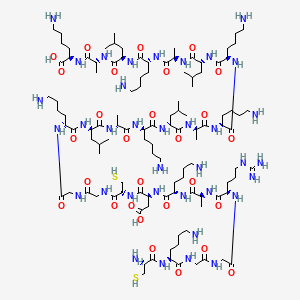
In detail, adipotide is a peptidomimetic with the sequence CKGGRAKDC-GG-(D)(KLAKLAK)2. The cyclic CKGGRAKDC motif binds prohibitin on the endothelium of white adipose tissue vasculature. The (KLAKLAK)2 domain is a proapoptotic sequence that disrupts mitochondrial membranes after internalization and triggers apoptosis of the targeted endothelial cells.5 Prohibitin is a cell-cycle regulating protein that is also overexpressed in some tumors, which is part of why the targeting strategy began in cancer research.4
Fat cells release fatty acids when hormones such as adrenaline and growth hormone signal them. Several fat-loss peptides are claimed to mimic part of that signal; human evidence is weak.
What the research shows on Adipotide
The core evidence is a single primate study. Researchers treated obese Old World monkeys from three species with adipotide. Treatment induced targeted cell death inside the blood vessels of white fat, produced rapid weight loss, and improved insulin resistance. Imaging confirmed a marked loss of white fat.5
At the doses the researchers judged optimal, the monkeys also showed predictable changes in the function of the kidney's proximal tubules, the part of the kidney that reabsorbs water and salts. The authors described these changes as reversible.5 Even so, a kidney signal at effective doses is a serious finding for a drug intended for long-term use in people with obesity, many of whom already have kidney risk from diabetes or high blood pressure.
The study also drew a published challenge. A critic argued that the weight loss might reflect the monkeys simply eating less, a direct effect on food intake, rather than the proposed fat-vessel mechanism.7 That matters because it questions whether the targeting is as selective as claimed.
Rodent studies preceded the primate work, but there are no published human efficacy or safety results. The primate study was small by clinical standards, and it was not designed to answer long-term safety questions.
It is also worth noting what the monkey data do not show. They do not show how long the weight loss lasts after treatment stops, whether fat returns, or how the body handles repeated courses. Those are the questions any obesity drug must answer, and adipotide has not answered them.
Studied for: Obesity research.
Adipotide reference data
| Molecular weight | 2,609 Da |
|---|---|
| FDA status | Not approved for any indication. |
| Prohibited in sport | Not listed |
Adipotide dosage in published research
How Adipotide is used in practice
There is no medical use of adipotide. It is not prescribed by doctors, not offered by legitimate telehealth services, and not available from US compounding pharmacies. It appears on research-chemical websites as lyophilized powder in vials, often marketed with before-and-after claims drawn loosely from the monkey study. Doses suggested by sellers are extrapolated from animal work, a step that is unreliable for any drug and especially risky for one designed to destroy tissue.
Buyers face the usual gray-market problems: unverified identity, unknown purity, possible bacterial contamination and no dosing guidance grounded in human data. With adipotide those problems carry higher stakes, because the intended effect is to kill cells. A product that is mislabeled, overdosed or contaminated could cause harm that is hard to reverse.
Adipotide risks and side effects
Kidney injury is the main known risk. The primate study found dose-related changes in kidney tubule function at the doses that produced weight loss.5 Anyone with existing kidney disease, dehydration, or who takes drugs that stress the kidneys, such as NSAIDs or certain antibiotics, would face added risk.
Dehydration, reduced appetite and injection-site reactions have also been reported. The proapoptotic part of the peptide is not selective on its own. If the homing sequence binds other vessels or the peptide is degraded in ways that free the payload, other tissues could be damaged. No one has studied effects on pregnancy, fertility, the heart or the liver in people. Long-term consequences of repeatedly destroying blood vessels in fat tissue are unknown.
There is also the question of where the destroyed tissue goes and what replaces it. That has not been studied in humans.
Reported side effects
Alternatives to Adipotide
Several FDA-approved medicines produce substantial, sustained weight loss with known safety profiles. These include semaglutide (Wegovy), tirzepatide (Zepbound) and liraglutide (Saxenda), as well as phentermine-topiramate (Qsymia), naltrexone-bupropion (Contrave) and orlistat. For people with severe obesity, bariatric surgery has the longest track record. Each option involves trade-offs, but all have been tested in large human trials.
For people focused on a specific fat area rather than overall weight, procedures such as liposuction or cryolipolysis are regulated and their risks are documented.
The bottom line on Adipotide
Adipotide caused real fat loss in monkeys by destroying the blood supply of fat, and it affected the kidneys at the doses that worked. It has no human efficacy data, no approval and no quality-controlled source. The risk profile is unfavorable, and approved weight-loss drugs do the job with far better evidence. It should not be used.
Questions for a clinician
- What evidence applies to my situation, and at what level?
- What established alternatives should I consider first?
- What monitoring would be necessary, and how often?
- Can this be prescribed at all where I live, or only sold for research?
Adipotide FAQ
What is Adipotide?
A proapoptotic peptide that destroys the blood supply to fat tissue. Caused kidney tubule changes in a primate study. It is classed as fat loss.
Is Adipotide FDA approved?
No. Adipotide is not approved by the FDA for any indication. Material sold online is labelled for research use only.
Is Adipotide legal in the US?
Adipotide is not FDA approved and is not on FDA’s 503A bulks list. US compounding pharmacies cannot routinely prepare it.
What dose of Adipotide is used in research?
Published research and practitioner protocols report 500 mcg - 1 mg, research protocols only. This is a reference range, not a recommendation; dosing should be set by a licensed clinician.
What are the side effects of Adipotide?
Reported side effects include kidney tubule changes (primate data), dehydration, injection-site reactions, reduced appetite. Contraindications: any renal impairment, pregnancy, dehydration.
What is the half-life of Adipotide?
The reported half-life of Adipotide is ~30-60 minutes.
Is Adipotide banned in sport?
Adipotide is not specifically named on the WADA prohibited list, but athletes should check the current list and their federation's rules.
References
Regulatory and primary sources
- FDA: Bulk drug substances that may present significant safety risks (Category 2 and withdrawn nominations) ↗ · content current as of April 22, 2026; checked October 18, 2026
- FDA: Bulk drug substances used in compounding under section 503A ↗ · how the 503A categories work
- PubChem compound record (CID 163360068) ↗ · structure, identifiers, synonyms
- FDA: Unapproved drugs and "research use only" products ↗ · regulatory status of non-approved products
Published literature
- Fluorinated High-Valent Sn(IV) Porphyrins Show Remarkable Photodynamic Activity in Cancer Cells.ChemMedChem 2024.PubMed 39017962 · doi:10.1002/cmdc.202400376
- A novel "three-dimensional-printed individual guide template-assisted percutaneous vertebroplasty" for osteoporotic vertebral compression fracture: a prospective, controlled study.J Orthop Surg Res 2021.PubMed 34016139 · doi:10.1186/s13018-021-02471-w
- Fitness-to-practise policies in Australian medical schools--are they fit for purpose?.Med J Aust 2010.PubMed 21143055 · doi:10.5694/j.1326-5377.2010.tb04098.x
- Prohibitin: targeting peptide coupled to ovarian cancer, luteinization and TGF-β pathways.J Ovarian Res 2017.PubMed 28427435 · doi:10.1186/s13048-017-0325-4
- A peptidomimetic targeting white fat causes weight loss and improved insulin resistance in obese monkeys.Sci Transl Med 2011.PubMed 22072637 · doi:10.1126/scitranslmed.3002621
- Mn(III) porphyrins as photosensitizers: structural, photophysical and anticancer studies.Dalton Trans 2025.PubMed 40673971 · doi:10.1039/d4dt03432e
- Comment on "a peptidomimetic targeting white fat causes weight loss and improved insulin resistance in obese monkeys".Sci Transl Med 2012.PubMed 22539771 · doi:10.1126/scitranslmed.3003760
- The effects on length of stay of introducing a fast track patient pathway for myocardial infarction: a before and after evaluation.Health Serv Manage Res 2012.PubMed 22323669 · doi:10.1258/hsmr.2011.011021
Literature retrieved from PubMed on October 16, 2026, favouring human studies and reviews. Numbered markers in the text show which paper supports which statement; uncited entries are background reading.