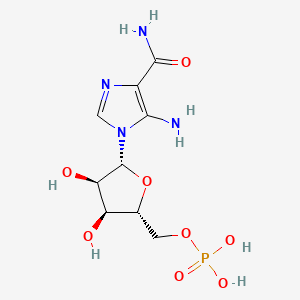
Is AICAR legal?
Not FDA approved- FDA status
- AICAR is not FDA approved and is not on FDA’s 503A bulks list.
- Compounding
- US compounding pharmacies cannot routinely prepare it.
- Prescription
- There is no approved US prescription product for AICAR.
- Online market
- Products sold online are labelled “for research use only”: not made, tested or labelled for human use, and often mislabelled.
- Sport
- Prohibited in sport under the World Anti-Doping Agency list.
US status checked October 2026 against FDA’s compounding lists. Sources at the foot of the page.
What is AICAR?
AICAR, also known as acadesine or AICA riboside, is a small nucleoside molecule that activates AMP-activated protein kinase, or AMPK, the cell's main energy sensor. It is not a peptide. For decades it has been a standard laboratory tool for switching AMPK on in cells and animals.5
As a drug, acadesine was first developed to protect the heart during surgery, and it was tested in people undergoing coronary artery bypass grafting. It was later studied as a possible treatment for chronic lymphocytic leukemia.7 It was never approved for either use.
AICAR became widely known outside medicine after mouse experiments suggested it could raise running endurance without training, which earned it the nickname "exercise in a pill". The World Anti-Doping Agency now prohibits it as a metabolic modulator. It is sold online for fat loss and endurance.
Its chemistry is simple. AICAR is a natural intermediate in the pathway cells use to build purines, the building blocks of DNA and the energy molecule ATP. Small amounts occur in the body normally, which is one reason anti-doping testing for it is technically demanding.
- Anecdotal only
- In vitro only
- Animal models only
- Preliminary human
- Clinical trials
- Regulator approved
How AICAR works
When a cell runs low on energy, levels of a molecule called AMP rise. AMPK detects that rise and responds by switching the cell into fuel-burning mode. It pulls in more glucose, burns more fat and builds more mitochondria, while slowing energy-hungry processes such as fat and protein synthesis. AICAR tricks the cell into thinking it is low on energy, so AMPK switches on even at rest.
Mechanistically, AICAR enters cells through nucleoside transporters and is phosphorylated by adenosine kinase to ZMP, an AMP analog that allosterically activates AMPK. It is not a clean AMPK activator. ZMP also affects other AMP-regulated enzymes and mitochondrial oxidative phosphorylation, so some of AICAR's effects do not go through AMPK at all.5 AMPK itself has wide-ranging and context-dependent roles, including in aging, autophagy and cancer biology, where it can act in opposing directions.1
Fat cells release fatty acids when hormones such as adrenaline and growth hormone signal them. Several fat-loss peptides are claimed to mimic part of that signal; human evidence is weak.
What the research shows on AICAR
Human studies of AICAR exist, but they mostly address heart surgery and blood cancer, not fat loss or exercise performance. In healthy subjects and in patients undergoing bypass surgery, acadesine was given intravenously and did not cause serious toxicity.7 Laboratory studies showed it can trigger cell death in leukemia cells, including drug-resistant ones, which led researchers to propose it as a treatment option for that disease.7
The fat-loss and endurance claims rest on animal research. Mouse studies found that AICAR improved endurance and shifted muscle toward a more oxidative, fatigue-resistant profile without training. Reviews of exercise and calorie-restriction mimetics conclude that these compounds have mostly been described in preclinical settings, with limited translation into humans.8
AICAR has also been used in lab work on related questions. In one study it prompted cultured muscle cells to release cathepsin B, a protein linked to the brain benefits of running in mice and to memory in people who exercised.3 Preclinical sepsis research and mitochondrial disease research have used AICAR to explore AMPK as a drug target.64 None of that work tested AICAR as a treatment for people.
There is also a translation gap between mouse and human exercise physiology. Mice are small animals with very different muscle fiber makeup and energy demands. A change that improves a mouse treadmill test does not tell us whether a human runner, cyclist or dieter would see a meaningful benefit, and no controlled human trial has tested that question.
The practical limits are significant. AICAR has a short half-life, poor oral absorption, and off-target effects that researchers have spent years trying to avoid by developing more specific AMPK activators.5
Studied for: Metabolic research, Endurance research, Cardioprotection studies.
AICAR reference data
| Molecular weight | 258.23 Da |
|---|---|
| CAS number | 2627-69-2 |
| FDA status | Not approved for any indication. |
| Prohibited in sport | Yes, under the WADA prohibited list |
AICAR dosage in published research
How AICAR is used in practice
AICAR has no approved clinical use. In the gray market it is sold as powder or injectable vials labeled for research, and it is used mainly by bodybuilders and endurance athletes chasing fat loss or stamina. Some products are sold as oral capsules, which is a poor fit given how little reaches the blood when swallowed.
As with other research chemicals, identity and purity are unverified. The doses consumers use are improvised from forums and vendor guidance, and they bear little relation to the intravenous protocols tested in surgical patients.
Some users stack AICAR with other compounds marketed as exercise mimetics or fat burners. Combining several poorly characterized substances makes it impossible to know which one is responsible for any effect or side effect, and it multiplies the chance of a harmful interaction.
For competitive athletes, AICAR is prohibited at all times, and anti-doping laboratories test for it.
AICAR risks and side effects
In human studies, AICAR's metabolism raises uric acid, which can provoke gout attacks or kidney stones in susceptible people. Headache, nausea and low blood sugar have also been reported. People with gout, kidney disease or diabetes treated with insulin or sulfonylureas face added risk.
AMPK activation is not uniformly good. Its role in cancer is context-dependent, promoting tumor growth in some settings and suppressing it in others.1 That makes long-term, high-dose use by healthy people hard to call safe without data, and no such data exist.
Effects in pregnancy, on fertility, and over months of use are unknown. Off-target effects on mitochondria and other enzymes add uncertainty.5 Contamination and mislabeling are additional risks for gray-market products.
Reported side effects
Alternatives to AICAR
Regular exercise, both endurance and resistance training, is the best-studied way to activate AMPK, improve endurance and support fat loss. That is not a platitude. AICAR research exists largely to imitate it.8
Metformin, an inexpensive diabetes drug with decades of human data, activates AMPK indirectly and is prescribed for type 2 diabetes and sometimes prediabetes. For weight loss, FDA-approved options include semaglutide (Wegovy), tirzepatide (Zepbound), liraglutide (Saxenda), phentermine-topiramate (Qsymia) and naltrexone-bupropion (Contrave).
The bottom line on AICAR
AICAR is a valuable research tool and a drug that was studied for heart surgery and leukemia but never approved. The "exercise in a pill" reputation comes from mice. In people it has no proven benefit for fat loss or performance, it raises uric acid, and it is banned in sport. Exercise and approved medicines are better choices.
Questions for a clinician
- What evidence applies to my situation, and at what level?
- What established alternatives should I consider first?
- What monitoring would be necessary, and how often?
- Can this be prescribed at all where I live, or only sold for research?
AICAR FAQ
What is AICAR?
An AMPK activator nicknamed exercise in a pill, and one of the earliest compounds added to WADA banned list as a metabolic modulator. It is classed as fat loss.
Is AICAR FDA approved?
No. AICAR is not approved by the FDA for any indication. Material sold online is labelled for research use only.
Is AICAR legal in the US?
AICAR is not FDA approved and is not on FDA’s 503A bulks list. US compounding pharmacies cannot routinely prepare it.
What dose of AICAR is used in research?
Published research and practitioner protocols report 50-100 mg, research protocols vary. This is a reference range, not a recommendation; dosing should be set by a licensed clinician.
What are the side effects of AICAR?
Reported side effects include elevated uric acid, headache, nausea, hypoglycaemia. Contraindications: gout or hyperuricaemia, pregnancy, renal impairment.
What is the half-life of AICAR?
The reported half-life of AICAR is ~30 minutes.
Is AICAR banned in sport?
Yes. AICAR falls under the World Anti-Doping Agency prohibited list.
References
Regulatory and primary sources
- FDA: Bulk drug substances that may present significant safety risks (Category 2 and withdrawn nominations) ↗ · content current as of April 22, 2026; checked October 18, 2026
- FDA: Bulk drug substances used in compounding under section 503A ↗ · how the 503A categories work
- PubChem compound record (CID 65110) ↗ · structure, identifiers, synonyms
- WADA Prohibited List ↗ · current year
- FDA: Unapproved drugs and "research use only" products ↗ · regulatory status of non-approved products
- CAS Registry Number 2627-69-2 ↗ · chemical identity
Published literature
- AMPK: The energy sensor at the crossroads of aging and cancer.Semin Cancer Biol 2024.PubMed 39197808 · doi:10.1016/j.semcancer.2024.08.002
- Autophagy in the physiological endometrium and cancer.Autophagy 2021.PubMed 32401642 · doi:10.1080/15548627.2020.1752548
- Running-Induced Systemic Cathepsin B Secretion Is Associated with Memory Function.Cell Metab 2016.PubMed 27345423 · doi:10.1016/j.cmet.2016.05.025
- Modulating Mitophagy in Mitochondrial Disease.Curr Med Chem 2018.PubMed 28618992 · doi:10.2174/0929867324666170616101741
- Beyond AICA riboside: in search of new specific AMP-activated protein kinase activators.IUBMB Life 2009.PubMed 18798311 · doi:10.1002/iub.135
- Targeting AMP-activated protein kinase in sepsis.Front Endocrinol (Lausanne) 2024.PubMed 39469575 · doi:10.3389/fendo.2024.1452993
- AICA-riboside (acadesine), an activator of AMP-activated protein kinase with potential for application in hematologic malignancies.Expert Opin Investig Drugs 2010.PubMed 20367195 · doi:10.1517/13543781003703694
- Caloric restriction and exercise "mimetics'': Ready for prime time?.Pharmacol Res 2016.PubMed 26658171 · doi:10.1016/j.phrs.2015.11.009
Literature retrieved from PubMed on October 16, 2026, favouring human studies and reviews. Numbered markers in the text show which paper supports which statement; uncited entries are background reading.