Is Melanotan I legal?
FDA approved- FDA status
- Melanotan I is FDA approved for: Increase of pain-free light exposure in adults with erythropoietic protoporphyria (Scenesse).
- Compounding
- It is a prescription medicine. Use outside the approved indication is off-label and a clinician’s decision. Compounded copies are restricted when the approved product is available.
- Prescription
- A licensed US clinician can prescribe Melanotan I.
US status checked October 2026 against FDA’s compounding lists. Sources at the foot of the page.
What is Melanotan I?
Melanotan I is a lab-made version of alpha-melanocyte-stimulating hormone, or alpha-MSH, the body's own signal for making skin pigment. Its drug name is afamelanotide. Researchers at the University of Arizona developed it in the 1980s while looking for a way to tan skin without sun exposure, which is where the Melanotan name comes from.
The Australian company Clinuvel later developed it as a medicine. It is sold as Scenesse, a small implant placed under the skin. The FDA approved Scenesse in 2019 to increase pain-free light exposure in adults with erythropoietic protoporphyria, or EPP, a rare inherited condition in which sunlight causes severe burning pain.6
There are two very different products sharing one name. One is a regulated prescription implant used by specialists for a rare disease. The other is an unregulated powder sold online as Melanotan I for cosmetic tanning. This page covers both, but the evidence applies only to the regulated drug.
- Anecdotal only
- In vitro only
- Animal models only
- Preliminary human
- Clinical trials
- Regulator approved
How Melanotan I works
Your skin cells that make pigment, the melanocytes, have a receptor called MC1R. When alpha-MSH binds to it, the cell switches toward making eumelanin, the dark brown pigment that absorbs ultraviolet light. Melanotan I binds the same receptor and does the same job, but it lasts longer and is far more potent than the natural hormone. The result is a tan that develops without UV exposure.
For people with EPP, the extra pigment acts like a built-in filter. It absorbs some of the visible light that would otherwise activate the excess protoporphyrin in their skin and trigger pain.
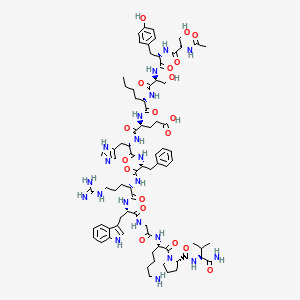
In more detail, afamelanotide is [Nle4, D-Phe7]-alpha-MSH. Swapping methionine for norleucine at position 4 removes an oxidation-prone site, and the D-phenylalanine at position 7 slows enzyme breakdown and strengthens receptor binding. It is relatively selective for MC1R, which signals through cyclic AMP to increase tyrosinase activity and eumelanin output.7 It has much less effect on the brain MC4R receptor than melanotan II, which explains why it causes less nausea and fewer sexual side effects.
One family of receptors controls skin pigment, appetite and sexual arousal. Drugs differ mainly in which receptor they favour: afamelanotide (MC1R), setmelanotide (MC4R), bremelanotide (MC4R), melanotan II (several).
What the research shows on Melanotan I
The strongest evidence comes from the phase 2 and phase 3 trials of the afamelanotide implant in EPP. A review of that program found the results were statistically significant, though the effects were not very large in absolute terms. Patients gained extra time in sunlight without pain. The same review described high adherence and consistent benefit over six years of compassionate use in Switzerland.7 A German review of porphyrias likewise concluded that afamelanotide is associated with better sunlight tolerance in EPP and the related X-linked form.4
Beyond EPP, the evidence is thinner. Randomized trials have tested afamelanotide in polymorphic light eruption and vitiligo, and smaller studies have looked at acne, Hailey-Hailey disease and solar urticaria.8 In vitiligo it has been studied mainly as an add-on to narrowband UVB phototherapy, and reviews still describe no clearly outstanding treatment for that disease.1 It has also been listed among experimental approaches for acne.3 None of these uses is approved.
There is no controlled research on the cosmetic tanning use of injectable research-grade Melanotan I. The dosing used online is not drawn from trials, and the purity of the products is unknown.
Studied for: Erythropoietic protoporphyria, Photoprotection, Tanning.
Melanotan I reference data
| Molecular weight | 1,646.8 Da |
|---|---|
| CAS number | 75921-69-6 |
| FDA status | Increase of pain-free light exposure in adults with erythropoietic protoporphyria (Scenesse) |
| Prohibited in sport | Not listed |
Melanotan I dosage in published research
Daily, or 16 mg implant every 2 months (approved use). A reference pattern, not a prescription.
How Melanotan I is used in practice
In approved medical use, Scenesse is a 16 mg implant, about the size of a grain of rice, placed under the skin of the hip by a trained clinician. It releases the drug over several weeks and is typically repeated every two months, often concentrated in the brighter months. In the US it is given through specialist centers, not through telehealth or retail pharmacies, and it is expensive.
The gray market is a different world. Vials of freeze-dried powder labeled Melanotan I are sold online as research chemicals, and buyers inject them for a tan. A German dermatology review noted that structurally related alpha-MSH derivatives are easy to buy online even though afamelanotide itself is a prescription drug, and described these products as dangerous.2 Compounding pharmacies do not legitimately supply it for tanning.
Research-chemical peptides are not checked for identity, sterility or dose. Vials may be underfilled, contain a different peptide such as melanotan II, or carry bacterial contamination from poor manufacturing.
Melanotan I risks and side effects
In the clinical trials, the common side effects were nausea, headache, fatigue and reactions at the implant site. Almost all patients develop diffuse darkening of the skin, which is the intended effect but can be uneven. Reviews of the trial data have not reported serious adverse effects.8
The main concern is moles. Melanotan I darkens existing naevi, and case reports describe activation of dysplastic naevi in people using it.2 Darker or changing moles are harder to monitor for melanoma. People with a history of melanoma or many atypical moles should not use it, and approved patients get regular skin checks.
Other cautions on the label include liver impairment and pregnancy, where there is not enough data. Long-term effects of repeated cosmetic use outside medical supervision are unknown. Injecting unregulated powders adds the risks of infection, wrong dosing and wrong product.
Reported side effects
Alternatives to Melanotan I
For EPP, the core tools are strict light avoidance and protective clothing. Dersimelagon, an oral MC1R agonist, has been in late-stage trials, and other drugs that target the heme pathway are under study. Clothing and window films that block visible light, and planning outdoor time around the strongest sun, also help. Patients should be managed by a porphyria specialist.
For a cosmetic tan, sunless tanning products containing dihydroxyacetone give color without UV or injections. They do not provide meaningful sun protection, so broad-spectrum sunscreen is still needed. For vitiligo, narrowband UVB phototherapy remains the first-line treatment for widespread disease.5 Topical ruxolitinib cream is FDA approved for nonsegmental vitiligo.
The bottom line on Melanotan I
As the Scenesse implant, afamelanotide is a real, approved and generally well-tolerated treatment for a rare and painful disease, with modest but genuine benefit. As an online powder for tanning, it is an untested, unregulated injection that darkens moles and offers nothing a bottle of self-tanner cannot.
Questions for a clinician
- What evidence applies to my situation, and at what level?
- What established alternatives should I consider first?
- What monitoring would be necessary, and how often?
Melanotan I FAQ
What is Melanotan I?
A selective MC1R agonist, FDA approved as an implant for a rare photosensitivity disorder. It is classed as melanocortins.
Is Melanotan I FDA approved?
Yes. Melanotan I is FDA approved for: Increase of pain-free light exposure in adults with erythropoietic protoporphyria (Scenesse).
Is Melanotan I legal in the US?
Melanotan I is FDA approved for: Increase of pain-free light exposure in adults with erythropoietic protoporphyria (Scenesse). It is a prescription medicine. Use outside the approved indication is off-label and a clinician’s decision. Compounded copies are restricted when the approved product is available.
What dose of Melanotan I is used in research?
Published research and practitioner protocols report 500 mcg - 1 mg, daily, or 16 mg implant every 2 months (approved use). This is a reference range, not a recommendation; dosing should be set by a licensed clinician.
What are the side effects of Melanotan I?
Reported side effects include nausea, headache, implant-site reactions, darkening of existing naevi, fatigue. Contraindications: melanoma history, hepatic impairment, pregnancy.
What is the half-life of Melanotan I?
The reported half-life of Melanotan I is ~1 hour (implant gives sustained release).
Is Melanotan I banned in sport?
Melanotan I is not specifically named on the WADA prohibited list, but athletes should check the current list and their federation's rules.
References
Regulatory and primary sources
- FDA: Bulk drug substances that may present significant safety risks (Category 2 and withdrawn nominations) ↗ · content current as of April 22, 2026; checked October 18, 2026
- FDA: Bulk drug substances used in compounding under section 503A ↗ · how the 503A categories work
- PubChem compound record (CID 16197727) ↗ · structure, identifiers, synonyms
- DailyMed: FDA-approved labeling for Melanotan I ↗ · indications, dosing, warnings as approved
- FDA Drugs@FDA database ↗ · approval history
- CAS Registry Number 75921-69-6 ↗ · chemical identity
Published literature
- Vitiligo: Pathogenesis and New and Emerging Treatments.Int J Mol Sci 2023.PubMed 38139134 · doi:10.3390/ijms242417306
- [Undesirable pigmentation].Hautarzt 2015.PubMed 26315100 · doi:10.1007/s00105-015-3671-4
- From pathogenesis of acne vulgaris to anti-acne agents.Arch Dermatol Res 2019.PubMed 30859308 · doi:10.1007/s00403-019-01908-x
- [Porphyrias-what is verified?].Internist (Berl) 2018.PubMed 30328490 · doi:10.1007/s00108-018-0509-z
- Phototherapy for Vitiligo.Dermatol Clin 2020.PubMed 31753192 · doi:10.1016/j.det.2019.08.005
- Targeting the central melanocortin system for the treatment of metabolic disorders.Nat Rev Endocrinol 2023.PubMed 37365323 · doi:10.1038/s41574-023-00855-y
- Afamelanotide (CUV1647) in dermal phototoxicity of erythropoietic protoporphyria.Expert Rev Clin Pharmacol 2015.PubMed 25470471 · doi:10.1586/17512433.2014.956089
- Afamelanotide: An Orphan Drug with Potential for Broad Dermatologic Applications.J Drugs Dermatol 2021.PubMed 33683075 · doi:10.36849/JDD.5526
Literature retrieved from PubMed on October 16, 2026, favouring human studies and reviews. Numbered markers in the text show which paper supports which statement; uncited entries are background reading.