Is Setmelanotide legal?
FDA approved- FDA status
- Setmelanotide is FDA approved for: Obesity due to POMC, PCSK1 or LEPR deficiency; Bardet-Biedl syndrome (Imcivree).
- Compounding
- It is a prescription medicine. Use outside the approved indication is off-label and a clinician’s decision. Compounded copies are restricted when the approved product is available.
- Prescription
- A licensed US clinician can prescribe Setmelanotide.
US status checked October 2026 against FDA’s compounding lists. Sources at the foot of the page.
What is setmelanotide?
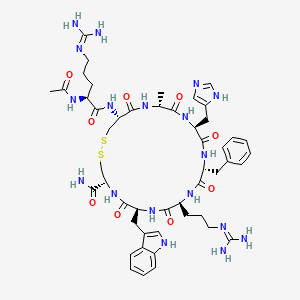
Setmelanotide is a daily injectable peptide sold as Imcivree by Rhythm Pharmaceuticals. It is approved for a small group of people whose severe obesity is caused by specific genetic problems in the brain's appetite pathway, rather than for common obesity. It is one of the clearest examples of precision medicine in weight management: who benefits depends on a confirmed genetic diagnosis.
The FDA first approved setmelanotide in November 2020 for chronic weight management in people aged 6 and older with obesity due to POMC, PCSK1 or LEPR deficiency2. Approval was later extended to Bardet-Biedl syndrome, a rare inherited disorder in which early obesity and constant hunger are major features5. The European Medicines Agency gave it priority medicines (PRIME) status for obesity and hunger linked to MC4R pathway disorders2. Rhythm has continued to test it in other rare conditions, most notably acquired hypothalamic obesity.
- Anecdotal only
- In vitro only
- Animal models only
- Preliminary human
- Clinical trials
- Regulator approved
How setmelanotide works
Body weight is partly controlled by a chain of signals in the hypothalamus. Fat tissue releases leptin, leptin acts on brain cells that make a hormone called POMC, POMC is cut into smaller messengers, and those messengers switch on the melanocortin-4 receptor (MC4R), which reduces hunger and helps regulate energy use. If any link before MC4R is broken, the 'stop eating' message never arrives, and people feel intense, constant hunger from early childhood. Setmelanotide acts directly on MC4R, skipping the broken links and restoring the final signal.
In more detail, setmelanotide is a cyclic peptide MC4R agonist. MC4R is the key downstream node of the leptin-melanocortin pathway, and biallelic variants in genes such as POMC, PCSK1 and LEPR disrupt signaling upstream of it8. Because the receptor itself is intact in these conditions, an agonist can restore signaling. Where MC4R itself is fully non-functional, setmelanotide has nothing to act on, which is why genetic testing determines eligibility. The drug also has some activity at the melanocortin-1 receptor in skin, which explains the darkening of skin and moles seen in many patients. It was the first obesity drug approved to act on the central melanocortin system.
One family of receptors controls skin pigment, appetite and sexual arousal. Drugs differ mainly in which receptor they favour: afamelanotide (MC1R), setmelanotide (MC4R), bremelanotide (MC4R), melanotan II (several).
What the research shows on setmelanotide
The pivotal trials were small, because the conditions are very rare. In two single-arm, open-label phase 3 trials funded by Rhythm, 8 of 10 participants with POMC deficiency and 5 of 11 with LEPR deficiency lost at least 10% of body weight after about a year8. Hunger scores fell by about 27% and 44% respectively8. The design included a short blinded withdrawal phase, but there was no parallel placebo group, which limits how precisely the effect can be measured.
The strongest controlled evidence now comes from hypothalamic obesity, which develops after damage to the hypothalamus from tumors such as craniopharyngioma, surgery or radiation. In a phase 3 randomized trial of 120 people aged 4 to 66, BMI fell by 16.5% with setmelanotide over 52 weeks, compared with a 3.3% increase on placebo, and hunger scores improved more with the drug7. That trial was also funded by Rhythm. Across all of these programs, the number of treated patients is small and follow-up is a few years at most, so rare or late side effects may not yet be known. Weight and hunger are expected to return if treatment stops, since the underlying genetic defect remains.
Setmelanotide has also been studied in Prader-Willi syndrome3, but it is not approved for that condition. Reviews of genetic and pediatric obesity treatment now include it among approved options for confirmed monogenic and syndromic cases, and emphasize that wider genetic testing is needed to find eligible patients14.
Studied for: POMC, PCSK1 and LEPR deficiency obesity, Bardet-Biedl syndrome.
Setmelanotide reference data
| Molecular weight | 1,117.3 Da |
|---|---|
| CAS number | 920014-72-8 |
| FDA status | Obesity due to POMC, PCSK1 or LEPR deficiency; Bardet-Biedl syndrome (Imcivree) |
| Prohibited in sport | Not listed |
Setmelanotide dosage in published research
Once daily. A reference pattern, not a prescription.
How setmelanotide is used in practice
Setmelanotide is prescribed by specialists, usually pediatric or adult endocrinologists and obesity medicine physicians, after genetic testing or a clinical diagnosis of Bardet-Biedl syndrome. It is injected under the skin once a day, starting at a lower dose and increasing as tolerated. Doctors typically reassess after several months and stop it if weight loss is insufficient.
It is very expensive and dispensed through specialty pharmacies, with insurers requiring proof of the genetic diagnosis. It is not a general weight-loss drug, and there is no meaningful telehealth or compounding route for it. Because people with common obesity do not have the upstream defects it corrects, it is not expected to work like a GLP-1 drug in that population, and buying it from gray-market sources makes little sense.
Setmelanotide risks and side effects
Injection-site reactions and skin hyperpigmentation are the most common side effects. In the POMC trial, every participant had both8. Darkening of the skin, lips and existing moles is expected, and regular skin examinations are recommended. Nausea and vomiting are also common, mainly early in treatment8.
In the hypothalamic obesity trial, all participants on setmelanotide reported adverse events, and serious adverse events occurred in 28% compared with 8% on placebo7. The label warns about depression and suicidal thoughts, so mood should be monitored. Spontaneous penile erections and other sexual effects can occur, because MC4R also influences sexual function. Its effects on bone are largely unknown6. Drug interactions are poorly characterized. It should not be used in pregnancy.
Reported side effects
Alternatives to setmelanotide
For common obesity in adults and adolescents, GLP-1 based medicines such as semaglutide and liraglutide, and the dual agonist tirzepatide, have far larger evidence bases. Several have pediatric approvals, and the American Academy of Pediatrics now recommends offering anti-obesity medicines to youth aged 12 and older with obesity4. Metabolic and bariatric surgery is an option for severe obesity, though outcomes may be weaker in some genetic syndromes.
For Prader-Willi syndrome, diazoxide choline extended-release was approved in the US in 2025 for hyperphagia. Across all genetic obesities, structured nutrition support, food security measures at home and multidisciplinary care remain the base of treatment1.
The bottom line on setmelanotide
Setmelanotide is a genuine precision medicine. For people with confirmed POMC, PCSK1 or LEPR deficiency or Bardet-Biedl syndrome, it can reduce extreme hunger and weight where little else works. For everyone else, it is the wrong tool. Skin darkening and mood monitoring are part of the trade-off.
Questions for a clinician
- What evidence applies to my situation, and at what level?
- What established alternatives should I consider first?
- What monitoring would be necessary, and how often?
Setmelanotide FAQ
What is Setmelanotide?
A selective MC4R agonist approved for rare genetic obesity syndromes, and a genuine precision medicine. It is classed as melanocortins.
Is Setmelanotide FDA approved?
Yes. Setmelanotide is FDA approved for: Obesity due to POMC, PCSK1 or LEPR deficiency; Bardet-Biedl syndrome (Imcivree).
Is Setmelanotide legal in the US?
Setmelanotide is FDA approved for: Obesity due to POMC, PCSK1 or LEPR deficiency; Bardet-Biedl syndrome (Imcivree). It is a prescription medicine. Use outside the approved indication is off-label and a clinician’s decision. Compounded copies are restricted when the approved product is available.
What dose of Setmelanotide is used in research?
Published research and practitioner protocols report 1-3 mg, once daily. This is a reference range, not a recommendation; dosing should be set by a licensed clinician.
What are the side effects of Setmelanotide?
Reported side effects include injection-site reactions, skin hyperpigmentation, nausea, spontaneous penile erection, depression. Contraindications: pregnancy, known hypersensitivity.
What is the half-life of Setmelanotide?
The reported half-life of Setmelanotide is ~11 hours.
Is Setmelanotide banned in sport?
Setmelanotide is not specifically named on the WADA prohibited list, but athletes should check the current list and their federation's rules.
References
Regulatory and primary sources
- FDA: Bulk drug substances that may present significant safety risks (Category 2 and withdrawn nominations) ↗ · content current as of April 22, 2026; checked October 18, 2026
- FDA: Bulk drug substances used in compounding under section 503A ↗ · how the 503A categories work
- PubChem compound record (CID 11993702) ↗ · structure, identifiers, synonyms
- DailyMed: FDA-approved labeling for Setmelanotide ↗ · indications, dosing, warnings as approved
- FDA Drugs@FDA database ↗ · approval history
- CAS Registry Number 920014-72-8 ↗ · chemical identity
Published literature
- Current Treatments for Patients with Genetic Obesity.J Clin Res Pediatr Endocrinol 2023.PubMed 37191347 · doi:10.4274/jcrpe.galenos.2023.2023-3-2
- Setmelanotide: First Approval.Drugs 2021.PubMed 33638809 · doi:10.1007/s40265-021-01470-9
- Clinical Trials in Prader-Willi Syndrome: A Review.Int J Mol Sci 2023.PubMed 36768472 · doi:10.3390/ijms24032150
- Current and future state of pharmacological management of pediatric obesity.Int J Obes (Lond) 2025.PubMed 38321079 · doi:10.1038/s41366-024-01465-y
- Bardet-Biedl syndrome: A clinical overview focusing on diagnosis, outcomes and best-practice management.Diabetes Obes Metab 2024.PubMed 38383825 · doi:10.1111/dom.15494
- The effects of anti-obesity medications on bone metabolism: A critical appraisal.Diabetes Obes Metab 2025.PubMed 40555693 · doi:10.1111/dom.16541
- Setmelanotide for the Treatment of Acquired Hypothalamic Obesity.N Engl J Med 2026.PubMed 42418774 · doi:10.1056/NEJMoa2512275
- Efficacy and safety of setmelanotide, an MC4R agonist, in individuals with severe obesity due to LEPR or POMC deficiency: single-arm, open-label, multicentre, phase 3 trials.Lancet Diabetes Endocrinol 2020.PubMed 33137293 · doi:10.1016/S2213-8587(20)30364-8
Literature retrieved from PubMed on October 16, 2026, favouring human studies and reviews. Numbered markers in the text show which paper supports which statement; uncited entries are background reading.