Is Triptorelin legal?
FDA approved- FDA status
- Triptorelin is FDA approved for: Palliative treatment of advanced prostate cancer (Trelstar); Central precocious puberty in children aged 2 and older (Triptodur, extended-release, approved 2017).
- Compounding
- It is a prescription medicine. Use outside the approved indication is off-label and a clinician’s decision. Compounded copies are restricted when the approved product is available.
- Prescription
- A licensed US clinician can prescribe Triptorelin.
- Sport
- Prohibited in sport under the World Anti-Doping Agency list.
US status checked October 2026 against FDA’s compounding lists. Sources at the foot of the page.
What is triptorelin?
Triptorelin is a synthetic version of gonadotropin-releasing hormone (GnRH), the brain signal that controls the reproductive hormones. It belongs to the class of drugs called GnRH agonists, alongside leuprolide, goserelin and buserelin. It has been in clinical use since the 1980s.
In the US, triptorelin is sold as Trelstar for the palliative treatment of advanced prostate cancer, and as Triptodur for central precocious puberty in children. In Europe and elsewhere it is widely sold as Decapeptyl and used for prostate cancer, endometriosis, fibroids, early puberty and in fertility treatment. It comes mostly as long-acting depot injections lasting one, three or six months.1
Triptorelin also has a niche off-label following among bodybuilders, who use a single small dose to try to restart their own testosterone production after a steroid cycle. That use has almost no formal evidence and works in the opposite direction from how the drug is used in medicine.
- Anecdotal only
- In vitro only
- Animal models only
- Preliminary human
- Clinical trials
- Regulator approved
How triptorelin works
Normally the brain releases GnRH in short pulses. Each pulse tells the pituitary gland to release LH and FSH, which in turn drive the testes to make testosterone and the ovaries to make estrogen and release eggs. The pulsing is essential.
Triptorelin behaves very differently depending on how it is given. A single dose acts like a big GnRH pulse, so LH, FSH and sex hormones surge for a few days. This is called the flare. Continuous exposure from a depot injection does the opposite. The pituitary stops responding, LH and FSH fall, and testosterone or estrogen drop to very low levels within a few weeks. Medicine uses that shutdown to treat hormone-driven diseases.
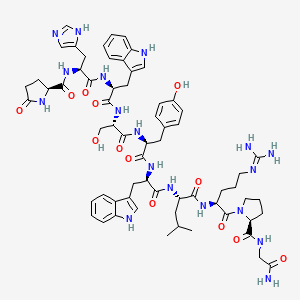
In more precise terms, triptorelin is a decapeptide in which the glycine at position 6 of native GnRH is replaced by D-tryptophan. That change increases receptor binding and resistance to enzymatic breakdown. Sustained occupancy of pituitary GnRH receptors leads to receptor desensitization and downregulation, suppressing gonadotropin secretion. In men with prostate cancer given a six-month depot, testosterone rose briefly and then fell to castrate levels in a mean of about 19 days.1
Kisspeptin starts the cascade; gonadorelin is GnRH itself; hCG acts like LH at the testes or ovaries. Continuous GnRH agonists such as triptorelin switch the axis off rather than on.
What the research shows on triptorelin
For prostate cancer, the evidence is robust. In the pivotal trial of the six-month formulation in 120 men with advanced prostate cancer, 97.5% reached castrate testosterone levels by day 29, and about 93% stayed suppressed from months 2 to 12. Side effects such as hot flushes matched the drug's hormonal action.1
For endometriosis, GnRH agonists including triptorelin relieve pain by inducing a temporary menopause-like state.4 A detailed review concluded that triptorelin improves endometriosis pain and shrinks endometriotic nodules during treatment.3 GnRH agonists also carry more side effects than some other options.4
In fertility medicine, a single dose of a GnRH agonist can replace or join hCG to trigger final egg maturation in IVF. A network meta-analysis found that a GnRH agonist trigger lowered the risk of ovarian hyperstimulation syndrome compared with hCG, without improving pregnancy rates.5 Combining the two, a dual trigger, was associated with higher live birth rates than hCG alone in another meta-analysis.8 GnRH agonist pretreatment before frozen embryo transfer in polycystic ovary syndrome was linked to higher pregnancy rates overall, though the effect disappeared when only randomized trials were analyzed.6 In women with adenomyosis, a recent randomized trial found low-dose letrozole performed similarly to a GnRH agonist before embryo transfer.2
For restarting testosterone after anabolic steroid use, there are no controlled trials. The practice rests on the flare effect, case reports and anecdote. Whether it speeds recovery more than time alone is unknown.
Studied for: Advanced prostate cancer, Endometriosis, Central precocious puberty, HPTA restart research.
Triptorelin reference data
| Molecular weight | 1,311.5 Da |
|---|---|
| CAS number | 57773-63-4 |
| FDA status | Palliative treatment of advanced prostate cancer (Trelstar); Central precocious puberty in children aged 2 and older (Triptodur, extended-release, approved 2017) |
| Prohibited in sport | Yes, under the WADA prohibited list |
Triptorelin dosage in published research
How triptorelin is used in practice
In medicine, triptorelin is given by a clinician as an intramuscular depot injection. In prostate cancer it is often combined with an anti-androgen at the start to block the effects of the initial testosterone flare. In children with early puberty, it pauses puberty until an appropriate age. In IVF clinics, short-acting triptorelin is used both to suppress natural cycles and as a one-off trigger shot.
In bodybuilding circles, triptorelin is bought from overseas pharmacies or research-chemical vendors and injected once at a low dose after a steroid cycle. Some telehealth men's health clinics have offered it as an alternative to hCG or clomiphene. Gray-market supply carries the usual risks of wrong dose and contamination, and with this drug the dose matters a lot. Too much or repeated dosing could suppress rather than stimulate the hormonal axis. Triptorelin is prohibited in male athletes under anti-doping rules.
Triptorelin risks and side effects
With long-term suppression, side effects come from low sex hormones: hot flushes, reduced libido, erectile dysfunction, fatigue, mood changes and, over months to years, loss of bone density. Androgen deprivation in men is also associated with weight gain, insulin resistance and higher cardiovascular risk. Injection-site reactions occurred in about 7% of men in the six-month depot trial.1
The initial flare can briefly worsen symptoms. In advanced prostate cancer this can mean increased bone pain or, rarely, spinal cord compression or urinary obstruction, which is why clinicians monitor high-risk patients closely.
Triptorelin must not be used in pregnancy. It can blunt the effects of hCG or gonadorelin if given around the same time. For off-label restart use, the main risk is that it simply does not work, or that an incorrect dose or repeated use prolongs suppression rather than ending it.
Reported side effects
Alternatives to triptorelin
For prostate cancer, other GnRH agonists include leuprolide and goserelin. GnRH antagonists such as degarelix and oral relugolix suppress testosterone without a flare. For endometriosis pain, the levonorgestrel intrauterine system and laparoscopic surgery also have evidence of benefit.4 Other options include hormonal contraceptives, progestins, and oral GnRH antagonists such as elagolix and relugolix combination therapy.
For recovering natural testosterone after steroid use, clinicians more often use hCG, clomiphene or enclomiphene, or simply time and monitoring. Men with persistent low testosterone should be evaluated for hypogonadism rather than relying on a one-off dose.
The bottom line on triptorelin
Triptorelin is a well-established, approved drug that reliably shuts down sex hormone production when given continuously, with solid evidence in prostate cancer, endometriosis and fertility care. The popular single-dose restart protocol is a different story: it relies on the brief flare, has no controlled evidence, and should not be mistaken for the drug's proven uses.
Questions for a clinician
- What evidence applies to my situation, and at what level?
- What established alternatives should I consider first?
- What monitoring would be necessary, and how often?
Triptorelin FAQ
What is Triptorelin?
A long-acting GnRH agonist that produces an initial LH surge and then profound suppression, depending entirely on how it is dosed. It is classed as reproductive & HPTA.
Is Triptorelin FDA approved?
Yes. Triptorelin is FDA approved for: Palliative treatment of advanced prostate cancer (Trelstar); Central precocious puberty in children aged 2 and older (Triptodur, extended-release, approved 2017).
Is Triptorelin legal in the US?
Triptorelin is FDA approved for: Palliative treatment of advanced prostate cancer (Trelstar); Central precocious puberty in children aged 2 and older (Triptodur, extended-release, approved 2017). It is a prescription medicine. Use outside the approved indication is off-label and a clinician’s decision. Compounded copies are restricted when the approved product is available.
What dose of Triptorelin is used in research?
Published research and practitioner protocols report 100 mcg, single dose in restart protocols; depot dosing for approved use. This is a reference range, not a recommendation; dosing should be set by a licensed clinician.
What are the side effects of Triptorelin?
Reported side effects include hot flushes, initial testosterone flare, reduced libido, injection-site reactions, bone density loss with long use. Contraindications: pregnancy, known hypersensitivity to gnrh analogs.
What is the half-life of Triptorelin?
The reported half-life of Triptorelin is ~3 hours (immediate release).
Is Triptorelin banned in sport?
Yes. Triptorelin falls under the World Anti-Doping Agency prohibited list.
References
Regulatory and primary sources
- FDA: Bulk drug substances that may present significant safety risks (Category 2 and withdrawn nominations) ↗ · content current as of April 22, 2026; checked October 18, 2026
- FDA: Bulk drug substances used in compounding under section 503A ↗ · how the 503A categories work
- PubChem compound record (CID 25074470) ↗ · structure, identifiers, synonyms
- DailyMed: FDA-approved labeling for Triptorelin ↗ · indications, dosing, warnings as approved
- FDA Drugs@FDA database ↗ · approval history
- WADA Prohibited List ↗ · current year
- CAS Registry Number 57773-63-4 ↗ · chemical identity
Published literature
- Triptorelin embonate (6-month formulation).Drugs 2010.PubMed 20166771 · doi:10.2165/11202230-000000000-00000
- Comparative analysis of low-dose letrozole versus GnRH agonist on implantation markers and IVF outcomes in symptomatic adenomyosis: a randomized trial.Sci Rep 2025.PubMed 41476263 · doi:10.1038/s41598-025-32974-z
- Triptorelin for the treatment of endometriosis.Expert Opin Pharmacother 2014.PubMed 24832495 · doi:10.1517/14656566.2014.916279
- An overview of treatments for endometriosis.JAMA 2015.PubMed 25603001 · doi:10.1001/jama.2014.17119
- Triggering oocyte maturation in in vitro fertilization treatment in healthy responders: a systematic review and network meta-analysis.Fertil Steril 2025.PubMed 39547644 · doi:10.1016/j.fertnstert.2024.11.011
- Pretreatment with or without GnRH-agonist before frozen-thawed embryo transfer in patients with PCOS: a systematic review and meta-analysis.J Ovarian Res 2024.PubMed 38907340 · doi:10.1186/s13048-024-01410-7
- [Pharmacodynamics of triptorelin].Rev Prat 2005.PubMed 15822863
- GnRH agonist and hCG (dual trigger) versus hCG trigger for follicular maturation: a systematic review and meta-analysis of randomized trials.Reprod Biol Endocrinol 2021.PubMed 34059045 · doi:10.1186/s12958-021-00766-5
Literature retrieved from PubMed on October 16, 2026, favouring human studies and reviews. Numbered markers in the text show which paper supports which statement; uncited entries are background reading.