Is Gonadorelin legal?
FDA approved · US product discontinued- FDA status
- Gonadorelin is FDA approved for: Evaluation of hypothalamic-pituitary-gonadal function (US marketing discontinued).
- Compounding
- The branded US product is no longer marketed. Some clinics prescribe compounded versions; ask the prescriber which pharmacy makes it and how it is tested.
- Prescription
- A licensed US clinician can prescribe Gonadorelin.
- Sport
- Prohibited in sport under the World Anti-Doping Agency list.
US status checked October 2026 against FDA’s compounding lists. Sources at the foot of the page.
What is Gonadorelin?
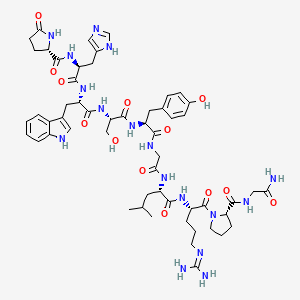
Gonadorelin is a synthetic copy of gonadotropin-releasing hormone (GnRH), also called LHRH. GnRH is a ten-amino acid hormone made in the hypothalamus that acts on the pituitary gland to release the reproductive hormones LH and FSH.5 GnRH is produced by a small population of specialized brain cells whose development and function have been studied for decades.4 Its structure was worked out in the early 1970s, work recognized with a share of the 1977 Nobel Prize in Physiology or Medicine.
Injected GnRH was first used as a diagnostic test of the pituitary's ability to release LH and FSH, and later to treat infertility and underactive gonads caused by hypothalamic problems in both men and women.7 Gonadorelin was FDA-approved for diagnostic use under the brand name Factrel, but US marketing has been discontinued.
Today, gonadorelin is most often prescribed in compounded form by men's health and testosterone replacement therapy (TRT) clinics, including telehealth services, to help preserve testicular size and function during TRT.
- Anecdotal only
- In vitro only
- Animal models only
- Preliminary human
- Clinical trials
- Regulator approved
How Gonadorelin works
The brain controls the testes and ovaries through a chain of signals. The hypothalamus releases GnRH in short bursts, the pituitary responds with LH and FSH, and those hormones tell the testes to make testosterone and sperm, or the ovaries to mature eggs. When a man takes testosterone, the brain senses high levels and turns this chain down, so the testes shrink and sperm production falls. Gonadorelin is meant to replace the missing top-level signal.
The catch is timing. The pituitary only responds properly to GnRH delivered in pulses, roughly every one to two hours in normal physiology. Constant exposure has the opposite effect: the pituitary stops responding and LH and FSH fall. That is how long-acting GnRH agonists such as leuprolide work, producing a reversible medical castration used to treat prostate and breast cancer, endometriosis and early puberty.73 Gonadorelin has a half-life of only minutes, which suits pulsatile use. Disrupting the normal GnRH pulse pattern, rather than pulsatile dosing itself, is also linked to hot flushes.1
Kisspeptin starts the cascade; gonadorelin is GnRH itself; hCG acts like LH at the testes or ovaries. Continuous GnRH agonists such as triptorelin switch the axis off rather than on.
What the research shows on Gonadorelin
The evidence for gonadorelin's established uses is solid. As a diagnostic agent, it reliably shows whether the pituitary can release LH and FSH. As a treatment, pulsatile GnRH given through a small pump that delivers a dose every one to two hours can restore puberty, sperm production and ovulation in people whose hypothalamus does not make enough GnRH.7
The evidence for the way TRT clinics use it is much weaker. Typical TRT protocols inject gonadorelin under the skin a few times a week, not every couple of hours. In theory each injection produces a short burst of LH and FSH, but it is not clear that occasional bursts are enough to maintain testicular size or sperm production in men whose own GnRH signal is suppressed by testosterone. Randomized trials showing that gonadorelin used this way preserves fertility during TRT are lacking. Human chorionic gonadotropin (hCG), which acts directly on the testes, has more supporting data for that purpose.
Research on the GnRH system has instead moved toward blocking it. Peptide and non-peptide GnRH antagonists were developed to suppress the axis without the initial hormone surge seen with agonists.5 Antagonists such as degarelix appear at least as effective as agonists in advanced prostate cancer,6 and the oral antagonist relugolix produced higher rates of sustained castration than leuprolide in a phase 3 trial, with fewer major cardiovascular events.2 In endometriosis, randomized trials found GnRH agonists as effective as danazol for pain, with side effects from low estrogen such as hot flushes and bone loss.8
Studied for: Preservation of testicular function during TRT, Hypogonadotropic hypogonadism, Fertility.
Gonadorelin reference data
| Sequence | pEHWSYGLRPG-NH2 |
|---|---|
| Molecular weight | 1,182.3 Da |
| CAS number | 33515-09-2 |
| FDA status | Evaluation of hypothalamic-pituitary-gonadal function (US marketing discontinued) |
| Prohibited in sport | Yes, under the WADA prohibited list |
Gonadorelin dosage in published research
2-3x weekly, or more frequently in fertility protocols · usually run for about 12 weeks. A reference pattern, not a prescription.
Open this in the dosage calculator ↗
How Gonadorelin is used in practice
Most gonadorelin prescribed in the US today is compounded. Clinics adopted it widely after hCG moved to regulation as a biologic in 2020, which largely ended routine pharmacy compounding of hCG. Gonadorelin is usually supplied as a powder to mix with bacteriostatic water and injected under the skin two or three times a week, sometimes more often in fertility-focused protocols. Doses and schedules vary widely between clinics, which reflects the lack of trial data rather than careful tailoring.
Clinics often monitor testosterone, estradiol and sometimes LH, and may track testicular size. Men who want to protect fertility should ask for a semen analysis rather than rely on symptoms or testicular size alone.
Because compounded products are not FDA-approved, potency and sterility depend on the pharmacy. Products from research-chemical sellers carry even fewer safeguards. Gonadorelin is prohibited in sport for men.
Gonadorelin risks and side effects
Gonadorelin is generally well tolerated. Reported side effects include injection-site reactions, headache, flushing, nausea and lightheadedness. Rare allergic reactions, including severe ones, have been reported with GnRH products.
The biggest practical risk is using it the wrong way. Dosing that is too frequent or too continuous could suppress rather than stimulate LH and FSH. Testosterone and estrogen also blunt the pituitary's response, which is part of why its benefit during TRT is uncertain. People on long-acting GnRH agonist treatment will not respond to gonadorelin.
Anyone with a hormone-sensitive cancer, such as prostate or certain breast cancers, should not use it unless a specialist directs otherwise, and it should not be used during pregnancy. Relying on gonadorelin when it is not working can also give a false sense of security about fertility.
Reported side effects
Alternatives to Gonadorelin
For men on TRT who want to keep fertility, hCG is the most commonly used and better-studied option, sometimes combined with FSH when sperm counts need restoring. Men actively trying to conceive are often advised to stop testosterone, because TRT itself suppresses sperm production. Clomiphene is sometimes used off-label to raise a man's own testosterone without suppressing fertility.
For hypothalamic causes of low reproductive hormones, specialist centers may use pulsatile GnRH pumps or gonadotropin injections. For prostate cancer, endometriosis and fibroids, where the goal is suppression, approved GnRH agonists such as leuprolide and antagonists such as relugolix are standard.2
The bottom line on Gonadorelin
Gonadorelin is a real hormone with well-proven diagnostic and pulsatile fertility uses. Its popular role as a TRT add-on rests mostly on theory, because a few injections a week do not mimic natural pulsing, and trials showing it preserves fertility are lacking. Men who care about fertility on TRT should discuss hCG and semen testing with their clinician.
Questions for a clinician
- What evidence applies to my situation, and at what level?
- What established alternatives should I consider first?
- What monitoring would be necessary, and how often?
Gonadorelin FAQ
What is Gonadorelin?
Synthetic gonadotropin-releasing hormone, increasingly used alongside TRT to maintain testicular function. It is classed as reproductive & HPTA.
Is Gonadorelin FDA approved?
Yes. Gonadorelin is FDA approved for: Evaluation of hypothalamic-pituitary-gonadal function (US marketing discontinued).
Is Gonadorelin legal in the US?
Gonadorelin is FDA approved for: Evaluation of hypothalamic-pituitary-gonadal function (US marketing discontinued). The branded US product is no longer marketed. Some clinics prescribe compounded versions; ask the prescriber which pharmacy makes it and how it is tested.
What dose of Gonadorelin is used in research?
Published research and practitioner protocols report 100-200 mcg, 2-3x weekly, or more frequently in fertility protocols, typically for 12 weeks. This is a reference range, not a recommendation; dosing should be set by a licensed clinician.
How is Gonadorelin reconstituted?
A 2 mg vial mixed with 2 mL of bacteriostatic water gives 1.0 mg/mL. At that concentration 100 mcg is 10.0 units on a 100-unit insulin syringe.
What are the side effects of Gonadorelin?
Reported side effects include injection-site reactions, headache, flushing, nausea. Contraindications: hormone-sensitive malignancy, pregnancy, known hypersensitivity.
What is the half-life of Gonadorelin?
The reported half-life of Gonadorelin is ~2-10 minutes.
Is Gonadorelin banned in sport?
Yes. Gonadorelin falls under the World Anti-Doping Agency prohibited list.
Which telehealth clinics prescribe Gonadorelin?
Clinics in our directory that list Gonadorelin include OneTwenty, Marek Health. Each is scored on our published rubric.
References
Regulatory and primary sources
- FDA: Bulk drug substances that may present significant safety risks (Category 2 and withdrawn nominations) ↗ · content current as of April 22, 2026; checked October 18, 2026
- FDA: Bulk drug substances used in compounding under section 503A ↗ · how the 503A categories work
- PubChem compound record (CID 638793) ↗ · structure, identifiers, synonyms
- DailyMed: FDA-approved labeling for Gonadorelin ↗ · indications, dosing, warnings as approved
- FDA Drugs@FDA database ↗ · approval history
- WADA Prohibited List ↗ · current year
- CAS Registry Number 33515-09-2 ↗ · chemical identity
Published literature
- The flush revisited.Eur J Obstet Gynecol Reprod Biol 1994.PubMed 7713285 · doi:10.1016/0028-2243(94)90289-5
- Relugolix in treatment of prostate cancer: a review.Arch Ital Urol Androl 2025.PubMed 41247145 · doi:10.4081/aiua.2025.14277
- GnRH and steroids in cancer.Front Biosci 2002.PubMed 12045004 · doi:10.2741/A864
- LHRH neurons: functions and development.Prog Brain Res 1992.PubMed 1480748 · doi:10.1016/s0079-6123(08)64572-0
- Non-peptidic GnRH receptor antagonists.Curr Med Chem 2004.PubMed 15544487 · doi:10.2174/0929867043363983
- Therapeutic outcomes of the LHRH antagonists.Expert Rev Pharmacoecon Outcomes Res 2017.PubMed 28870102 · doi:10.1080/14737167.2017.1375855
- GnRH agonists: gonadorelin, leuprolide and nafarelin.Am Fam Physician 1991.PubMed 1835275
- Endometriosis 1990. Current treatment approaches.Drugs 1990.PubMed 2190793 · doi:10.2165/00003495-199039040-00003
Literature retrieved from PubMed on October 16, 2026, favouring human studies and reviews. Numbered markers in the text show which paper supports which statement; uncited entries are background reading.