Is Dihexa legal?
Not FDA approved- FDA status
- Dihexa is not FDA approved and is not on FDA’s 503A bulks list.
- Compounding
- US compounding pharmacies cannot routinely prepare it.
- Prescription
- There is no approved US prescription product for Dihexa.
- Online market
- Products sold online are labelled “for research use only”: not made, tested or labelled for human use, and often mislabelled.
US status checked October 2026 against FDA’s compounding lists. Sources at the foot of the page.
What is Dihexa?
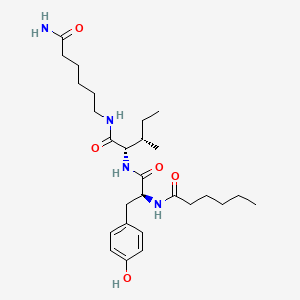
Dihexa is a small, peptide-like molecule derived from angiotensin IV, a fragment of the hormone system better known for controlling blood pressure. Its chemical name is N-hexanoic-Tyr-Ile-(6) aminohexanoic amide, and it is also listed as PNB-0408. It was developed by a research group at Washington State University as a possible treatment for Alzheimer's and Parkinson's disease.4
In animal work, the developers described it as orally active, able to cross the blood-brain barrier and able to help form new connections between nerve cells.2 Those features, plus a widely repeated claim that it is millions of times more potent than a key brain growth factor, made it popular in online nootropic communities.
Dihexa has never been tested in a published human trial. It is sold online as a research chemical for memory, focus and protection against cognitive decline, with no approved medical use anywhere.
- Anecdotal only
- In vitro only
- Animal models only
- Preliminary human
- Clinical trials
- Regulator approved
How Dihexa works
Brain cells talk to each other through connections called synapses, and losing synapses is a core feature of Alzheimer's disease. Dihexa is thought to boost a growth signal called hepatocyte growth factor, or HGF, at its receptor, c-Met. In the brain this system helps neurons grow branches and form new synapses. The idea is that strengthening it could rebuild some of the connections lost to disease.
In more detail, activating c-Met drives cell growth, cell movement, tissue shaping and the maturation of stem cells into neurons, and protects many cell types from injury. The developers reported that Dihexa stimulates this system to induce dendritic branching and synapse formation.2 The original target of angiotensin IV, called the AT4 receptor, has been disputed. One group identified it as an enzyme, insulin-regulated aminopeptidase, while the Washington State group presented evidence that the angiotensin IV system overlaps with HGF and c-Met.4 The often-quoted figure of seven orders of magnitude greater potency than BDNF comes from cell-culture assays of synapse formation, not from animal behavior or human data.
Different compounds are said to act on different systems. Most of the evidence comes from animal work and small studies, much of it from Russia.
What the research shows on Dihexa
All of the evidence comes from cells and animals. The developers' reviews describe Dihexa improving memory consolidation in animal models of Alzheimer's disease2 and improving memory and motor problems in rodent models, including models relevant to Parkinson's disease.4
An independent 2018 systematic review looked at animal studies of angiotensin IV and its analogs. Of 32 studies that met its criteria, eight of nine studies in animals with induced cognitive deficits found that angiotensin IV or an analog, including Dihexa, improved performance on spatial working memory or avoidance tasks. The authors noted that these peptides worked best when injected directly into the brain's fluid spaces close to the time of learning or testing.3 That is very different from how people take Dihexa.
A 2026 review of therapeutic peptides listed Dihexa among neuroactive compounds acting on the HGF and c-Met pathway, while stressing that clinical trials are lacking.1
Several limits stand out. Most primary studies come from one laboratory. There are no published human data on how Dihexa is absorbed, how long it lasts, what dose is safe or whether it changes cognition. A related HGF and c-Met modulator, fosgonimeton, developed by a company that grew out of this research program, did not meet its primary endpoint in a mid-stage Alzheimer's trial reported in 2024. That does not test Dihexa itself, but it shows how hard it is to turn this pathway into a working treatment.
Studied for: Cognitive research, Neurodegeneration research.
Dihexa reference data
| Molecular weight | 517.7 Da |
|---|---|
| FDA status | Not approved for any indication. |
| Prohibited in sport | Not listed |
Dihexa dosage in published research
Once daily · usually run for about 4 weeks. A reference pattern, not a prescription.
How Dihexa is used in practice
Dihexa is not prescribed by mainstream clinics, and FDA has restricted it from use in compounding. The legal status box on this page has the details. In practice it is bought from research-chemical vendors as a powder, capsules, oral solutions or skin creams.
Users usually take it by mouth or apply it to the skin, with doses taken from online forums and scaled from rodent studies. Because no human dosing data exist, every regimen is guesswork. Some users report short courses of a few weeks followed by breaks, based on the belief that new synapses persist once formed, an idea that has not been tested in people.
There is no pharmacopeial standard for Dihexa, and research-chemical products are not checked for identity, purity or dose. Buyers have no reliable way to know what they are taking.
Dihexa risks and side effects
The honest answer is that Dihexa's side effects in humans are unknown. Users report headaches and feeling overstimulated, but these reports are anecdotal.
The main theoretical concern is cancer. c-Met is a well-known cancer-related receptor, and overactive HGF and c-Met signaling helps many tumors grow, invade and spread. The same reviews that promote Dihexa describe c-Met activation as stimulating cell division and cell movement.2 A drug that boosts this pathway throughout the body, taken repeatedly by people who may have undiagnosed tumors, is a real concern rather than a remote one. People with active or suspected cancer, and anyone who is pregnant, should avoid it.
Other unknowns include effects on blood pressure, interactions with other medicines and long-term effects on the brain. Product contamination adds to these risks.
Reported side effects
Alternatives to Dihexa
Anyone worried about memory decline should start with a medical evaluation. Thyroid problems, vitamin B12 deficiency, depression, sleep apnea, medication side effects and hearing loss can all impair memory and are treatable.
For diagnosed Alzheimer's disease, approved treatments include the cholinesterase inhibitors donepezil, rivastigmine and galantamine, and memantine. For early Alzheimer's with confirmed amyloid, the antibody treatments lecanemab (Leqembi) and donanemab (Kisunla) are FDA-approved and modestly slow decline. For healthy adults, regular aerobic exercise, good sleep, blood pressure control and staying socially and mentally active have the best evidence for protecting cognition.
For people drawn to the HGF and c-Met idea specifically, the legitimate route to an experimental brain drug is a registered clinical trial. Trials provide a known product, a defined dose, safety monitoring and informed consent, none of which a research-chemical purchase offers.
The bottom line on Dihexa
Dihexa is an interesting laboratory compound with promising animal data from a small number of researchers, and nothing more. It has never been tested in people, it acts on a pathway tied to cancer growth, and products sold online are unverified. The headline potency claim comes from cell-culture work. Until human safety data exist, it is not a reasonable choice for cognitive enhancement.
Questions for a clinician
- What evidence applies to my situation, and at what level?
- What established alternatives should I consider first?
- What monitoring would be necessary, and how often?
- Can this be prescribed at all where I live, or only sold for research?
Dihexa FAQ
What is Dihexa?
An angiotensin IV derivative reported in animal work to be dramatically more potent than BDNF at promoting synaptogenesis. It is classed as nootropic & neuro.
Is Dihexa FDA approved?
No. Dihexa is not approved by the FDA for any indication. Material sold online is labelled for research use only.
Is Dihexa legal in the US?
Dihexa is not FDA approved and is not on FDA’s 503A bulks list. US compounding pharmacies cannot routinely prepare it.
What dose of Dihexa is used in research?
Published research and practitioner protocols report 8-45 mg, once daily, typically for 4 weeks. This is a reference range, not a recommendation; dosing should be set by a licensed clinician.
What are the side effects of Dihexa?
Reported side effects include headache, overstimulation, poorly characterised. Contraindications: active or suspected malignancy, pregnancy.
What is the half-life of Dihexa?
The reported half-life of Dihexa is ~10-12 hours.
Is Dihexa banned in sport?
Dihexa is not specifically named on the WADA prohibited list, but athletes should check the current list and their federation's rules.
References
Regulatory and primary sources
- FDA: Bulk drug substances that may present significant safety risks (Category 2 and withdrawn nominations) ↗ · content current as of April 22, 2026; checked October 18, 2026
- FDA: Bulk drug substances used in compounding under section 503A ↗ · how the 503A categories work
- PubChem compound record (CID 129010512) ↗ · structure, identifiers, synonyms
- FDA: Unapproved drugs and "research use only" products ↗ · regulatory status of non-approved products
Published literature
- Therapeutic Peptides in Orthopaedics: Applications, Challenges, and Future Directions.J Am Acad Orthop Surg Glob Res Rev 2026.PubMed 41490200 · doi:10.5435/JAAOSGlobal-D-25-00236
- The Brain Hepatocyte Growth Factor/c-Met Receptor System: A New Target for the Treatment of Alzheimer's Disease.J Alzheimers Dis 2015.PubMed 25649658 · doi:10.3233/JAD-142814
- Cognitive benefits of angiotensin IV and angiotensin-(1-7): A systematic review of experimental studies.Neurosci Biobehav Rev 2018.PubMed 29733881 · doi:10.1016/j.neubiorev.2018.05.005
- The development of small molecule angiotensin IV analogs to treat Alzheimer's and Parkinson's diseases.Prog Neurobiol 2015.PubMed 25455861 · doi:10.1016/j.pneurobio.2014.11.004
Literature retrieved from PubMed on October 16, 2026, favouring human studies and reviews. Numbered markers in the text show which paper supports which statement; uncited entries are background reading.