Is N-Acetyl Semax Amidate legal?
Not FDA approved- FDA status
- N-Acetyl Semax Amidate is not FDA approved and is not on FDA’s 503A bulks list.
- Compounding
- US compounding pharmacies cannot routinely prepare it.
- Prescription
- There is no approved US prescription product for N-Acetyl Semax Amidate.
- Online market
- Products sold online are labelled “for research use only”: not made, tested or labelled for human use, and often mislabelled.
US status checked October 2026 against FDA’s compounding lists. Sources at the foot of the page.
What is N-Acetyl Semax Amidate?
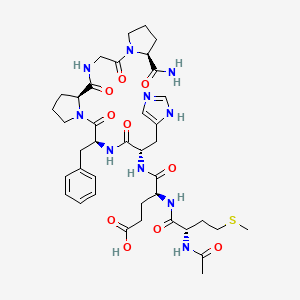
N-acetyl semax amidate, often sold as NA-Semax-Amidate or NASA, is a chemically modified version of Semax, a Russian nootropic peptide. Two small chemical caps have been added, one at each end of the molecule. Sellers claim this makes it stronger and longer lasting than the original.
To understand it you have to start with Semax. Semax was developed in the 1980s at the Institute of Molecular Genetics of the Russian Academy of Sciences. It is a seven-amino-acid peptide based on a fragment of adrenocorticotropic hormone (ACTH 4-7) with a short Pro-Gly-Pro tail added for stability. It is approved in Russia and some neighboring countries, mostly as a nasal drop for stroke and other brain conditions. It is not approved in the US or the European Union.
The N-acetyl amidate version has no such history. It appeared in the online nootropics market in the 2010s. As far as we can find, it has never been tested in a published human study, and its supposed advantages come from vendor marketing.
- Anecdotal only
- In vitro only
- Animal models only
- Preliminary human
- Clinical trials
- Regulator approved
How N-Acetyl Semax Amidate works
Semax is thought to work mainly by raising levels of brain-derived neurotrophic factor (BDNF), a protein that supports the survival of nerve cells and the formation of new connections. It also appears to affect dopamine and serotonin systems, which may explain reports of better focus and motivation. Unlike its parent hormone ACTH, it does not meaningfully stimulate cortisol release.
The two chemical caps on NA-Semax-Amidate are standard tricks in peptide chemistry. Enzymes called exopeptidases chew peptides from their ends, so capping the ends can slow breakdown. Capping can also make a molecule slightly more fat friendly, which may help it cross membranes. In theory, that could make each dose last longer.
In more detail, Semax is Met-Glu-His-Phe-Pro-Gly-Pro. NA-Semax-Amidate adds an acetyl group to the N-terminal methionine and converts the C-terminal carboxyl group to an amide. Both modifications remove charged groups and block aminopeptidase and carboxypeptidase cleavage. Whether these changes alter receptor activity, brain penetration or potency in people has not been measured. The commonly repeated claim that it is several times more potent than Semax does not trace to any published comparative study.
Different compounds are said to act on different systems. Most of the evidence comes from animal work and small studies, much of it from Russia.
What the research shows on N-Acetyl Semax Amidate
There are no published human or controlled animal studies of N-acetyl semax amidate itself. Everything below concerns the parent drug, Semax, and may not carry over to the modified version.
Clinical research on Semax comes almost entirely from Russian groups, often from the institutions that developed it. In one study of 110 patients recovering from ischemic stroke, those given Semax alongside rehabilitation had higher blood BDNF levels and better recovery scores on a daily-living scale than those who were not.4 The study was not described as blinded or placebo-controlled, and it was published in Russian. More broadly, Semax trials are generally small and open-label, and larger independent blinded trials have not appeared in English-language journals.
Animal work supports a neuroprotective effect. In rats with focal brain ischemia, Semax changed the activity of many genes, and researchers have proposed that the protein transthyretin is involved in its protective effect.5 Russian reviews describe Semax among short peptides used clinically for neuroprotection in older patients.7 International reviews list Semax among peptides that reduce oxidative stress and support synaptic plasticity in early studies of neurodegenerative disease, while noting that clinical validation is still needed.6
Lab studies have also found that Semax and related proline-containing peptides can affect blood clotting.8 What this means for people is unclear.
Studied for: Cognitive enhancement research, Focus and motivation.
N-Acetyl Semax Amidate reference data
| FDA status | Not approved for any indication. |
|---|---|
| Prohibited in sport | Not listed |
N-Acetyl Semax Amidate dosage in published research
1-2x daily intranasal · usually run for about 4 weeks. A reference pattern, not a prescription.
Open this in the dosage calculator ↗
How N-Acetyl Semax Amidate is used in practice
In the US, NA-Semax-Amidate is sold online as a research chemical, either as a ready-made nasal spray or as powder to mix. It is not FDA approved, not a recognized compounding ingredient and not prescribed by legitimate telehealth services. Users take it for focus, motivation, mood and productivity, often alongside Selank, a related Russian peptide. Some sellers also offer an N-acetyl amidate version of Selank, built on the same marketing logic and with the same lack of data.
Recent reviews written for doctors note that neuroactive peptides like Semax are described as enhancing BDNF, but that clinical trials of this group are lacking.1 For the modified version, there is no trial at all.
Product quality is a real issue. Nasal sprays from unregulated sellers may contain the wrong peptide, the wrong amount, or preservatives and contaminants that are not on the label. Peptides in solution can also degrade quickly, so a spray may lose strength long before it is used up.
N-Acetyl Semax Amidate risks and side effects
User reports describe nasal irritation, headache, overstimulation, irritability, anxiety and trouble sleeping. Some people report a crash in mood or energy after stopping. None of these has been studied properly for the modified version.
It should be avoided in pregnancy, and by people with psychosis, bipolar disorder or severe anxiety, since a stimulating effect could make these worse. It may add to the effects of stimulant medications and caffeine. Given the lab findings on clotting, people taking blood thinners should be cautious.
Because it is usually taken as a nasal spray, dosing is imprecise, and the amount reaching the brain is unknown. The largest unknown is long-term safety. Raising BDNF and changing neurotransmitter activity repeatedly over months has not been studied in healthy people.
Reported side effects
Alternatives to N-Acetyl Semax Amidate
If focus or attention is a real problem, an evaluation for ADHD, sleep disorders, depression or thyroid problems is the right first step. Approved treatments for ADHD, including methylphenidate, amphetamine salts, atomoxetine and guanfacine, have extensive trial evidence.
For general mental performance, the best-supported measures are regular sleep, aerobic exercise and moderate caffeine use. Among peptides, plain Semax at least has some published clinical work, though largely from a single country.
The bottom line on N-Acetyl Semax Amidate
N-acetyl semax amidate is a chemically reasonable tweak of Semax, but it has never been studied in published research, and claims of greater potency come from sellers. The parent drug has modest, mostly Russian evidence. Buying the modified version means trusting an unregulated product with no data behind it.
Questions for a clinician
- What evidence applies to my situation, and at what level?
- What established alternatives should I consider first?
- What monitoring would be necessary, and how often?
- Can this be prescribed at all where I live, or only sold for research?
N-Acetyl Semax Amidate FAQ
What is N-Acetyl Semax Amidate?
An acetylated and amidated Semax variant marketed as more potent and longer lasting. The potency claims are not from published human work. It is classed as nootropic & neuro.
Is N-Acetyl Semax Amidate FDA approved?
No. N-Acetyl Semax Amidate is not approved by the FDA for any indication. Material sold online is labelled for research use only.
Is N-Acetyl Semax Amidate legal in the US?
N-Acetyl Semax Amidate is not FDA approved and is not on FDA’s 503A bulks list. US compounding pharmacies cannot routinely prepare it.
What dose of N-Acetyl Semax Amidate is used in research?
Published research and practitioner protocols report 100-300 mcg, 1-2x daily intranasal, typically for 4 weeks. This is a reference range, not a recommendation; dosing should be set by a licensed clinician.
How is N-Acetyl Semax Amidate reconstituted?
A 5 mg vial mixed with 2 mL of bacteriostatic water gives 2.5 mg/mL. At that concentration 100 mcg is 4.0 units on a 100-unit insulin syringe.
What are the side effects of N-Acetyl Semax Amidate?
Reported side effects include nasal irritation, overstimulation, headache, irritability. Contraindications: pregnancy, acute psychosis, severe anxiety disorders.
What is the half-life of N-Acetyl Semax Amidate?
The reported half-life of N-Acetyl Semax Amidate is ~1-2 hours.
Is N-Acetyl Semax Amidate banned in sport?
N-Acetyl Semax Amidate is not specifically named on the WADA prohibited list, but athletes should check the current list and their federation's rules.
References
Regulatory and primary sources
- FDA: Bulk drug substances that may present significant safety risks (Category 2 and withdrawn nominations) ↗ · content current as of April 22, 2026; checked October 18, 2026
- FDA: Bulk drug substances used in compounding under section 503A ↗ · how the 503A categories work
- PubChem compound record (CID 172638603) ↗ · structure, identifiers, synonyms
- FDA: Unapproved drugs and "research use only" products ↗ · regulatory status of non-approved products
Published literature
- Therapeutic Peptides in Orthopaedics: Applications, Challenges, and Future Directions.J Am Acad Orthop Surg Glob Res Rev 2026.PubMed 41490200 · doi:10.5435/JAAOSGlobal-D-25-00236
- Pharmacological Aspects of Neuro-Immune Interactions.Curr Pharm Des 2018.PubMed 28875850 · doi:10.2174/1381612823666170829135115
- [Evolution of the stress concept].Vestn Ross Akad Med Nauk 2008.PubMed 19140465
- [The efficacy of semax in the tretament of patients at different stages of ischemic stroke].Zh Nevrol Psikhiatr Im S S Korsakova 2018.PubMed 29798983 · doi:10.17116/jnevro20181183261-68
- [POSSIBLE ROLE OF TRANSTHYRETIN IN THE BIOLOGICAL MECHANISM OF THE REGULATORY PEPTIDE NEUROPROTECTION.].Mol Gen Mikrobiol Virusol 2016.PubMed 30383932
- Modulation of neuropathological pathways by bioactive peptides and proteins/polypeptides: Targeting oxidative stress in neurodegenerative diseases.Neuropeptides 2025.PubMed 41004910 · doi:10.1016/j.npep.2025.102563
- [Neuroprotective effects of peptides bioregulators in people of various age].Adv Gerontol 2013.PubMed 24738258
- [Comparison of anticoagulant effects of regulatory proline-containing oligopeptides. Specificity of glyprolines, semax, and selank and potential of their practical application].Izv Akad Nauk Ser Biol 2006.PubMed 16634437
Literature retrieved from PubMed on October 16, 2026, favouring human studies and reviews. Numbered markers in the text show which paper supports which statement; uncited entries are background reading.