Is SS-31 legal?
FDA approved- FDA status
- SS-31 is FDA approved for: Barth syndrome, to improve muscle strength in patients weighing at least 30 kg (Forzinity, accelerated approval September 2025).
- Compounding
- It is a prescription medicine. Use outside the approved indication is off-label and a clinician’s decision. Compounded copies are restricted when the approved product is available.
- Prescription
- A licensed US clinician can prescribe SS-31.
US status checked October 2026 against FDA’s compounding lists. Sources at the foot of the page.
What is SS-31?
SS-31 is a small synthetic peptide, four amino acids long, that targets mitochondria, the structures inside cells that produce most of their energy. Its drug name is elamipretide, and it has also been known as Bendavia and MTP-131. The name SS-31 comes from the Szeto-Schiller family of mitochondria-targeting peptides developed by researchers Hazel Szeto and Peter Schiller. Stealth BioTherapeutics has led its clinical development.
In September 2025, elamipretide received FDA accelerated approval as Forzinity, to improve muscle strength in adults and children weighing at least 30 kg who have Barth syndrome2. Barth syndrome is an ultra-rare inherited disorder that affects the heart, muscles and immune system, and elamipretide is the first treatment approved specifically for it2. It is also in late-stage trials for dry age-related macular degeneration and mitochondrial myopathies2. Separately, SS-31 is sold online as a research peptide and promoted for energy, endurance and healthy aging.
- Anecdotal only
- In vitro only
- Animal models only
- Preliminary human
- Clinical trials
- Regulator approved
How SS-31 works
Mitochondria make energy using a chain of proteins embedded in their inner membrane. That membrane is folded into ridges, called cristae, and its shape depends on a fat molecule called cardiolipin. When cardiolipin is damaged, the energy-making machinery works poorly and leaks harmful molecules known as reactive oxygen species. SS-31 travels into cells, collects on the inner mitochondrial membrane, and sticks to cardiolipin. The idea is that it helps hold the membrane and its machinery in shape, so mitochondria make energy more efficiently and produce less oxidative damage at the source.
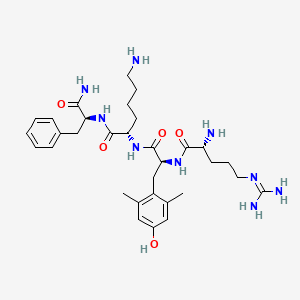
In more detail, elamipretide (D-Arg-dimethylTyr-Lys-Phe-NH2) has alternating aromatic and basic residues that give it a positive charge and allow it to cross cell membranes and concentrate in the inner mitochondrial membrane independently of membrane potential. It selectively binds cardiolipin, stabilizing cristae structure, reducing oxidative stress and enhancing ATP production5. In heart failure research it is described as stabilizing the cardiolipin-cytochrome c supercomplex3. Barth syndrome is caused by mutations in the TAZ gene that disrupt cardiolipin remodeling, which makes it a logical target for a cardiolipin-binding drug.
These compounds target the cell’s energy machinery at different points: the inner mitochondrial membrane, the AMPK energy sensor, or NAD+ metabolism.
What the research shows on SS-31
Preclinical evidence is broad. Animal and cell studies report benefits in models of heart failure, neurodegeneration, ischemia-reperfusion injury, metabolic disease and muscle weakness5. In dogs with heart failure it increased ejection fraction, and in rats it prevented harmful heart remodeling3. It has also been studied as a candidate for macular degeneration1 and kidney disease driven by mitochondrial dysfunction6.
Human results have been more mixed. Early phase I and II trials in primary mitochondrial myopathy suggested safety and improvements in six-minute walk distance and fatigue8. The larger phase III trial in that condition, MMPOWER-3, did not meet its primary endpoints. In Barth syndrome, the randomized TAZPOWER trial was small and its primary endpoints in the placebo-controlled phase were not met, but patients in the longer open-label extension showed improvements in function and strength. The accelerated approval is tied to improvement in muscle strength, and under that pathway continued approval depends on confirmatory evidence.
In early heart failure trials, elamipretide caused no severe adverse events and showed hemodynamic improvements only at the highest doses, and the authors called for more studies of long-term safety and efficacy3. Clinical programs described in reviews include PROGRESS-HF in heart failure and ReCLAIM in eye disease5. For dry macular degeneration, a subcutaneous elamipretide program has advanced to phase 34. There are no trials showing benefit in healthy people, athletes or normal aging.
Studied for: Primary mitochondrial myopathy, Barth syndrome, Age-related muscle decline research.
SS-31 reference data
| Sequence | D-Arg-Dmt-Lys-Phe-NH2 |
|---|---|
| Molecular weight | 639.8 Da |
| CAS number | 736992-21-5 |
| FDA status | Barth syndrome, to improve muscle strength in patients weighing at least 30 kg (Forzinity, accelerated approval September 2025) |
| Prohibited in sport | Not listed |
SS-31 dosage in published research
Once daily · usually run for about 12 weeks. A reference pattern, not a prescription.
Open this in the dosage calculator ↗
How SS-31 is used in practice
As Forzinity, elamipretide is a once-daily subcutaneous injection prescribed by specialists for people with Barth syndrome who meet the weight threshold. Smaller children with Barth syndrome fall outside the current label because of the 30 kg threshold. It is not a general-purpose mitochondrial supplement.
Outside that setting, SS-31 is sold by research-peptide vendors and some longevity and sports clinics, often promoted for energy, endurance or recovery and sometimes paired with MOTS-c. A 2026 sports medicine review included SS-31 among peptides marketed directly to patients through a gray market, noting that rigorous human safety data for such uses are scarce7. Gray-market products are not made to pharmaceutical standards, and purity, dose and sterility are unverified. Doses used by consumers are often copied from trial protocols without the monitoring those trials included.
SS-31 risks and side effects
Injection-site reactions are the most common side effect in clinical trials and can include redness, itching, pain and swelling at the injection site. Headache, nausea and dizziness have also been reported. Overall the drug was generally well tolerated in trials, with no major safety signal in early heart failure studies3.
Important unknowns remain. Long-term safety data are limited, especially outside Barth syndrome and in children. Because it is a daily injection, injection-site tolerance can limit long-term use for some people. Drug interactions are poorly characterized. There are no adequate data in pregnancy. For healthy people, the risk-benefit balance is unknown because no benefit has been shown. Gray-market products add risks of contamination, infection at the injection site and wrong dosing.
Reported side effects
Alternatives to SS-31
For Barth syndrome, elamipretide is now the only disease-specific treatment, used alongside standard heart failure care, management of neutropenia, nutrition and physical therapy. For primary mitochondrial myopathies, there is no approved disease-modifying drug for most forms; care relies on exercise programs, physical therapy and supplements such as coenzyme Q10, which have limited evidence.
For dry macular degeneration with geographic atrophy, pegcetacoplan (Syfovre) and avacincaptad pegol (Izervay) are FDA approved, and AREDS2 supplements are recommended for some intermediate disease. For general energy and healthy aging, regular aerobic and resistance exercise is the best-proven way to improve mitochondrial function.
The bottom line on SS-31
SS-31 is a serious drug with a distinctive mechanism and, since 2025, an FDA approval for Barth syndrome. Its broader trials have been mixed, and there is no evidence it helps healthy people. For anyone without a qualifying diagnosis, research-grade SS-31 offers unproven benefit with unverified product quality.
Questions for a clinician
- What evidence applies to my situation, and at what level?
- What established alternatives should I consider first?
- What monitoring would be necessary, and how often?
SS-31 FAQ
What is SS-31?
A cardiolipin-binding tetrapeptide that has been through multiple phase III trials in mitochondrial disease. It is classed as mitochondrial & longevity.
Is SS-31 FDA approved?
Yes. SS-31 is FDA approved for: Barth syndrome, to improve muscle strength in patients weighing at least 30 kg (Forzinity, accelerated approval September 2025).
Is SS-31 legal in the US?
SS-31 is FDA approved for: Barth syndrome, to improve muscle strength in patients weighing at least 30 kg (Forzinity, accelerated approval September 2025). It is a prescription medicine. Use outside the approved indication is off-label and a clinician’s decision. Compounded copies are restricted when the approved product is available.
What dose of SS-31 is used in research?
Published research and practitioner protocols report 40-60 mg, once daily, typically for 12 weeks. This is a reference range, not a recommendation; dosing should be set by a licensed clinician.
How is SS-31 reconstituted?
A 50 mg vial mixed with 2 mL of bacteriostatic water gives 25.0 mg/mL. At that concentration 40 mg is 160.0 units on a 100-unit insulin syringe.
What are the side effects of SS-31?
Reported side effects include injection-site reactions, headache, nausea, dizziness. Contraindications: pregnancy, known hypersensitivity.
What is the half-life of SS-31?
The reported half-life of SS-31 is ~2-4 hours.
Is SS-31 banned in sport?
SS-31 is not specifically named on the WADA prohibited list, but athletes should check the current list and their federation's rules.
References
Regulatory and primary sources
- FDA: Bulk drug substances that may present significant safety risks (Category 2 and withdrawn nominations) ↗ · content current as of April 22, 2026; checked October 18, 2026
- FDA: Bulk drug substances used in compounding under section 503A ↗ · how the 503A categories work
- PubChem compound record (CID 11764719) ↗ · structure, identifiers, synonyms
- DailyMed: FDA-approved labeling for SS-31 ↗ · indications, dosing, warnings as approved
- FDA Drugs@FDA database ↗ · approval history
- CAS Registry Number 736992-21-5 ↗ · chemical identity
Published literature
- Potential Therapeutic Candidates for Age-Related Macular Degeneration (AMD).Cells 2021.PubMed 34572131 · doi:10.3390/cells10092483
- Elamipretide: First Approval.Drugs 2026.PubMed 41335372 · doi:10.1007/s40265-025-02269-8
- Targeting mitochondrial dysfunction with elamipretide.Heart Fail Rev 2022.PubMed 35037146 · doi:10.1007/s10741-021-10199-2
- Beyond the injection: delivery systems reshaping retinal disease management.Expert Opin Pharmacother 2025.PubMed 40319468 · doi:10.1080/14656566.2025.2496424
- Elamipretide: A Review of Its Structure, Mechanism of Action, and Therapeutic Potential.Int J Mol Sci 2025.PubMed 39940712 · doi:10.3390/ijms26030944
- Mitochondrial Dysfunction: The Silent Catalyst of Kidney Disease Progression.Cells 2025.PubMed 40497970 · doi:10.3390/cells14110794
- Safety and Efficacy of Approved and Unapproved Peptide Therapies for Musculoskeletal Injuries and Athletic Performance.Sports Med 2026.PubMed 41966639 · doi:10.1007/s40279-026-02437-0
- Advances in primary mitochondrial myopathies.Curr Opin Neurol 2019.PubMed 31408013 · doi:10.1097/WCO.0000000000000743
Literature retrieved from PubMed on October 16, 2026, favouring human studies and reviews. Numbered markers in the text show which paper supports which statement; uncited entries are background reading.