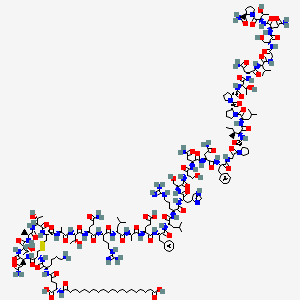
Is Cagrilintide legal?
Investigational- FDA status
- Cagrilintide is in clinical trials and is not FDA approved for any use.
- Compounding
- It cannot be legally prescribed or compounded outside a clinical trial. Products sold online under this name are unapproved and unverified.
- Prescription
- There is no approved US prescription product for Cagrilintide.
- Online market
- Products sold online are labelled “for research use only”: not made, tested or labelled for human use, and often mislabelled.
US status checked October 2026 against FDA’s compounding lists. Sources at the foot of the page.
What is Cagrilintide?
Cagrilintide is a long-acting, injectable version of amylin, a hormone the pancreas releases alongside insulin after meals. It was developed by Novo Nordisk as a once-weekly weight-loss treatment.6
It is best known as half of CagriSema, a combination of cagrilintide and semaglutide, the active ingredient in Wegovy and Ozempic. Most of its development has focused on that pairing rather than on cagrilintide alone. The combination has completed large phase 3 trials in adults with overweight or obesity, with and without type 2 diabetes.23
Cagrilintide on its own is not an approved medicine. It is sometimes sold online as a research peptide, either alone or premixed with semaglutide, and it has drawn interest from people already using GLP-1 drugs.
Amylin drugs are not new. Pramlintide, a short-acting amylin analog, has been used in diabetes care for years, but it must be injected before meals several times a day. Cagrilintide's main advance is a fatty-acid side chain that lets it last long enough for once-weekly dosing.
- Anecdotal only
- In vitro only
- Animal models only
- Preliminary human
- Clinical trials
- Regulator approved
How Cagrilintide works
After you eat, your pancreas releases amylin along with insulin.4 Amylin tells the brain you are full, slows how fast food leaves the stomach and dampens the release of glucagon, a hormone that raises blood sugar. Natural amylin lasts only minutes. Cagrilintide is built to last about a week, so a single weekly injection keeps those fullness signals active.
Technically, cagrilintide is an acylated amylin analog that acts at amylin receptors and at calcitonin receptors, which is why it is described as a dual amylin and calcitonin receptor agonist. Amylin acts on brain regions involved in both homeostatic and reward-driven eating, a pathway distinct from the one GLP-1 drugs use.4 That distinction is the rationale for combining it with semaglutide: two different satiety signals, potentially adding up. Amylin-based agents are now one of several strategies being layered onto GLP-1 therapy.8
GLP-1 drugs copy a gut hormone that the body breaks down within minutes; the drugs are modified to last hours or days. Dual and triple agonists add GIP and glucagon receptors.
What the research shows on Cagrilintide
Cagrilintide has a strong, if mostly industry-funded, human evidence base. All of the key trials below were funded by Novo Nordisk.
As a standalone drug, the main evidence is a 26-week phase 2 dose-finding trial in 706 adults with overweight or obesity and no diabetes. Weight loss ranged from 6.0% to 10.8% across cagrilintide doses, versus 3.0% with placebo. The highest dose, 4.5 mg, produced more weight loss than liraglutide 3.0 mg, at 10.8% versus 9.0%.6
In combination, the evidence is larger. In REDEFINE 1, 3,417 adults with overweight or obesity were randomized. After 68 weeks, average weight loss was 20.4% with cagrilintide-semaglutide versus 3.0% with placebo.2 In REDEFINE 2, which enrolled 1,206 adults with obesity and type 2 diabetes, weight loss was 13.7% with the combination versus 3.4% with placebo, and 73.5% of treated participants reached an HbA1c of 6.5% or lower.3
An earlier phase 2 trial in type 2 diabetes compared the combination with each drug alone over 32 weeks. Weight loss was 15.6% with CagriSema, 8.1% with cagrilintide and 5.1% with semaglutide. The combination improved HbA1c more than cagrilintide alone but not significantly more than semaglutide alone.7 A 2024 network meta-analysis of GLP-1-based drugs in type 2 diabetes ranked CagriSema highest for weight loss among the treatments compared.1
The limits are mainly about duration and independence. Trials ran for up to 68 weeks, all were sponsored by the manufacturer, and long-term cardiovascular outcome data are still being collected.
Studied for: Investigational obesity treatment (usually combined with semaglutide).
Cagrilintide reference data
| FDA status | Not approved for any indication. |
|---|---|
| Prohibited in sport | Not listed |
Cagrilintide dosage in published research
Once weekly (trial protocols). A reference pattern, not a prescription.
How Cagrilintide is used in practice
In trials, cagrilintide was injected under the skin once weekly, with the dose increased step by step over several weeks to limit nausea.6 In REDEFINE 2, the target dose was 2.4 mg of each drug.3
Outside trials, cagrilintide is not available as an approved prescription drug, and it is not a standard compounding ingredient. Products sold online as "cagrilintide" or premixed "CagriSema" are research-chemical products. They have no regulatory oversight, and long-acting acylated peptides are complex to manufacture. Purity, actual dose and sterility cannot be verified, and the dose-escalation schedules used in trials are hard to replicate safely with unverified vials.
Telehealth weight-loss services in the US prescribe approved GLP-1 drugs and, in some cases, compounded versions. Cagrilintide is not part of that legitimate supply chain, and a service offering it should be viewed with caution.
Reviews of obesity treatment expect amylin-based combinations to reach weight loss in the range achieved by the most effective current drugs, which explains the interest.5
Cagrilintide risks and side effects
The main side effects are gastrointestinal. In the phase 2 standalone trial, gastrointestinal adverse events affected 41% to 63% of people on cagrilintide versus 32% on placebo, mostly nausea, along with constipation, diarrhea and injection-site reactions.6 In REDEFINE 1, gastrointestinal events affected 79.6% on the combination versus 39.9% on placebo, and most were transient and mild to moderate.2
Because amylin slows stomach emptying, cagrilintide can change how quickly oral medicines are absorbed. Combining it with a GLP-1 drug adds to both the benefit and the gastrointestinal burden. As with GLP-1 drugs, people with a history of pancreatitis or severe gastrointestinal disease, and those who are pregnant or planning pregnancy, need specific medical guidance.
Using gray-market cagrilintide alongside a prescribed GLP-1 drug, without medical supervision, combines unverified products with additive effects on appetite, hydration and blood sugar. Rapid weight loss itself carries risks such as gallstones and loss of muscle along with fat, which is why trials paired treatment with diet and activity advice.
Reported side effects
Alternatives to Cagrilintide
FDA-approved weight-loss medicines include semaglutide (Wegovy), tirzepatide (Zepbound) and liraglutide (Saxenda), along with older options such as phentermine-topiramate (Qsymia) and naltrexone-bupropion (Contrave). Tirzepatide currently produces some of the largest average weight loss among approved drugs.5
Pramlintide (Symlin), an older, short-acting amylin analog, is approved for diabetes in people who use mealtime insulin, though not for weight loss. Several other next-generation drugs, including amylin-based agents and triple agonists such as retatrutide, are in development.8
The bottom line on Cagrilintide
Cagrilintide is a well-studied investigational drug with solid trial evidence, especially in combination with semaglutide, where weight loss is among the largest seen with medicines. It is not approved on its own, and gray-market versions are unverified. The sensible route is an approved GLP-1 drug now, or a regulated cagrilintide product if one becomes available.
Questions for a clinician
- What evidence applies to my situation, and at what level?
- What established alternatives should I consider first?
- What monitoring would be necessary, and how often?
- Can this be prescribed at all where I live, or only sold for research?
Cagrilintide FAQ
What is Cagrilintide?
A long-acting amylin analog developed primarily as a combination partner for semaglutide rather than as a standalone agent. It is classed as GLP-1 & incretins.
Is Cagrilintide FDA approved?
No. Cagrilintide is not approved by the FDA for any indication. Material sold online is labelled for research use only.
Is Cagrilintide legal in the US?
Cagrilintide is in clinical trials and is not FDA approved for any use. It cannot be legally prescribed or compounded outside a clinical trial. Products sold online under this name are unapproved and unverified.
What dose of Cagrilintide is used in research?
Published research and practitioner protocols report 300 mcg - 2.4 mg, once weekly (trial protocols). This is a reference range, not a recommendation; dosing should be set by a licensed clinician.
What are the side effects of Cagrilintide?
Reported side effects include nausea, vomiting, decreased appetite, injection-site reactions. Contraindications: pregnancy, known hypersensitivity.
What is the half-life of Cagrilintide?
The reported half-life of Cagrilintide is ~7-8 days.
Is Cagrilintide banned in sport?
Cagrilintide is not specifically named on the WADA prohibited list, but athletes should check the current list and their federation's rules.
References
Regulatory and primary sources
- FDA: Bulk drug substances that may present significant safety risks (Category 2 and withdrawn nominations) ↗ · content current as of April 22, 2026; checked October 18, 2026
- FDA: Bulk drug substances used in compounding under section 503A ↗ · how the 503A categories work
- PubChem compound record (CID 171397054) ↗ · structure, identifiers, synonyms
- FDA: Unapproved drugs and "research use only" products ↗ · regulatory status of non-approved products
Published literature
- Comparative effectiveness of GLP-1 receptor agonists on glycaemic control, body weight, and lipid profile for type 2 diabetes: systematic review and network meta-analysis.BMJ 2024.PubMed 38286487 · doi:10.1136/bmj-2023-076410
- Coadministered Cagrilintide and Semaglutide in Adults with Overweight or Obesity.N Engl J Med 2025.PubMed 40544433 · doi:10.1056/NEJMoa2502081
- Cagrilintide-Semaglutide in Adults with Overweight or Obesity and Type 2 Diabetes.N Engl J Med 2025.PubMed 40544432 · doi:10.1056/NEJMoa2502082
- Amylin, Another Important Neuroendocrine Hormone for the Treatment of Diabesity.Int J Mol Sci 2024.PubMed 38338796 · doi:10.3390/ijms25031517
- Weight management treatment in obesity.Med Clin (Barc) 2025.PubMed 40865172 · doi:10.1016/j.medcli.2025.107152
- Once-weekly cagrilintide for weight management in people with overweight and obesity: a multicentre, randomised, double-blind, placebo-controlled and active-controlled, dose-finding phase 2 trial.Lancet 2021.PubMed 34798060 · doi:10.1016/S0140-6736(21)01751-7
- Efficacy and safety of co-administered once-weekly cagrilintide 2·4 mg with once-weekly semaglutide 2·4 mg in type 2 diabetes: a multicentre, randomised, double-blind, active-controlled, phase 2 trial.Lancet 2023.PubMed 37364590 · doi:10.1016/S0140-6736(23)01163-7
- Novel GLP-1-based Medications for Type 2 Diabetes and Obesity.Endocr Rev 2026.PubMed 41054801 · doi:10.1210/endrev/bnaf036
Literature retrieved from PubMed on October 16, 2026, favouring human studies and reviews. Numbered markers in the text show which paper supports which statement; uncited entries are background reading.