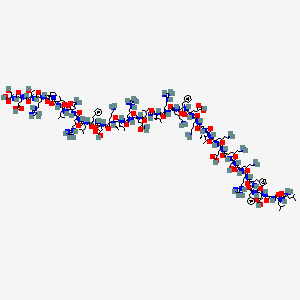
Is LL-37 legal?
Not approved · not compoundable- FDA status
- LL-37 is not FDA approved. It was moved off FDA’s Category 2 safety-risk list in 2026 after its nomination was withdrawn, but it was not added to the 503A bulks list.
- Compounding
- That leaves no routine legal path for a US compounding pharmacy to prepare it.
- Prescription
- There is no approved US prescription product for LL-37.
- Online market
- Products sold online are labelled “for research use only”: not made, tested or labelled for human use, and often mislabelled.
US status checked October 2026 against FDA’s compounding lists. Sources at the foot of the page.
What is LL-37?
LL-37 is a natural antimicrobial peptide made by the human body. It is the only member of the cathelicidin family in humans. Its name comes from its structure: it is 37 amino acids long and begins with two leucines (L). It is cut from a larger precursor protein called hCAP18, which is made by white blood cells called neutrophils and by cells lining the skin, gut and airways. The precursor was described in the mid-1990s.
LL-37 is part of the body's first line of defense against infection.8 It is not an approved drug. Small early-phase trials have tested it applied to chronic leg ulcers, but it is not approved for that or any other use. Online it is sold as a research chemical and marketed for immune support, chronic infections, biofilms and wound healing.
- Anecdotal only
- In vitro only
- Animal models only
- Preliminary human
- Clinical trials
- Regulator approved
How LL-37 works
LL-37 does two different jobs. First, it kills microbes directly. It carries a positive charge and is attracted to the negatively charged outer surfaces of bacteria, where it punches holes in their membranes. Second, it acts as a messenger for the immune system. It calls in immune cells, changes how cells respond to bacterial fragments and influences wound repair.
At first, scientists studied cathelicidins mainly for their killing power. Today their immune-signaling roles are seen as just as important.7 That second role is where things get complicated, because the same signals that help fight infection can also drive unwanted inflammation.
In more precise terms, LL-37 is an amphipathic, cationic alpha-helical peptide. It binds bacterial lipopolysaccharide and other microbial molecules, and it changes how Toll-like receptors detect them. For lipid ligands such as LPS it tends to dampen signaling, while for nucleic acids such as self-DNA and RNA it can enhance it.7 Its production is switched on by vitamin D. In immune cells, active vitamin D directly induces the gene for LL-37, which is a key part of antibacterial and antiviral defense.2
Repair peptides are said to act on blood-vessel growth and cell migration in the proliferation stage. Most of that evidence comes from animal studies.
What the research shows on LL-37
Most of what is known about LL-37 comes from studying the body's own peptide in health and disease, not from giving it as a treatment.
Its protective role is well supported. LL-37 is one of the key antimicrobial molecules in the layered defenses of the skin.8 In the lungs of people with cystic fibrosis, neutrophils release LL-37 as part of the response to infection, but Pseudomonas aeruginosa can resist these defenses.3 In people with eczema who develop a severe skin herpes infection called eczema herpeticum, levels of LL-37 and other antimicrobial peptides are reduced.6
Its harmful role is just as well supported. In rosacea, increased cathelicidin in the skin is one of the drivers of inflammation.1 Recent work describes a TLR2, LL-37 and mTORC1 signaling axis as a core pathway in the disease.4 In psoriasis, LL-37 released from neutrophils binds the body's own DNA, which helps activate immune cells and the IL-17 pathway that drives the disease.5 Reviews link cathelicidins to worse inflammation in autoimmune conditions more broadly.7
As a treatment, the evidence is thin. Small trials of topical LL-37 in chronic leg ulcers exist, but no large trial has shown benefit, and there are no human trials of injected LL-37 for immune support, chronic infection or biofilms. Vitamin D is sometimes promoted as a natural way to raise LL-37. Low vitamin D status is associated with greater susceptibility to viral infections,2 but an association is not proof that supplements prevent infection in people with normal levels. Lab studies showing that LL-37 kills bacteria in a dish do not show that injecting it clears an infection in the body.
Studied for: Antimicrobial research, Biofilm research, Wound healing.
LL-37 reference data
| Molecular weight | 4,493.3 Da |
|---|---|
| CAS number | 154947-66-7 |
| FDA status | Not approved for any indication. |
| Prohibited in sport | Not listed |
LL-37 dosage in published research
Once daily, short courses · usually run for about 2 weeks. A reference pattern, not a prescription.
Open this in the dosage calculator ↗
How LL-37 is used in practice
LL-37 has no approved medical use. Some integrative and functional medicine clinics have offered it, usually as a short course of injections under the skin, for chronic infections, Lyme-related symptoms, mold illness or recurring infections. These uses are not supported by clinical trials. It is sometimes pitched as an alternative to antibiotics, which it is not. Compounding access is restricted because of FDA concerns about bulk peptides.
Most LL-37 is bought online as "research use only" powder. It is a fairly long peptide that is harder to make cleanly than short ones, and online products are not made to pharmaceutical standards. Buyers cannot verify identity, purity, sterility or contamination with bacterial toxins. Any injected product with bacterial endotoxin can itself trigger fever and inflammation.
LL-37 risks and side effects
Reported side effects include redness and inflammation at the injection site, flu-like symptoms and flushing. These fit with LL-37's role as an immune signal.
The main concern is that more LL-37 may worsen certain diseases. Because it drives inflammation in rosacea and psoriasis,15 people with those conditions, or with other autoimmune or inflammatory skin diseases, should avoid it. Its effects on autoimmune disease more generally are a reasonable concern.7 At high concentrations in the lab, LL-37 can also damage human cells, not just bacteria.
There are no data on long-term use, safe doses or interactions. It should not be used in pregnancy. Using an unproven peptide in place of proper diagnosis and antibiotics for a real infection can let that infection progress.
Reported side effects
Alternatives to LL-37
For bacterial infections, the right antibiotic, chosen with cultures when possible, remains the standard. Chronic or biofilm-related infections, such as those around implants or in chronic wounds, usually need specialist care, which may include surgical cleaning or device removal along with targeted antibiotics.
For chronic wounds, proven measures include compression for venous ulcers, offloading for diabetic foot ulcers, debridement and infection control. Becaplermin (Regranex) is an FDA-approved growth factor gel for certain diabetic foot ulcers. For people with low vitamin D, correcting the deficiency supports the body's own LL-37 production,2 although supplements are not a cure for infection.
The bottom line on LL-37
LL-37 is a genuinely important part of human immunity, and research on it is active. But it cuts both ways, driving inflammation in rosacea and psoriasis as well as fighting microbes. There is no good human evidence for injecting it, and grey-market products are of unknown quality. It remains a research molecule.
Questions for a clinician
- What evidence applies to my situation, and at what level?
- What established alternatives should I consider first?
- What monitoring would be necessary, and how often?
- Can this be prescribed at all where I live, or only sold for research?
LL-37 FAQ
What is LL-37?
The only human cathelicidin antimicrobial peptide, with broad antibacterial activity and a complicated immunomodulatory profile. It is classed as healing & repair.
Is LL-37 FDA approved?
No. LL-37 is not approved by the FDA for any indication. Material sold online is labelled for research use only.
Is LL-37 legal in the US?
LL-37 is not FDA approved. It was moved off FDA’s Category 2 safety-risk list in 2026 after its nomination was withdrawn, but it was not added to the 503A bulks list. That leaves no routine legal path for a US compounding pharmacy to prepare it.
What dose of LL-37 is used in research?
Published research and practitioner protocols report 100-500 mcg, once daily, short courses, typically for 2 weeks. This is a reference range, not a recommendation; dosing should be set by a licensed clinician.
How is LL-37 reconstituted?
A 5 mg vial mixed with 2 mL of bacteriostatic water gives 2.5 mg/mL. At that concentration 100 mcg is 4.0 units on a 100-unit insulin syringe.
What are the side effects of LL-37?
Reported side effects include injection-site inflammation, flu-like symptoms, flushing. Contraindications: autoimmune inflammatory skin disease, pregnancy.
What is the half-life of LL-37?
The reported half-life of LL-37 is ~1 hour.
Is LL-37 banned in sport?
LL-37 is not specifically named on the WADA prohibited list, but athletes should check the current list and their federation's rules.
References
Regulatory and primary sources
- FDA: Bulk drug substances that may present significant safety risks (Category 2 and withdrawn nominations) ↗ · content current as of April 22, 2026; checked October 18, 2026
- FDA: Bulk drug substances used in compounding under section 503A ↗ · how the 503A categories work
- PubChem compound record (CID 16198951) ↗ · structure, identifiers, synonyms
- FDA: Unapproved drugs and "research use only" products ↗ · regulatory status of non-approved products
- CAS Registry Number 154947-66-7 ↗ · chemical identity
Published literature
- Rosacea Pathogenesis.Dermatol Clin 2018.PubMed 29499802 · doi:10.1016/j.det.2017.11.001
- Vitamin D, infections and immunity.Rev Endocr Metab Disord 2022.PubMed 34322844 · doi:10.1007/s11154-021-09679-5
- Cystic Fibrosis and Pseudomonas aeruginosa: the Host-Microbe Interface.Clin Microbiol Rev 2019.PubMed 31142499 · doi:10.1128/CMR.00138-18
- Advances in the pathogenesis of rosacea.Front Immunol 2025.PubMed 41646975 · doi:10.3389/fimmu.2025.1705588
- Psoriasis and Antimicrobial Peptides.Int J Mol Sci 2020.PubMed 32947991 · doi:10.3390/ijms21186791
- Eczema herpeticum in atopic dermatitis.Allergy 2021.PubMed 33844308 · doi:10.1111/all.14853
- Cathelicidins Modulate TLR-Activation and Inflammation.Front Immunol 2020.PubMed 32582207 · doi:10.3389/fimmu.2020.01137
- Architecture of antimicrobial skin defense.Cytokine Growth Factor Rev 2019.PubMed 31473081 · doi:10.1016/j.cytogfr.2019.08.001
Literature retrieved from PubMed on October 16, 2026, favouring human studies and reviews. Numbered markers in the text show which paper supports which statement; uncited entries are background reading.