Is Pentosan Polysulfate legal?
FDA approved- FDA status
- Pentosan Polysulfate is FDA approved for: Bladder pain or discomfort associated with interstitial cystitis (Elmiron).
- Compounding
- It is a prescription medicine. Use outside the approved indication is off-label and a clinician’s decision. Compounded copies are restricted when the approved product is available.
- Prescription
- A licensed US clinician can prescribe Pentosan Polysulfate.
US status checked October 2026 against FDA’s compounding lists. Sources at the foot of the page.
What is Pentosan Polysulfate?
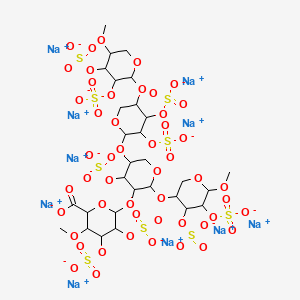
Pentosan polysulfate sodium, often shortened to PPS, is a prescription drug for bladder pain. It is sold in the US as Elmiron, an oral capsule. It is not a peptide. It is a semi-synthetic sugar chain, made from beech tree material and chemically modified with sulfate groups, that resembles the protective molecules lining the bladder.
The FDA approved Elmiron in 1996 to relieve bladder pain or discomfort in interstitial cystitis, a chronic condition now often called interstitial cystitis/bladder pain syndrome (IC/BPS). For many years it was the only FDA-approved oral therapy for the condition.1
PPS also has a second life outside the bladder. An injectable form has long been used in veterinary medicine for arthritis in dogs and horses, and injectable PPS is being studied in people with knee osteoarthritis. That is why it sometimes shows up in discussions of joint-repair compounds.
- Anecdotal only
- In vitro only
- Animal models only
- Preliminary human
- Clinical trials
- Regulator approved
How Pentosan Polysulfate works
The inner lining of the bladder is coated with a layer of sugar-based molecules called glycosaminoglycans, or GAGs. This layer keeps irritating substances in urine, such as potassium, away from the bladder wall. In some people with interstitial cystitis the layer appears to be damaged or leaky. PPS is thought to work by sticking to the bladder lining and patching that layer. Only a small fraction of each oral dose ends up in the urine, which is one reason it takes months to work.
PPS also thins the blood slightly, a bit like a much weaker version of heparin, and it has anti-inflammatory effects.
In more precise terms, PPS is a mixture of sulfated xylan polysaccharides with an average molecular weight around 4,000 to 6,000 daltons. Its structure resembles heparin and other sulfated GAGs. Oral bioavailability is very low, and the drug is excreted partly in urine, where it is believed to adsorb to the urothelial mucosa. In joint tissue, laboratory and animal studies suggest it inhibits cartilage-degrading enzymes, reduces inflammatory signaling and improves blood flow in subchondral bone, the basis for its use in osteoarthritis research.
Repair peptides are said to act on blood-vessel growth and cell migration in the proliferation stage. Most of that evidence comes from animal studies.
What the research shows on Pentosan Polysulfate
PPS was approved on the basis of placebo-controlled trials in the 1980s and 1990s showing that a modest share of patients reported meaningful improvement in pain after about three months, more than with placebo. The benefit was real but limited, and many patients did not respond. A later large, multicenter placebo-controlled trial did not find a significant difference from placebo, which raised further doubts about how much it helps. Trials in this condition are hard to run. Symptoms rise and fall on their own, placebo responses are high, and there is no objective test to confirm improvement.
The most important research of the past decade concerns safety. Starting in 2018, eye specialists described a distinctive, vision-threatening maculopathy in long-term PPS users. A 2022 review of all published reports found a strong, dose-dependent association between PPS exposure and damage to the retinal pigment epithelium. The damage may keep worsening after the drug is stopped. Early symptoms include slow adjustment to darkness and difficulty reading.1
For osteoarthritis, injectable PPS is listed among new therapeutic strategies under study, alongside nerve growth factor antagonists, stem cells and other disease-modifying candidates.2 Smaller earlier trials reported improvements in knee pain, and larger trials have been under way. It is not approved for osteoarthritis in humans in the US.
Studied for: Interstitial cystitis, Bladder pain syndrome, Osteoarthritis research.
Pentosan Polysulfate reference data
| Molecular weight | 4,000 Da |
|---|---|
| CAS number | 116001-96-8 |
| FDA status | Bladder pain or discomfort associated with interstitial cystitis (Elmiron) |
| Prohibited in sport | Not listed |
Pentosan Polysulfate dosage in published research
3x daily (oral, approved use). A reference pattern, not a prescription.
How Pentosan Polysulfate is used in practice
Elmiron is prescribed by urologists, gynecologists and primary care doctors for IC/BPS. The approved dose is taken by mouth three times a day, on an empty stomach, and patients are usually told it may take three to six months to judge whether it helps. It can be prescribed through telehealth like other routine prescription drugs, but it should not be started without a plan for eye monitoring.
Since the eye findings, practice has changed. Many urologists now use PPS less often, limit the dose and duration, and stop it in patients who have not clearly improved. Experts recommend a baseline retinal exam with multimodal imaging, followed by regular screening during treatment.1 People already taking PPS who have done well are usually advised to discuss any change with their prescriber rather than stop on their own, and to ask about an eye exam if they have not had one.
Injectable PPS for joints is not an approved human product in the US. The veterinary product is not meant for human use, and buying it for self-injection carries the usual risks of dosing errors and contamination.
Pentosan Polysulfate risks and side effects
Common side effects include diarrhea, nausea, headache, hair thinning, abdominal pain and indigestion. Abnormal liver tests can occur. Because it has mild blood-thinning activity, bruising and rectal or gum bleeding have been reported.
The most serious risk is pigmentary maculopathy. The risk rises with total dose and length of use, and in some patients vision loss continues after stopping. Anyone taking PPS long term needs eye exams, and any change in vision or night vision should be reported promptly.1 The US label carries a warning about retinal pigmentary changes.
PPS should be used with caution with anticoagulants, antiplatelet drugs, high-dose aspirin, NSAIDs or thrombolytics because of added bleeding risk. People with bleeding disorders, those due for surgery and those with liver problems need extra care. It is not recommended in pregnancy unless clearly needed.
Reported side effects
Alternatives to Pentosan Polysulfate
For IC/BPS, guidelines favor a stepwise approach. Self-care such as avoiding trigger foods and managing stress comes first, along with pelvic floor physical therapy from a specialist. Oral options include amitriptyline, hydroxyzine and cimetidine. Bladder instillations include dimethyl sulfoxide (DMSO), which is FDA approved for interstitial cystitis, and lidocaine or heparin mixtures. Patients with Hunner lesions may benefit from cystoscopic treatment, and bladder botulinum toxin injections and cyclosporine are options in difficult cases.
For knee osteoarthritis, exercise therapy, weight loss, topical and oral NSAIDs and corticosteroid injections have the strongest evidence.
The bottom line on Pentosan Polysulfate
Pentosan polysulfate is a legitimate, FDA-approved drug for interstitial cystitis, but its benefit is modest and inconsistent across trials. Long-term use carries a real, dose-related risk of retinal damage. It can still be reasonable for some patients with eye monitoring, and injectable use for osteoarthritis remains experimental.
Questions for a clinician
- What evidence applies to my situation, and at what level?
- What established alternatives should I consider first?
- What monitoring would be necessary, and how often?
Pentosan Polysulfate FAQ
What is Pentosan Polysulfate?
An FDA-approved semi-synthetic polysaccharide for bladder pain, with a label warning about retinal damage (pigmentary maculopathy) with long-term use. It is classed as healing & repair.
Is Pentosan Polysulfate FDA approved?
Yes. Pentosan Polysulfate is FDA approved for: Bladder pain or discomfort associated with interstitial cystitis (Elmiron).
Is Pentosan Polysulfate legal in the US?
Pentosan Polysulfate is FDA approved for: Bladder pain or discomfort associated with interstitial cystitis (Elmiron). It is a prescription medicine. Use outside the approved indication is off-label and a clinician’s decision. Compounded copies are restricted when the approved product is available.
What dose of Pentosan Polysulfate is used in research?
Published research and practitioner protocols report 100-300 mg, 3x daily (oral, approved use). This is a reference range, not a recommendation; dosing should be set by a licensed clinician.
What are the side effects of Pentosan Polysulfate?
Reported side effects include pigmentary maculopathy with long-term use, diarrhoea, nausea, headache, alopecia. Contraindications: bleeding disorders, pregnancy, known hypersensitivity.
What is the half-life of Pentosan Polysulfate?
The reported half-life of Pentosan Polysulfate is ~4-5 hours.
Is Pentosan Polysulfate banned in sport?
Pentosan Polysulfate is not specifically named on the WADA prohibited list, but athletes should check the current list and their federation's rules.
References
Regulatory and primary sources
- FDA: Bulk drug substances that may present significant safety risks (Category 2 and withdrawn nominations) ↗ · content current as of April 22, 2026; checked October 18, 2026
- FDA: Bulk drug substances used in compounding under section 503A ↗ · how the 503A categories work
- PubChem compound record (CID 92043424) ↗ · structure, identifiers, synonyms
- DailyMed: FDA-approved labeling for Pentosan Polysulfate ↗ · indications, dosing, warnings as approved
- FDA Drugs@FDA database ↗ · approval history
- CAS Registry Number 116001-96-8 ↗ · chemical identity
Published literature
- Pentosan polysulfate maculopathy.Surv Ophthalmol 2022.PubMed 34000253 · doi:10.1016/j.survophthal.2021.05.005
- New therapeutic strategies in osteoarthritis.Joint Bone Spine 2024.PubMed 38685527 · doi:10.1016/j.jbspin.2024.105739
- [Peripapillary pachychoroid syndrome].Vestn Oftalmol 2024.PubMed 39731248 · doi:10.17116/oftalma2024140061138
- Post-poliomyelitis syndrome.Muscle Nerve 2005.PubMed 15599928 · doi:10.1002/mus.20259
- Post-pericardiotomy Syndrome.Curr Cardiol Rep 2016.PubMed 27761786 · doi:10.1007/s11886-016-0791-0
- Primary periodic paralyses.Acta Neurol Scand 2008.PubMed 18031562 · doi:10.1111/j.1600-0404.2007.00963.x
- Postpericardiotomy syndrome after cardiac surgery.Ann Med 2020.PubMed 32314595 · doi:10.1080/07853890.2020.1758339
- Prescription psychostimulants for the treatment of stimulant use disorder: a systematic review and meta-analysis.Psychopharmacology (Berl) 2020.PubMed 32601988 · doi:10.1007/s00213-020-05563-3
Literature retrieved from PubMed on October 16, 2026, favouring human studies and reviews. Numbered markers in the text show which paper supports which statement; uncited entries are background reading.