Is TB-500 legal?
Not approved · not compoundable- FDA status
- TB-500 is not FDA approved. It was moved off FDA’s Category 2 safety-risk list in 2026 after its nomination was withdrawn, but it was not added to the 503A bulks list.
- Compounding
- That leaves no routine legal path for a US compounding pharmacy to prepare it. FDA’s Pharmacy Compounding Advisory Committee discussed it in July 2026; FDA had not announced a decision as of October 2026.
- Prescription
- There is no approved US prescription product for TB-500.
- Online market
- Products sold online are labelled “for research use only”: not made, tested or labelled for human use, and often mislabelled.
- Sport
- Prohibited in sport under the World Anti-Doping Agency list.
US status checked October 2026 against FDA’s compounding lists. Sources at the foot of the page.
What is TB-500?
TB-500 is a name used in the gray-market peptide trade for a synthetic version of thymosin beta-4 (Tβ4), or for a short fragment of it. Thymosin beta-4 is a 43-amino-acid peptide found inside almost every human cell, and it is especially abundant in platelets and white blood cells.
The name is a historical accident. Tβ4 was first isolated from thymosin fraction 5, a calf thymus extract studied for its immune effects. Researchers later concluded that none of the peptides isolated from that extract were true thymic hormones, and Tβ4 turned out to be a general-purpose cell protein rather than a product of the thymus.2
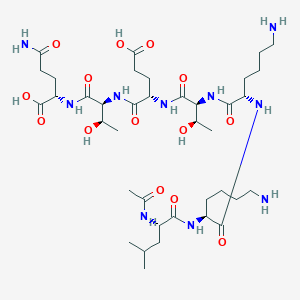
What is sold as TB-500 is not consistent. Some vendors sell full-length synthetic Tβ4. Others sell a short fragment built around the LKKTETQ actin-binding sequence, sometimes with an acetyl group added. A recent sports medicine review describes TB-500 as a thymosin beta-4 fragment and lists it among the unapproved peptides marketed directly to patients.6 A buyer generally cannot tell which molecule is in the vial without independent testing.
TB-500 is promoted mainly for tendon, ligament and muscle injuries, faster recovery from training, and general healing, often stacked with BPC-157. It is not approved for any use, and it is banned in sport. Pharmaceutical development of thymosin beta-4 itself has focused on eye drops and topical gels, not on injectable recovery products.
- Anecdotal only
- In vitro only
- Animal models only
- Preliminary human
- Clinical trials
- Regulator approved
How TB-500 works
Cells move and change shape by building and dismantling an internal scaffold made of a protein called actin. Thymosin beta-4 holds onto loose actin units and controls when they are released for building. That matters whenever cells need to crawl somewhere, such as skin cells closing a cut or blood vessel cells forming new capillaries. The theory behind TB-500 is that adding more of this peptide helps repair cells reach the injury and get to work.
Platelets show the system clearly. In a resting platelet only a minority of the actin is assembled into filaments, partly because thymosin beta-4 binds the free units. When the platelet is activated, actin assembles rapidly to form the extensions that help plug a wound.5
In more precise terms, beta-thymosins are the main intracellular G-actin-sequestering peptides in most vertebrate cells. Tβ4 is unstructured on its own and folds when it binds monomeric actin, with an affinity that allows fast binding and release.2 Not all of its reported effects fit a simple monomer-buffering role, and review authors have proposed that it also acts on signaling pathways that shape cell motility.1 Its N-terminal fragment, acetyl-SDKP, has separately been described as a natural inhibitor of blood cell production in bone marrow.7 How extracellular Tβ4, the form delivered by injection, produces its effects is still poorly understood.2
Repair peptides are said to act on blood-vessel growth and cell migration in the proliferation stage. Most of that evidence comes from animal studies.
What the research shows on TB-500
The best human evidence is not for TB-500 as sold. It is for pharmaceutical-grade thymosin beta-4 applied to skin and eyes. A review by scientists who helped develop Tβ4 for wound healing reported that it sped repair in phase 2 trials in patients with pressure ulcers, venous stasis ulcers and epidermolysis bullosa wounds, and that it was well tolerated.8 These were small trials, the authors were not independent of the program, and the product has not been approved for these wounds.
Animal data are broader. Tβ4 increased the rate of skin healing in several animal models, including diabetic and aged animals, and in burns.8 Rodent studies have also explored heart, eye and nerve repair, which is why cardiac research appears among its listed uses. None of that work has produced an approved injectable treatment.
For the musculoskeletal uses that drive demand, the human evidence is close to nil. A 2026 primer for orthopedic and sports medicine physicians concluded that Tβ4 and TB-500 promoted angiogenesis and tissue repair in preclinical models, but that human orthopedic data are lacking.4 A separate orthopedic review reached a similar conclusion: the preclinical findings are promising, but clinical trials are missing.3
A 2026 review in Sports Medicine went further. It noted that many unapproved peptides look favorable in animal models, that rigorous human safety data are scarce, and that there is potential for serious harm. It also discussed the placebo effect as a likely contributor to reported benefits, amplified by social media.6 That matters because most TB-500 success stories are self-reported, uncontrolled, and involve injuries that often improve on their own.
Studied for: Soft tissue repair research, Wound healing, Cardiac repair research.
TB-500 reference data
| Sequence | LKKTETQ (active fragment) |
|---|---|
| Molecular weight | 4,963.4 Da |
| CAS number | 77591-33-4 |
| FDA status | Not approved for any indication. |
| Prohibited in sport | Yes, under the WADA prohibited list |
TB-500 dosage in published research
2x weekly loading, then weekly · usually run for about 6 weeks. A reference pattern, not a prescription.
Open this in the dosage calculator ↗
How TB-500 is used in practice
Almost all TB-500 reaches users as a freeze-dried powder labeled for research use only. Users mix it with bacteriostatic water and inject it under the skin or into muscle, usually on a loading schedule followed by less frequent maintenance doses. Those schedules come from vendors, forums and some clinics. They are not derived from clinical trials, because no trial has tested injected TB-500 for these purposes.
Some wellness and sports clinics have offered TB-500, sometimes combined with BPC-157. Because it is not approved and compounding pharmacies face restrictions on using it, most supply comes from online sellers operating outside regulatory oversight, which a 2026 review describes as a gray market.6
Quality is the practical problem. Independent testing of gray-market peptides has repeatedly found products that are underdosed, mislabeled or contaminated. For TB-500 there is the added confusion between the full-length peptide and the fragment. Sterility and endotoxin testing are rarely documented. Competitive athletes face another issue: thymosin beta-4 and its fragments are prohibited at all times under anti-doping rules.
TB-500 risks and side effects
Reported side effects include injection-site redness or pain, transient fatigue, a brief head rush and mild nausea. These reports are mostly anecdotal. The phase 2 trials of topical Tβ4 found it well tolerated, but that tells us little about repeated systemic injections of products of uncertain identity and purity.8
The main theoretical concern is cancer. Tβ4 encourages cell migration and new blood vessel growth, two processes tumors also exploit. No human data show that TB-500 causes or accelerates cancer, but there is also no long-term safety data to rule it out. People with an active or suspected malignancy are generally advised to avoid it.
There is no safety data in pregnancy or breastfeeding, and none in children. Drug interactions have not been studied. Injecting any nonsterile product carries a risk of abscess or infection, and impurities from synthesis can cause immune reactions. Finally, the uncertainty about what is in a given vial means side effects may come from the contents rather than from thymosin beta-4 itself.
Reported side effects
Alternatives to TB-500
For tendon, ligament and muscle injuries, the options with real evidence are less exciting but more reliable. Structured physical therapy with progressive loading is first-line for most tendinopathies. Relative rest, activity modification and short courses of anti-inflammatory drugs help in the acute phase. Corticosteroid injections can give short-term relief in some conditions. Platelet-rich plasma has mixed but growing trial data for specific injuries, and surgery remains appropriate for complete tears. Sports medicine authors recommend discussing these alternatives with patients who ask about peptides.6
For chronic wounds, standard care such as debridement, offloading for diabetic foot ulcers and compression for venous ulcers has the strongest evidence. Becaplermin gel is FDA approved for certain diabetic foot ulcers.
BPC-157 and GHK-Cu are often suggested as alternatives, but their evidence for musculoskeletal repair in humans is just as thin.4
The bottom line on TB-500
Thymosin beta-4 is a real and well-studied protein with plausible repair biology and some small human trials in skin and eye wounds. TB-500 as sold for injuries is a different matter. Its identity varies by vendor, no controlled human trial supports it for tendons or muscles, and its long-term safety is unknown. Interest has far outrun the evidence.
Questions for a clinician
- What evidence applies to my situation, and at what level?
- What established alternatives should I consider first?
- What monitoring would be necessary, and how often?
- Can this be prescribed at all where I live, or only sold for research?
TB-500 FAQ
What is TB-500?
A synthetic version of thymosin beta-4, the actin-sequestering peptide most often paired with BPC-157. It is classed as healing & repair.
Is TB-500 FDA approved?
No. TB-500 is not approved by the FDA for any indication. Material sold online is labelled for research use only.
Is TB-500 legal in the US?
TB-500 is not FDA approved. It was moved off FDA’s Category 2 safety-risk list in 2026 after its nomination was withdrawn, but it was not added to the 503A bulks list. That leaves no routine legal path for a US compounding pharmacy to prepare it. FDA’s Pharmacy Compounding Advisory Committee discussed it in July 2026; FDA had not announced a decision as of October 2026.
What dose of TB-500 is used in research?
Published research and practitioner protocols report 2-5 mg, 2x weekly loading, then weekly, typically for 6 weeks. This is a reference range, not a recommendation; dosing should be set by a licensed clinician.
How is TB-500 reconstituted?
A 5 mg vial mixed with 2 mL of bacteriostatic water gives 2.5 mg/mL. At that concentration 2 mg is 80.0 units on a 100-unit insulin syringe.
What are the side effects of TB-500?
Reported side effects include injection-site reactions, transient fatigue, head rush, mild nausea. Contraindications: active or suspected malignancy, pregnancy.
What is the half-life of TB-500?
The reported half-life of TB-500 is ~2-3 hours.
Is TB-500 banned in sport?
Yes. TB-500 falls under the World Anti-Doping Agency prohibited list.
References
Regulatory and primary sources
- FDA: Bulk drug substances that may present significant safety risks (Category 2 and withdrawn nominations) ↗ · content current as of April 22, 2026; checked October 18, 2026
- FDA: Bulk drug substances used in compounding under section 503A ↗ · how the 503A categories work
- PubChem compound record (CID 62707662) ↗ · structure, identifiers, synonyms
- WADA Prohibited List ↗ · current year
- FDA: Unapproved drugs and "research use only" products ↗ · regulatory status of non-approved products
- CAS Registry Number 77591-33-4 ↗ · chemical identity
Published literature
- The beta-thymosin enigma.Ann N Y Acad Sci 2007.PubMed 17495248 · doi:10.1196/annals.1415.021
- beta-Thymosins.Ann N Y Acad Sci 2007.PubMed 17468232 · doi:10.1196/annals.1415.018
- Therapeutic Peptides in Orthopaedics: Applications, Challenges, and Future Directions.J Am Acad Orthop Surg Glob Res Rev 2026.PubMed 41490200 · doi:10.5435/JAAOSGlobal-D-25-00236
- Injectable Peptide Therapy: A Primer for Orthopaedic and Sports Medicine Physicians.Am J Sports Med 2026.PubMed 41476424 · doi:10.1177/03635465251357593
- The platelet cytoskeleton.Thromb Haemost 1993.PubMed 8165606
- Safety and Efficacy of Approved and Unapproved Peptide Therapies for Musculoskeletal Injuries and Athletic Performance.Sports Med 2026.PubMed 41966639 · doi:10.1007/s40279-026-02437-0
- [Biomolecules suppressing myelopoiesis].Acta Cient Venez 1992.PubMed 1343739
- Thymosin β4 Promotes Dermal Healing.Vitam Horm 2016.PubMed 27450738 · doi:10.1016/bs.vh.2016.04.005
Literature retrieved from PubMed on October 16, 2026, favouring human studies and reviews. Numbered markers in the text show which paper supports which statement; uncited entries are background reading.