Is GHK-Cu legal?
Not approved · not compoundable- FDA status
- GHK-Cu is not FDA approved. It was moved off FDA’s Category 2 safety-risk list in 2026 after its nomination was withdrawn, but it was not added to the 503A bulks list.
- Compounding
- That leaves no routine legal path for a US compounding pharmacy to prepare injectable GHK-Cu. The restriction covers injectable compounding, not topical GHK-Cu sold as a cosmetic ingredient, which is a different category.
- Prescription
- There is no approved US prescription product for GHK-Cu.
US status checked October 2026 against FDA’s compounding lists. Sources at the foot of the page.
What is GHK-Cu?
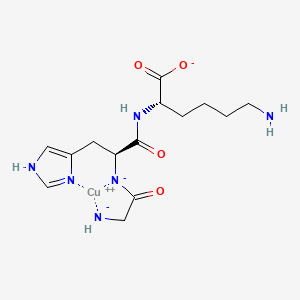
GHK-Cu is a small natural peptide, glycyl-L-histidyl-L-lysine, bound to a copper ion. GHK is found in human blood plasma, saliva and urine, and its levels fall with age.2 It was identified in the 1970s by Loren Pickart, who has since written much of the research literature on it. GHK grips copper with an affinity similar to the copper-carrying site on albumin, the main blood protein, and the resulting complex is GHK-Cu.7
GHK-Cu has been used in skin-care products for decades, where it is often sold as copper peptide or copper tripeptide-1. It is marketed for firmer skin, fewer fine lines, wound healing and hair growth.
More recently, injectable GHK-Cu has been offered by some clinics, telehealth services and research-chemical sellers for tissue repair, joint pain and general anti-aging. That use has much less support than the topical one, and it is not approved.
- Anecdotal only
- In vitro only
- Animal models only
- Preliminary human
- Clinical trials
- Regulator approved
How GHK-Cu works
When skin or other tissue is injured, the body first cleans up the damage and then rebuilds. GHK-Cu appears to act as a signal in that rebuilding phase. It attracts repair cells to the injured area, calms inflammation and prompts skin cells to make more collagen and elastin, the proteins that keep skin firm and springy. It also delivers copper, which several repair enzymes need.
In more detail, GHK stimulates the synthesis of collagen, dermatan sulfate, chondroitin sulfate and the proteoglycan decorin, and it adjusts the activity of the enzymes that break down tissue and their inhibitors, so it supports both building and remodeling.2 Laboratory work shows it attracts macrophages, mast cells and capillary cells, suppresses free-radical damage and raises production of growth factors such as VEGF and FGF-2.7 Gene-expression analyses suggest GHK can shift the activity of thousands of human genes toward patterns linked with repair.1 Those gene data come from computer comparisons of cell-line databases, not from treating people.
Repair peptides are said to act on blood-vessel growth and cell migration in the proliferation stage. Most of that evidence comes from animal studies.
What the research shows on GHK-Cu
The best evidence is for topical use on aging skin. Controlled studies of GHK-Cu creams reported tighter skin, better elasticity and firmness, fewer fine lines and wrinkles, and less sun damage and hyperpigmentation.7 In animals, GHK speeds wound healing of skin, hair follicles, the gut and bone, and it improved healing in rats, mice and pigs.2 A 2026 review of peptides in aesthetic medicine described skin rejuvenation as one of the more promising uses of therapeutic peptides, while calling for more research.8 For hair, GHK-Cu increased hair follicle size in laboratory work and has been reported to improve hair transplant success,7 but controlled trials comparing copper-peptide hair products with established treatments are lacking.
These results have limits. Many cosmetic studies were small, short and sponsored by ingredient makers, and much of the summarizing literature comes from GHK's discoverer and colleagues. Getting GHK-Cu into skin is also a challenge. The complex is water-loving and passes poorly through the skin's outer layer. Liposomes might help, but a 2025 review found that how well liposomal GHK-Cu penetrates skin has received little study.6
Evidence for injected GHK-Cu is much weaker. A 2026 primer for orthopaedic surgeons found that GHK-Cu showed promise for wound healing and inflammation, but that no clinical data support its use for musculoskeletal conditions.3 A 2026 Sports Medicine review grouped it with unapproved peptides for which rigorous human safety data are scarce.5 Another review of peptides in orthopaedics described promising preclinical work but a lack of clinical trials.4
Studied for: Skin repair and anti-ageing, Wound healing, Hair follicle stimulation.
GHK-Cu reference data
| Sequence | GHK |
|---|---|
| Molecular weight | 403.94 Da |
| CAS number | 89030-95-5 |
| FDA status | Not approved for any indication. |
| Prohibited in sport | Not listed |
GHK-Cu dosage in published research
Daily topical, or subcutaneous in research protocols · usually run for about 12 weeks. A reference pattern, not a prescription.
Open this in the dosage calculator ↗
How GHK-Cu is used in practice
Topical GHK-Cu is widely sold in serums, creams and hair products, from drugstore brands to dermatology lines, with no prescription needed. Concentrations vary and are rarely verified, and the blue tint of some products is not a reliable sign of strength. Like most anti-aging topicals, it needs consistent use for at least several weeks before any change is visible, and it does not replace sunscreen.
Injectable GHK-Cu has been prescribed by some anti-aging clinics and telehealth services as compounded vials, and research-chemical sellers offer larger vials of powder. Users inject it under the skin daily or several times a week, sometimes mixed with other peptides. Its compounding status is covered in the legal status box on this page.
Research-chemical products are not tested for identity, copper content, sterility or endotoxin. Whatever the source, there is no approved dose for injection.
GHK-Cu risks and side effects
Topical GHK-Cu is generally well tolerated. The usual side effects are mild irritation and temporary redness. Some dermatologists advise against applying it at the same time as strong acids or high-strength vitamin C, which may destabilize the copper complex or irritate the skin. Allergic skin reactions are uncommon but possible, so people with sensitive skin or a history of reactions to cosmetics may want to test a small area first.
Injection raises different questions. Side effects reported include injection-site pain, redness and lumps. The long-term effects of repeatedly delivering a growth-promoting signal and extra copper into the bloodstream have not been studied. People with Wilson disease or other copper-overload conditions should avoid it. Injectable use during pregnancy is not advised.
Some reviews describe anticancer effects of GHK in laboratory studies,1 but GHK also promotes new blood vessel growth, and neither effect has been studied in people with cancer. Contamination and dosing errors are real risks with unregulated injectables.
Reported side effects
Alternatives to GHK-Cu
For aging skin, daily broad-spectrum sunscreen and topical retinoids have the strongest evidence. Prescription tretinoin is FDA-approved for treating sun damage and fine wrinkles, and over-the-counter retinol is a milder option. Vitamin C serums, chemical peels, microneedling and laser treatments are other choices with a dermatologist.
For hair loss, topical and oral minoxidil and, in men, finasteride have far more trial evidence than copper peptides. For chronic wounds, standard wound care is the foundation, and becaplermin gel is FDA-approved for certain diabetic foot ulcers. For tendon and joint injuries, physical therapy and loading programs have the best evidence.
The bottom line on GHK-Cu
GHK-Cu is one of the better-supported peptides in skin care, with controlled studies showing modest improvements in aging skin and a sensible repair-focused mechanism. Injected GHK-Cu is another story: there are no clinical trials for joint, tendon or whole-body use, and product quality varies. Use it on the skin if you like it, and be skeptical of the injectable version.
Questions for a clinician
- What evidence applies to my situation, and at what level?
- What established alternatives should I consider first?
- What monitoring would be necessary, and how often?
GHK-Cu FAQ
What is GHK-Cu?
A naturally occurring copper-binding tripeptide with the strongest human evidence base of any compound in the healing group, mostly topical. It is classed as healing & repair.
Is GHK-Cu FDA approved?
No. GHK-Cu is not approved by the FDA for any indication.
Is GHK-Cu legal in the US?
GHK-Cu is not FDA approved. It was moved off FDA’s Category 2 safety-risk list in 2026 after its nomination was withdrawn, but it was not added to the 503A bulks list. That leaves no routine legal path for a US compounding pharmacy to prepare injectable GHK-Cu. The restriction covers injectable compounding, not topical GHK-Cu sold as a cosmetic ingredient, which is a different category.
What dose of GHK-Cu is used in research?
Published research and practitioner protocols report 1-2 mg, daily topical, or subcutaneous in research protocols, typically for 12 weeks. This is a reference range, not a recommendation; dosing should be set by a licensed clinician.
How is GHK-Cu reconstituted?
A 50 mg vial mixed with 5 mL of bacteriostatic water gives 10.0 mg/mL. At that concentration 1 mg is 10.0 units on a 100-unit insulin syringe.
What are the side effects of GHK-Cu?
Reported side effects include local irritation, transient redness, injection-site reactions. Contraindications: wilson disease or copper overload, pregnancy (injectable).
What is the half-life of GHK-Cu?
The reported half-life of GHK-Cu is ~30 minutes (systemic).
Is GHK-Cu banned in sport?
GHK-Cu is not specifically named on the WADA prohibited list, but athletes should check the current list and their federation's rules.
References
Regulatory and primary sources
- FDA: Bulk drug substances that may present significant safety risks (Category 2 and withdrawn nominations) ↗ · content current as of April 22, 2026; checked October 18, 2026
- FDA: Bulk drug substances used in compounding under section 503A ↗ · how the 503A categories work
- PubChem compound record (CID 139035031) ↗ · structure, identifiers, synonyms
- CAS Registry Number 89030-95-5 ↗ · chemical identity
Published literature
- Regenerative and Protective Actions of the GHK-Cu Peptide in the Light of the New Gene Data.Int J Mol Sci 2018.PubMed 29986520 · doi:10.3390/ijms19071987
- GHK Peptide as a Natural Modulator of Multiple Cellular Pathways in Skin Regeneration.Biomed Res Int 2015.PubMed 26236730 · doi:10.1155/2015/648108
- Injectable Peptide Therapy: A Primer for Orthopaedic and Sports Medicine Physicians.Am J Sports Med 2026.PubMed 41476424 · doi:10.1177/03635465251357593
- Therapeutic Peptides in Orthopaedics: Applications, Challenges, and Future Directions.J Am Acad Orthop Surg Glob Res Rev 2026.PubMed 41490200 · doi:10.5435/JAAOSGlobal-D-25-00236
- Safety and Efficacy of Approved and Unapproved Peptide Therapies for Musculoskeletal Injuries and Athletic Performance.Sports Med 2026.PubMed 41966639 · doi:10.1007/s40279-026-02437-0
- Are We Ready to Measure Skin Permeation of Modern Antiaging GHK-Cu Tripeptide Encapsulated in Liposomes?.Molecules 2025.PubMed 39795193 · doi:10.3390/molecules30010136
- The human tri-peptide GHK and tissue remodeling.J Biomater Sci Polym Ed 2008.PubMed 18644225 · doi:10.1163/156856208784909435
- Therapeutic Peptides in Aesthetic, Metabolic and Endocrine Conditions: Effects, Safety, Clinical Applications, and Future Perspectives.Int J Mol Sci 2026.PubMed 42123471 · doi:10.3390/ijms27093890
Literature retrieved from PubMed on October 16, 2026, favouring human studies and reviews. Numbered markers in the text show which paper supports which statement; uncited entries are background reading.