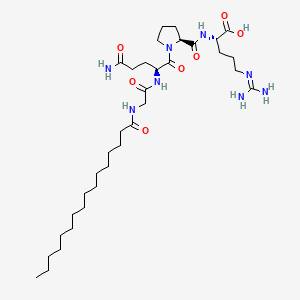
Is Palmitoyl Tetrapeptide-7 legal?
Cosmetic ingredient- FDA status
- Palmitoyl Tetrapeptide-7 is used in topical skin-care products and is regulated as a cosmetic ingredient, not as a drug.
- Compounding
- It is not a prescription medicine. Cosmetic claims may not promise to change the body’s structure or function.
- Prescription
- There is no approved US prescription product for Palmitoyl Tetrapeptide-7.
US status checked October 2026 against FDA’s compounding lists. Sources at the foot of the page.
What is Palmitoyl Tetrapeptide-7?
Palmitoyl tetrapeptide-7 is a cosmetic ingredient made of four amino acids, glycine, glutamine, proline and arginine (GQPR), with a fatty acid called palmitic acid attached. The fatty tail helps it get into the skin. It is sold to brands by the ingredient maker Sederma under the name Rigin, and it was previously listed on labels as palmitoyl tetrapeptide-3.
The peptide has an unusual origin. GQPR is a natural fragment of human immunoglobulin G, the most common antibody in blood. In 1981, researchers predicted that this fragment would behave like tuftsin, another antibody fragment that stimulates immune cells, and confirmed that the synthetic tetrapeptide had similar activity. They named it rigin.6
In skin care, palmitoyl tetrapeptide-7 is marketed to calm inflammation linked to aging and sun exposure. It is best known as one of the two peptides in Matrixyl 3000, where it is paired with palmitoyl tripeptide-1 (Pal-GHK). It is a cosmetic ingredient, not a drug.
- Anecdotal only
- In vitro only
- Animal models only
- Preliminary human
- Clinical trials
- Regulator approved
How Palmitoyl Tetrapeptide-7 works
Skin aging is partly driven by low-level, ongoing inflammation. Sun exposure and age push skin cells to release inflammatory signals such as interleukin-6 (IL-6). Over time those signals help switch on enzymes that break down collagen and elastin. The idea behind palmitoyl tetrapeptide-7 is that it turns down that inflammatory signaling, so less damage builds up.
Its partner in Matrixyl 3000, palmitoyl tripeptide-1, is meant to do the opposite job, sending a build-more-collagen signal. Together the blend aims to slow breakdown and boost repair. Glycation is another aging process that appears in marketing. Sugars can bind to collagen and stiffen it over time. Claims that this peptide reduces glycation in skin come from supplier lab tests rather than human studies.
In more detail, rigin is residues 341 to 344 of the heavy chain of IgG, one of several biologically active peptides released when antibodies are cleaved.3 Supplier data report that the palmitoylated form reduces IL-6 release from keratinocytes and fibroblasts in culture, including after UV exposure. Rigin itself has immunomodulating properties and has been used as a template for designing new antimicrobial peptides.8 Like all peptides, it penetrates intact skin poorly. Studies on excised human skin found that microneedles raised delivery of rigin and Pal-KTTKS several-fold, which shows how limited passive delivery is.5
Signal peptides are meant to prompt fibroblasts to make collagen; neurotransmitter-inhibiting peptides aim to soften expression lines. Both must first get through the outer skin barrier.
What the research shows on Palmitoyl Tetrapeptide-7
Independent research on palmitoyl tetrapeptide-7 alone is very limited. Most of the efficacy data comes from the supplier and from tests of finished products that contain several actives, so it is hard to say what this peptide contributes on its own.
One indexed clinical study tested an eye cream containing a yeast and rice ferment filtrate, N-acetylneuraminic acid, palmitoyl tripeptide-1 and palmitoyl tetrapeptide-7. In fibroblast culture, the active mix increased cell growth and collagen and elastin production. Over 12 weeks of use, skin hydration rose by about 28% and elasticity by about 19%, with dermatologists rating improvements in fine lines by week 8.2 The study was run with a manufacturer, had no placebo cream arm described in the abstract, and cannot separate the peptide's effect from the other ingredients.
Supplier studies of Matrixyl 3000 have reported reductions in wrinkle depth and roughness over a few months. These were not published in independent peer-reviewed journals, and claims about reducing glycation in skin rest on lab data rather than human trials.
The basic science behind rigin is older and comes from immunology, not dermatology.6 Penetration is a broader problem for this whole category. Cell results only matter if enough peptide reaches living skin cells, and passive delivery through intact skin is limited.5
Studied for: Inflammatory skin ageing, Glycation reduction, Anti-ageing skincare.
Palmitoyl Tetrapeptide-7 reference data
| Sequence | Pal-GQPR |
|---|---|
| Molecular weight | 693 Da |
| CAS number | 221227-05-0 |
| FDA status | Not approved for any indication. |
| Prohibited in sport | Not listed |
Palmitoyl Tetrapeptide-7 dosage in published research
Applied topically 1-2x daily at 1-4% concentration. A reference pattern, not a prescription.
How Palmitoyl Tetrapeptide-7 is used in practice
Palmitoyl tetrapeptide-7 is sold over the counter in serums, moisturizers and eye creams, almost always with palmitoyl tripeptide-1 under the Matrixyl 3000 name. It is not prescribed, not part of telehealth care and not injected. Labels rarely say how much is present.
Supplier guidance suggests including the Matrixyl 3000 stock at a few percent of a formula, and the actual peptide content of that stock is in the parts-per-million range. Products are often combined with niacinamide, hyaluronic acid, retinoids or other peptides.
Because cosmetics are not tested for active content, two products listing the same peptide can differ a great deal. A product can feature Matrixyl 3000 prominently on the front while giving no information about how much it contains.
Palmitoyl Tetrapeptide-7 risks and side effects
Palmitoyl tetrapeptide-7 is well tolerated in cosmetic use. The eye cream study reported a high safety profile over 12 weeks.2 Mild redness, stinging or irritation can occur, usually from other parts of the formula. Anyone with a known allergy to an ingredient should avoid the product, and a patch test is sensible for sensitive skin.
There are no known drug interactions with topical use, and it is commonly combined with sunscreen, vitamin C and retinoids. Data in pregnancy is lacking, although skin absorption is expected to be very low.
The main downside is cost relative to proven benefit. As with any new skin care product, it makes sense to introduce one product at a time so that any irritation can be traced to its source.
Reported side effects
Alternatives to Palmitoyl Tetrapeptide-7
For wrinkles and sun damage, tretinoin is FDA approved and has the strongest evidence. Over-the-counter retinol and adapalene are gentler options. Daily broad-spectrum sunscreen prevents more of the aging that this peptide aims to soften.
For redness and inflammation, niacinamide and azelaic acid have reasonable evidence. Among peptides, Matrixyl (palmitoyl pentapeptide-4) has more controlled human data, and GHK-Cu is another common choice. Procedures such as botulinum toxin, lasers and fillers produce larger changes. For people who mainly want a gentle, low-irritation routine, a basic moisturizer, daily sunscreen and niacinamide are a good-value starting point.
The bottom line on Palmitoyl Tetrapeptide-7
Palmitoyl tetrapeptide-7 is a safe, mild anti-inflammatory peptide with an interesting immunology backstory. Evidence that it improves wrinkles on its own is weak, and most data come from multi-ingredient products and supplier tests. It is a reasonable extra in a routine built on sunscreen and a retinoid, not a reason to buy a product by itself.
Questions for a clinician
- What evidence applies to my situation, and at what level?
- What established alternatives should I consider first?
- What monitoring would be necessary, and how often?
Palmitoyl Tetrapeptide-7 FAQ
What is Palmitoyl Tetrapeptide-7?
An anti-inflammatory cosmetic peptide that targets glycation and cytokine-driven skin ageing, best known as one half of Matrixyl 3000. It is classed as cosmetic & topical.
Is Palmitoyl Tetrapeptide-7 FDA approved?
No. Palmitoyl Tetrapeptide-7 is not approved by the FDA for any indication.
Is Palmitoyl Tetrapeptide-7 legal in the US?
Palmitoyl Tetrapeptide-7 is used in topical skin-care products and is regulated as a cosmetic ingredient, not as a drug. It is not a prescription medicine. Cosmetic claims may not promise to change the body’s structure or function.
What dose of Palmitoyl Tetrapeptide-7 is used in research?
Published research and practitioner protocols report 1-4 mg, applied topically 1-2x daily at 1-4% concentration. This is a reference range, not a recommendation; dosing should be set by a licensed clinician.
What are the side effects of Palmitoyl Tetrapeptide-7?
Reported side effects include mild local irritation. Contraindications: known hypersensitivity.
What is the half-life of Palmitoyl Tetrapeptide-7?
The reported half-life of Palmitoyl Tetrapeptide-7 is Topical.
Is Palmitoyl Tetrapeptide-7 banned in sport?
Palmitoyl Tetrapeptide-7 is not specifically named on the WADA prohibited list, but athletes should check the current list and their federation's rules.
References
Regulatory and primary sources
- FDA: Bulk drug substances that may present significant safety risks (Category 2 and withdrawn nominations) ↗ · content current as of April 22, 2026; checked October 18, 2026
- FDA: Bulk drug substances used in compounding under section 503A ↗ · how the 503A categories work
- PubChem compound record (CID 10078408) ↗ · structure, identifiers, synonyms
- CAS Registry Number 221227-05-0 ↗ · chemical identity
Published literature
- The nucleoprotein of influenza A virus inhibits the innate immune response by inducing mitophagy.Autophagy 2023.PubMed 36588386 · doi:10.1080/15548627.2022.2162798
- Comprehensive evaluation of the efficacy and safety of a new multi-component anti-aging topical eye cream.Skin Res Technol 2024.PubMed 38932444 · doi:10.1111/srt.13790
- The second life of antibodies.Biochemistry (Mosc) 2014.PubMed 24512657 · doi:10.1134/S0006297914010015
- Palmitoyl-transferase 3 promotes mitochondrial antiviral signaling protein degradation by modulating its ubiquitination.Int J Biol Macromol 2025.PubMed 40300684 · doi:10.1016/j.ijbiomac.2025.143609
- Microneedle enhanced delivery of cosmeceutically relevant peptides in human skin.PLoS One 2014.PubMed 25033398 · doi:10.1371/journal.pone.0101956
- Rigin, another phagocytosis-stimulating tetrapeptide isolated from human IgG. Confirmations of a hypothesis.Int J Pept Protein Res 1981.PubMed 7309346 · doi:10.1111/j.1399-3011.1981.tb02011.x
- Cytoplasmic Translocation of Nucleolar Protein NOP53 Promotes Viral Replication by Suppressing Host Defense.Viruses 2018.PubMed 29677136 · doi:10.3390/v10040208
- Antifungal Peptides with Unexpected Structure from a Library of Synthetic Analogs of Host-Defense Peptide Rigin.Int J Mol Sci 2025.PubMed 40076526 · doi:10.3390/ijms26051900
Literature retrieved from PubMed on October 16, 2026, favouring human studies and reviews. Numbered markers in the text show which paper supports which statement; uncited entries are background reading.