Is Anamorelin legal?
Not FDA approved- FDA status
- Anamorelin is not FDA approved and is not on FDA’s 503A bulks list.
- Compounding
- US compounding pharmacies cannot routinely prepare it.
- Prescription
- There is no approved US prescription product for Anamorelin.
- Outside the US
- Approved in Japan for cancer cachexia (Adlumiz)
- Online market
- Products sold online are labelled “for research use only”: not made, tested or labelled for human use, and often mislabelled.
- Sport
- Prohibited in sport under the World Anti-Doping Agency list.
US status checked October 2026 against FDA’s compounding lists. Sources at the foot of the page.
What is Anamorelin?
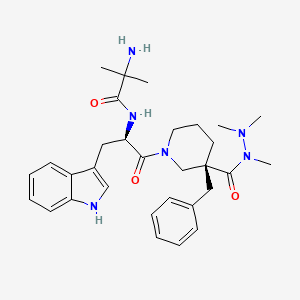
Anamorelin is an oral drug that mimics ghrelin, the stomach hormone that drives hunger and triggers growth hormone release. It is the most clinically advanced compound in the ghrelin-mimetic class. It is a small molecule rather than a peptide, but it is often grouped with growth hormone secretagogue peptides because it acts on the same receptor.
It was developed for cancer anorexia-cachexia syndrome, the combination of appetite loss and muscle wasting that affects many people with advanced cancer.8 Japan approved it in January 2021, under the brand name Adlumiz, for cancer cachexia in non-small-cell lung, gastric, pancreatic and colorectal cancer.6
It is not approved in the United States or the European Union. Its regulatory path diverged largely because trials showed gains in body weight and lean mass but no consistent improvement in physical function, which regulators outside Japan weighed heavily. It is prohibited in sport as a growth hormone secretagogue.
- Anecdotal only
- In vitro only
- Animal models only
- Preliminary human
- Clinical trials
- Regulator approved
How Anamorelin works
Ghrelin is released by the stomach when it is empty. It signals the brain to make you hungry and tells the pituitary gland to release growth hormone. Growth hormone in turn prompts the liver to make IGF-1, which helps build muscle protein. Anamorelin switches on the same receptor ghrelin uses, so it raises appetite and growth hormone at the same time. In people losing weight because of cancer, the goal is more eating and less muscle loss.1
More precisely, anamorelin is a selective agonist of the growth hormone secretagogue receptor type 1a (GHS-R1a). It is orally bioavailable with a half-life of roughly seven hours, which allows once-daily dosing and separates it from injectable ghrelin-mimetic peptides such as GHRP-2. Receptor activation in the hypothalamus stimulates appetite, while pituitary activation increases growth hormone and downstream IGF-1 and IGFBP-3. Ghrelin signaling also affects gastric motility and inflammation, which may contribute to its effects in cachexia.5
Growth hormone secretagogues such as ipamorelin, GHRP-2, GHRP-6 and MK-677 act on the ghrelin receptor in the pituitary and hypothalamus, triggering a GH pulse.
What the research shows on Anamorelin
Anamorelin has a substantial human evidence base, including several randomized, double-blind, placebo-controlled trials and completed phase III trials, mainly in non-small-cell lung cancer.78
A 2023 meta-analysis pooled five trials with 1,331 participants. Compared with placebo, anamorelin increased body weight by about 1.6 kg, lean body mass by about 1.4 kg and fat mass by about 1 kg. It also raised IGF-1 and IGFBP-3. Appetite improved significantly at the 100 mg daily dose, though not across all doses pooled together.3
The limitation is function. Across most trials, anamorelin did not improve hand-grip strength, the main measure of physical function used.5 Reviews of the phase III data describe a clear effect on reversing muscle loss but an inconsistent effect on physical function.7 That gap is central. Patients and clinicians want people to feel stronger and more capable, not only to weigh more.
Japanese experience since approval largely confirms gains in lean mass, weight and appetite in routine practice. It also shows limits. In pancreatic cancer patients with severe weight loss, anamorelin did not increase body weight.6 Reviews consistently argue that it works best combined with nutrition support and exercise rather than alone.54
Long-term safety beyond the trial periods, and effects in cancers outside those studied, remain less well characterized.8
Studied for: Cancer cachexia, Appetite stimulation, Lean mass preservation.
Anamorelin reference data
| Molecular weight | 546.71 Da |
|---|---|
| CAS number | 249921-19-5 |
| FDA status | Not approved for any indication. |
| Prohibited in sport | Yes, under the WADA prohibited list |
Anamorelin dosage in published research
Once daily · usually run for about 12 weeks. A reference pattern, not a prescription.
How Anamorelin is used in practice
In Japan, anamorelin is prescribed by oncologists for eligible patients with cancer cachexia, typically as one tablet daily, alongside nutrition counseling. A post-marketing surveillance program has followed patients since approval, though full results have not been published.6
In the US and Europe it is not available through normal prescribing, compounding or legitimate telehealth services. Some research-chemical sellers list it, and it attracts interest from bodybuilders and people seeking an oral growth hormone booster. Those products have no regulatory oversight, and an oral small molecule sold as powder or capsules is easy to mislabel or underdose.
Using a cancer cachexia drug for muscle building in healthy people is outside anything the trials studied. There are no data on whether it adds meaningful muscle in people who are not losing weight from illness. The benefit-risk balance in a person with advanced cancer and progressive weight loss is very different from that in a healthy adult.
Anamorelin risks and side effects
The most important side effects are metabolic. Anamorelin can raise blood sugar and has been linked to new-onset diabetes. Less often it causes liver enzyme elevations and cardiovascular events, including heart conduction abnormalities, high blood pressure and ischemic heart problems.5
Cardiac effects deserve attention. Japanese case reports describe cardiac adverse reactions, and clinicians there are advised to watch for serious arrhythmias even after the first dose.6 People with heart failure, conduction disorders or uncontrolled diabetes need particular caution.
Anamorelin is broken down mainly by the liver enzyme CYP3A4, so drugs that strongly inhibit that enzyme can raise its levels. Nausea and headache are also reported. As with other growth hormone secretagogues, there is a theoretical concern about stimulating growth signals in people with cancer, and long-term data on that question are limited. Unregulated products add contamination and dosing risks.
Reported side effects
Alternatives to Anamorelin
For cancer-related appetite loss and weight loss, options include nutrition counseling and oral nutrition supplements, structured exercise where feasible, and medicines such as low-dose olanzapine, short courses of corticosteroids like dexamethasone, and megestrol acetate. Each carries its own trade-offs, and choices should be made with the oncology team.
Other cachexia drugs have shown early promise but struggled to win regulatory approval, which reflects how hard the condition is to treat and to measure in trials.2 Newer approaches, including antibodies against GDF-15, a protein linked to cachexia, are in development but not established. For healthy adults seeking muscle or growth hormone effects, resistance training, adequate protein and sleep are the evidence-based approach, and diagnosed growth hormone deficiency is treated with prescribed growth hormone.
The bottom line on Anamorelin
Anamorelin is a real drug with real trial evidence. It modestly increases weight, lean mass and appetite in cancer cachexia and is approved for that use in Japan. It does not reliably improve strength, it can raise blood sugar and affect the heart, and it is not approved in the US or Europe. It has no established role outside cancer care.
Questions for a clinician
- What evidence applies to my situation, and at what level?
- What established alternatives should I consider first?
- What monitoring would be necessary, and how often?
- Can this be prescribed at all where I live, or only sold for research?
Anamorelin FAQ
What is Anamorelin?
An orally active ghrelin-receptor agonist approved in Japan for cancer cachexia, and the most clinically advanced compound in the class. It is classed as gHRPs & ghrelin mimetics.
Is Anamorelin FDA approved?
No. Anamorelin is not approved by the FDA for any indication. Material sold online is labelled for research use only.
Is Anamorelin legal in the US?
Anamorelin is not FDA approved and is not on FDA’s 503A bulks list. US compounding pharmacies cannot routinely prepare it.
What dose of Anamorelin is used in research?
Published research and practitioner protocols report 50-100 mg, once daily, typically for 12 weeks. This is a reference range, not a recommendation; dosing should be set by a licensed clinician.
What are the side effects of Anamorelin?
Reported side effects include hyperglycaemia, nausea, elevated hepatic enzymes, headache. Contraindications: uncontrolled diabetes, congestive heart failure, pregnancy.
What is the half-life of Anamorelin?
The reported half-life of Anamorelin is ~7 hours.
Is Anamorelin banned in sport?
Yes. Anamorelin falls under the World Anti-Doping Agency prohibited list.
References
Regulatory and primary sources
- FDA: Bulk drug substances that may present significant safety risks (Category 2 and withdrawn nominations) ↗ · content current as of April 22, 2026; checked October 18, 2026
- FDA: Bulk drug substances used in compounding under section 503A ↗ · how the 503A categories work
- PubChem compound record (CID 9828911) ↗ · structure, identifiers, synonyms
- WADA Prohibited List ↗ · current year
- FDA: Unapproved drugs and "research use only" products ↗ · regulatory status of non-approved products
- CAS Registry Number 249921-19-5 ↗ · chemical identity
Published literature
- Anamorelin for cancer cachexia.Drugs Today (Barc) 2022.PubMed 35274629 · doi:10.1358/dot.2022.58.3.3381585
- What is next after anamorelin?.Curr Opin Support Palliat Care 2017.PubMed 28957883 · doi:10.1097/SPC.0000000000000299
- The effect of anamorelin (ONO-7643) on cachexia in cancer patients: Systematic review and meta-analysis of randomized controlled trials.J Oncol Pharm Pract 2023.PubMed 37525932 · doi:10.1177/10781552231189864
- [Overview of Cancer-Associated Cachexia].Gan To Kagaku Ryoho 2019.PubMed 31879394
- Anamorelin for the Treatment of Cancer Anorexia-Cachexia Syndrome.Curr Oncol Rep 2024.PubMed 38771469 · doi:10.1007/s11912-024-01549-y
- Anamorelin in Japanese patients with cancer cachexia: an update.Curr Opin Support Palliat Care 2023.PubMed 37389636 · doi:10.1097/SPC.0000000000000658
- Clinical results in cachexia therapeutics.Curr Opin Clin Nutr Metab Care 2016.PubMed 26974316 · doi:10.1097/MCO.0000000000000274
- Anamorelin hydrochloride for the treatment of cancer-anorexia-cachexia in NSCLC.Expert Opin Pharmacother 2015.PubMed 25945893 · doi:10.1517/14656566.2015.1041500
Literature retrieved from PubMed on October 16, 2026, favouring human studies and reviews. Numbered markers in the text show which paper supports which statement; uncited entries are background reading.