Is GHRP-2 legal?
FDA Category 2- FDA status
- GHRP-2 is not FDA approved. FDA lists it in Category 2 of its 503A bulk substances review: substances that may present significant safety risks.
- Compounding
- US compounding pharmacies should not prepare it.
- Prescription
- There is no approved US prescription product for GHRP-2.
- Outside the US
- Approved in Japan as a diagnostic agent for GH deficiency
- Online market
- Products sold online are labelled “for research use only”: not made, tested or labelled for human use, and often mislabelled.
- Sport
- Prohibited in sport under the World Anti-Doping Agency list.
US status checked October 2026 against FDA’s compounding lists. Sources at the foot of the page.
What is GHRP-2?
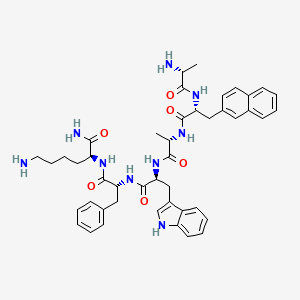
GHRP-2 (growth hormone-releasing peptide 2) is a synthetic six-amino acid peptide that triggers release of growth hormone (GH). It came out of a series of GH-releasing peptides developed by researchers at Tulane University, led by Cyril Bowers, and the German company Polygen. Its drug name is pralmorelin, and the Japanese company Kaken took over its development.3 It belongs to a family of GH-releasing peptides that also includes GHRP-1, GHRP-6 and hexarelin, and it helped inspire non-peptide drugs such as MK-0677 (ibutamoren).4
GHRP-2 is approved in Japan as a diagnostic agent to test for GH deficiency, and it is the only ghrelin-receptor agonist from the early wave of this research to reach the market.5 In Japan, the GHRP-2 test is used as a convenient and safe way to diagnose adult GH deficiency.2
It is not approved in the US. Outside Japan, it is sold as a research chemical for raising GH, building muscle, recovery and appetite.
- Anecdotal only
- In vitro only
- Animal models only
- Preliminary human
- Clinical trials
- Regulator approved
How GHRP-2 works
GHRP-2 mimics ghrelin, the hormone that rises before meals and makes you hungry. Ghrelin also signals the pituitary to release GH. GHRP-2 binds the same receptor, so it produces a sharp GH pulse and often an increase in appetite. It works through a different receptor from GHRH, the body's main GH-releasing hormone, which is why the two kinds of drug add to each other.
In more detail, GHRPs have no structural resemblance to GHRH and act through their own receptors in the pituitary and hypothalamus. They appear to work partly by counteracting somatostatin, the hormone that switches GH off, and partly through GHRH. Their effect is synergistic with GHRH and is blunted by glucose, fatty acids, glucocorticoids and somatostatin.1 GHRPs also raise prolactin and the stress hormones ACTH and cortisol, and their receptors are found in the heart and other tissues.6 When taken by mouth in children, GHRP-2 raised GH within 15 minutes, peaked at about 60 minutes and returned to baseline by 180 minutes.8
Growth hormone secretagogues such as ipamorelin, GHRP-2, GHRP-6 and MK-677 act on the ghrelin receptor in the pituitary and hypothalamus, triggering a GH pulse.
What the research shows on GHRP-2
The strongest evidence is for diagnosis. GHRP-2 markedly increases GH in healthy people regardless of sex, weight or age, while people with GH deficiency respond much less. The developer's analysis set a GH peak cut-off of 15 micrograms per liter to separate the two groups.3 Japanese practice uses a cut-off of 9 micrograms per liter to diagnose severe adult GH deficiency.2
Studies from the 1990s established how the drug behaves. Its GH release is strong and dose-related whether given by vein, under the skin, through the nose or by mouth. It partly loses effect with continuous use, and longer courses raise IGF-1. An increase in growth rate was reported in short children treated over time.1 Oral GHRP-2 raised GH in normal children, worked together with GHRH, and produced a larger response in obese adolescents than in controls.8 Reviews from the same era saw possible roles in short stature, aging, wasting conditions and heart failure.4
Those possibilities were not borne out by approvals. A US development program for GH deficiency appears to have been discontinued,3 and a 2022 review of treatments for cachexia listed GHRP-2 among agents that may help but noted the lack of evidence-based recommendations.7 No controlled trials show that GHRP-2 improves muscle, fat loss or performance in healthy adults.
The heart has drawn interest too. Receptors for GHRPs are dense in human heart tissue, and the related peptide hexarelin showed direct effects on heart muscle in animals and in people.6 Those findings concern hexarelin rather than GHRP-2, and they have not led to any approved heart treatment.
Studied for: GH secretory testing, Growth hormone elevation, Appetite stimulation.
GHRP-2 reference data
| Sequence | D-Ala-D-2-Nal-Ala-Trp-D-Phe-Lys-NH2 |
|---|---|
| Molecular weight | 817.98 Da |
| CAS number | 158861-67-7 |
| FDA status | Not approved for any indication. |
| Prohibited in sport | Yes, under the WADA prohibited list |
GHRP-2 dosage in published research
2-3x daily · usually run for about 12 weeks. A reference pattern, not a prescription.
Open this in the dosage calculator ↗
How GHRP-2 is used in practice
In Japan, GHRP-2 is given once by vein in a hospital as a test of the pituitary's GH reserve. That is its only approved use.
Elsewhere, it is bought from research-chemical vendors as freeze-dried powder for injection or as a nasal spray. Users typically inject it under the skin two or three times a day, often on an empty stomach because food blunts the response, and frequently combine it with a GHRH analog such as CJC-1295 or sermorelin. FDA has restricted it from use in compounding. The legal status box on this page has the details.
GHRP-2 is banned in sport. As with other research peptides, nothing guarantees that a vial contains the stated peptide at the stated dose, or that it is sterile.
GHRP-2 risks and side effects
Compared with some newer GH secretagogues, GHRP-2 causes more hormonal spillover. It raises prolactin and cortisol along with GH.6 Users report increased appetite, water retention, tiredness and tingling or numbness in the hands.
Higher GH lowers insulin sensitivity, so blood sugar can rise, which matters for people with diabetes or prediabetes. Because GH and IGF-1 promote cell growth, active cancer is a contraindication. People with high prolactin or a pituitary tumor should avoid it, as should anyone who is pregnant.
The effect partly fades with continuous exposure,1 which can push users toward higher or more frequent doses. Long-term safety of repeated daily use has not been studied.
Reported side effects
Alternatives to GHRP-2
For testing GH reserve in the US, macimorelin, an oral ghrelin-receptor agonist, is FDA-approved for diagnosing adult GH deficiency. The insulin tolerance test remains the reference standard, and the glucagon stimulation test is also widely used.2
For confirmed GH deficiency, recombinant growth hormone (somatropin) and long-acting weekly forms are the approved treatments.2 For weight loss and appetite problems linked to serious illness, a clinician may consider approved options such as megestrol acetate, alongside nutrition support. For healthy adults seeking muscle or recovery, resistance training, enough protein and good sleep have far better evidence than any GH secretagogue.
If the real question is whether your own GH system works, a doctor can order an IGF-1 blood test and, when needed, a formal stimulation test. Self-testing with research-grade GHRP-2 cannot answer that question, because the dose and purity are unknown and the result depends on timed laboratory GH measurements.
The bottom line on GHRP-2
GHRP-2 is a well-characterized GH releaser with a legitimate diagnostic role in Japan. As a performance or anti-aging drug, it has no supporting outcome trials, it raises cortisol and prolactin along with GH, and products sold online are unverified. Its pharmacology is real; its benefits for healthy people are not established.
Questions for a clinician
- What evidence applies to my situation, and at what level?
- What established alternatives should I consider first?
- What monitoring would be necessary, and how often?
- Can this be prescribed at all where I live, or only sold for research?
GHRP-2 FAQ
What is GHRP-2?
A potent ghrelin-receptor agonist approved in Japan as a diagnostic agent, with a stronger GH pulse than ipamorelin and more hormonal spillover. It is classed as gHRPs & ghrelin mimetics.
Is GHRP-2 FDA approved?
No. GHRP-2 is not approved by the FDA for any indication. Material sold online is labelled for research use only.
Is GHRP-2 legal in the US?
GHRP-2 is not FDA approved. FDA lists it in Category 2 of its 503A bulk substances review: substances that may present significant safety risks. US compounding pharmacies should not prepare it.
What dose of GHRP-2 is used in research?
Published research and practitioner protocols report 100-300 mcg, 2-3x daily, typically for 12 weeks. This is a reference range, not a recommendation; dosing should be set by a licensed clinician.
How is GHRP-2 reconstituted?
A 5 mg vial mixed with 2 mL of bacteriostatic water gives 2.5 mg/mL. At that concentration 100 mcg is 4.0 units on a 100-unit insulin syringe.
What are the side effects of GHRP-2?
Reported side effects include increased appetite, elevated cortisol and prolactin, water retention, tiredness. Contraindications: active malignancy, pregnancy, hyperprolactinaemia.
What is the half-life of GHRP-2?
The reported half-life of GHRP-2 is ~30 minutes.
Is GHRP-2 banned in sport?
Yes. GHRP-2 falls under the World Anti-Doping Agency prohibited list.
References
Regulatory and primary sources
- FDA: Bulk drug substances that may present significant safety risks (Category 2 and withdrawn nominations) ↗ · content current as of April 22, 2026; checked October 18, 2026
- FDA: Bulk drug substances used in compounding under section 503A ↗ · how the 503A categories work
- PubChem compound record (CID 6918245) ↗ · structure, identifiers, synonyms
- WADA Prohibited List ↗ · current year
- FDA: Unapproved drugs and "research use only" products ↗ · regulatory status of non-approved products
- CAS Registry Number 158861-67-7 ↗ · chemical identity
Published literature
- Growth hormone-releasing peptides.Eur J Endocrinol 1997.PubMed 9186261 · doi:10.1530/eje.0.1360445
- Adult growth hormone deficiency: current concepts.Neurol Med Chir (Tokyo) 2014.PubMed 25070016 · doi:10.2176/nmc.ra.2014-0088
- Pralmorelin: GHRP 2, GPA 748, growth hormone-releasing peptide 2, KP-102 D, KP-102 LN, KP-102D, KP-102LN.Drugs R D 2004.PubMed 15230633 · doi:10.2165/00126839-200405040-00011
- Growth hormone-releasing peptides and their analogs.Front Neuroendocrinol 1998.PubMed 9465289 · doi:10.1006/frne.1997.0158
- Ghrelin Receptor Ligands Reaching Clinical Trials: From Peptides to Peptidomimetics; from Agonists to Antagonists.Horm Metab Res 2016.PubMed 26551992 · doi:10.1055/s-0035-1564149
- Growth hormone-releasing peptides and the cardiovascular system.Ann Endocrinol (Paris) 2000.PubMed 10790589
- Pharmacotherapy in Cachexia: A Review of Endocrine Abnormalities and Steroid Pharmacotherapy.J Pain Palliat Care Pharmacother 2022.PubMed 35758863 · doi:10.1080/15360288.2022.2063469
- Growth hormone-releasing peptides: clinical and basic aspects.Horm Res 1996.PubMed 8950613 · doi:10.1159/000185015
Literature retrieved from PubMed on October 16, 2026, favouring human studies and reviews. Numbered markers in the text show which paper supports which statement; uncited entries are background reading.