Is MK-677 legal?
Not FDA approved- FDA status
- MK-677 is not FDA approved and is not on FDA’s 503A bulks list.
- Compounding
- US compounding pharmacies cannot routinely prepare it.
- Prescription
- There is no approved US prescription product for MK-677.
- Online market
- Products sold online are labelled “for research use only”: not made, tested or labelled for human use, and often mislabelled.
- Sport
- Prohibited in sport under the World Anti-Doping Agency list.
US status checked October 2026 against FDA’s compounding lists. Sources at the foot of the page.
What is MK-677?
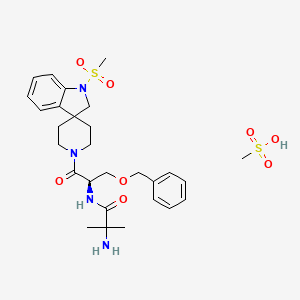
MK-677, also called ibutamoren, is a pill that makes the body release more of its own growth hormone. It is usually discussed with peptides, but it is not one. It is a small molecule, which is why it works when swallowed.
Merck developed it in the 1990s as part of a search for oral drugs that mimic growth hormone-releasing peptides such as GHRP-6. Of the non-peptide compounds that came out of that work, MK-677 was considered the most promising.1 Merck studied it for frailty in older adults, hip fracture recovery and other conditions, but did not bring it to market. It was later licensed and studied as LUM-201 for children with growth hormone deficiency.
MK-677 is not approved by the FDA for any use. It is sold online as a research chemical and, illegally, in some products marketed as supplements. People buy it to build muscle, sleep more deeply, recover faster and look younger.
- Anecdotal only
- In vitro only
- Animal models only
- Preliminary human
- Clinical trials
- Regulator approved
How MK-677 works
Your stomach makes a hormone called ghrelin. It makes you hungry, and it also tells the pituitary gland in the brain to release growth hormone. MK-677 copies ghrelin. It switches on the same receptor, so you get more growth hormone, which then raises IGF-1, the hormone that drives most of growth hormone's effects. You also get ghrelin's other effect, which is hunger.
Because it stays in the body for about a day, a single daily dose keeps growth hormone and IGF-1 raised around the clock. That convenience is also the source of its main downsides.
More precisely, MK-677 is a spiropiperidine agonist of the growth hormone secretagogue receptor type 1a (GHS-R1a), a G-protein-coupled receptor in the pituitary and hypothalamus. The receptor was in fact first identified using MK-0677 as a probe, and ghrelin was later found to be its natural ligand.7 Activation increases the amplitude of natural growth hormone pulses rather than replacing them, and the effect is synergistic with growth hormone-releasing hormone.4 Because release stays pulsatile and subject to negative feedback, levels are less likely to reach the extremes seen with injected growth hormone.3
Growth hormone secretagogues such as ipamorelin, GHRP-2, GHRP-6 and MK-677 act on the ghrelin receptor in the pituitary and hypothalamus, triggering a GH pulse.
What the research shows on MK-677
MK-677 has more human data than most compounds in this category, mostly from Merck-funded trials in the 1990s and 2000s. The results are consistent about hormones and less convincing about real-world outcomes.
In older adults, daily MK-677 restored the size of growth hormone pulses toward levels seen in young adults. Over longer treatment it increased lean mass and bone density, with only modest improvements in strength.8 Measures of physical function did not clearly improve.
In a small crossover trial, eight healthy young volunteers on a calorie-restricted diet took 25 mg of MK-677 or placebo for a week. MK-677 reversed the nitrogen loss caused by dieting and raised IGF-1 and IGFBP-3 compared with placebo.2 That is a marker of reduced protein breakdown over seven days, not a measure of muscle growth.
A broader review of growth hormone secretagogues found they may improve growth in children, stimulate appetite, increase lean mass in wasting states and improve sleep. It also noted a consistent concern about rising blood glucose from reduced insulin sensitivity, and too few long-term, well-controlled studies.3 More recently, early pediatric data on ibutamoren in children with partial growth hormone deficiency has been reported, but it is not an approved treatment.5
Studied for: Growth hormone elevation, Appetite stimulation, Sleep depth, Lean mass.
MK-677 reference data
| Molecular weight | 528.66 Da |
|---|---|
| CAS number | 159752-10-0 |
| FDA status | Not approved for any indication. |
| Prohibited in sport | Yes, under the WADA prohibited list |
MK-677 dosage in published research
Once daily · usually run for about 12 weeks. A reference pattern, not a prescription.
How MK-677 is used in practice
Licensed US telehealth providers do not legitimately prescribe MK-677, and it is not an FDA-recognized compounding ingredient. Most users buy it as capsules or a liquid from research-chemical sites, or in products illegally sold as dietary supplements. The FDA has warned companies selling such products.
Users typically take it once a day, often at night, and run it for weeks or months. Studies used doses of up to 25 mg daily. Because it is oral and cheap, it is one of the most widely used compounds in this space. Users often take it alongside other performance drugs, which makes it hard to tell which one is causing a side effect.
Unregulated products are a problem. Testing of online performance products has repeatedly found labels that do not match contents, including wrong doses and undeclared ingredients. There is no way for a buyer to verify what a given bottle contains.
MK-677 risks and side effects
The most reliable side effect is increased appetite, sometimes intense. Water retention, swelling in the hands and feet, joint aches, tingling or numbness in the hands, and tiredness are also common. These reflect higher growth hormone levels.
The most important risk is to blood sugar. MK-677 reduces insulin sensitivity and can raise fasting glucose.3 People with diabetes or prediabetes should not use it, and anyone using it would need glucose monitoring. A trial in older adults recovering from hip fracture was stopped early because of more heart failure events in the treatment group, which is why heart failure is listed as a contraindication.
Long-term effects on cancer risk are unknown. Raising IGF-1 for months is a concern for anyone with active cancer or a history of it. It should not be used in pregnancy. It may add to the effects of other growth hormone secretagogues and can blunt the effect of diabetes medicines. It is banned in sport.
Reported side effects
Alternatives to MK-677
For diagnosed adult or childhood growth hormone deficiency, FDA-approved somatropin and long-acting growth hormone products are the proper treatment. Tesamorelin (Egrifta) is an approved GHRH analog for excess abdominal fat in people with HIV. Macimorelin (Macrilen) is an approved oral ghrelin-receptor agonist, but only as a single-dose diagnostic test.
For muscle and strength, resistance training, sufficient protein and creatine have far better evidence. For sleep, treating sleep apnea and improving sleep habits help more than chasing growth hormone. For cancer-related appetite loss, anamorelin is approved in Japan.
The bottom line on MK-677
MK-677 reliably raises growth hormone and IGF-1 when taken by mouth, and trials show gains in lean mass and bone density. They do not show clear gains in strength or function, and the drug consistently worsens insulin sensitivity and increases appetite. It is unapproved, sold through an unregulated market, and its long-term safety is not established.
Questions for a clinician
- What evidence applies to my situation, and at what level?
- What established alternatives should I consider first?
- What monitoring would be necessary, and how often?
- Can this be prescribed at all where I live, or only sold for research?
MK-677 FAQ
What is MK-677?
An orally active, long-acting ghrelin-receptor agonist. Frequently grouped with peptides but chemically a non-peptide small molecule. It is classed as gHRPs & ghrelin mimetics.
Is MK-677 FDA approved?
No. MK-677 is not approved by the FDA for any indication. Material sold online is labelled for research use only.
Is MK-677 legal in the US?
MK-677 is not FDA approved and is not on FDA’s 503A bulks list. US compounding pharmacies cannot routinely prepare it.
What dose of MK-677 is used in research?
Published research and practitioner protocols report 10-25 mg, once daily, typically for 12 weeks. This is a reference range, not a recommendation; dosing should be set by a licensed clinician.
What are the side effects of MK-677?
Reported side effects include increased appetite, water retention, reduced insulin sensitivity, lethargy, numbness in extremities. Contraindications: diabetes or prediabetes, active malignancy, congestive heart failure, pregnancy.
What is the half-life of MK-677?
The reported half-life of MK-677 is ~24 hours.
Is MK-677 banned in sport?
Yes. MK-677 falls under the World Anti-Doping Agency prohibited list.
References
Regulatory and primary sources
- FDA: Bulk drug substances that may present significant safety risks (Category 2 and withdrawn nominations) ↗ · content current as of April 22, 2026; checked October 18, 2026
- FDA: Bulk drug substances used in compounding under section 503A ↗ · how the 503A categories work
- PubChem compound record (CID 6450830) ↗ · structure, identifiers, synonyms
- WADA Prohibited List ↗ · current year
- FDA: Unapproved drugs and "research use only" products ↗ · regulatory status of non-approved products
- CAS Registry Number 159752-10-0 ↗ · chemical identity
Published literature
- Growth hormone-releasing peptides.Eur J Endocrinol 1997.PubMed 9186261 · doi:10.1530/eje.0.1360445
- MK-677, an orally active growth hormone secretagogue, reverses diet-induced catabolism.J Clin Endocrinol Metab 1998.PubMed 9467534 · doi:10.1210/jcem.83.2.4551
- The Safety and Efficacy of Growth Hormone Secretagogues.Sex Med Rev 2018.PubMed 28400207 · doi:10.1016/j.sxmr.2017.02.004
- Growth hormone-releasing peptides and their analogs.Front Neuroendocrinol 1998.PubMed 9465289 · doi:10.1006/frne.1997.0158
- New directions in growth hormone treatment in children.Pediatr Endocrinol Diabetes Metab 2025.PubMed 41693185 · doi:10.5114/pedm.2025.158544
- Growth hormone-releasing peptides and the cardiovascular system.Ann Endocrinol (Paris) 2000.PubMed 10790589
- Regulation of ghrelin secretion and action.Endocrine 2003.PubMed 14610293 · doi:10.1385/ENDO:22:1:5
- Ghrelin receptor (GHS-R1A) agonists show potential as interventive agents during aging.Ann N Y Acad Sci 2007.PubMed 18056963 · doi:10.1196/annals.1404.023
Literature retrieved from PubMed on October 16, 2026, favouring human studies and reviews. Numbered markers in the text show which paper supports which statement; uncited entries are background reading.