Is Hexarelin legal?
Not FDA approved- FDA status
- Hexarelin is not FDA approved and is not on FDA’s 503A bulks list.
- Compounding
- US compounding pharmacies cannot routinely prepare it.
- Prescription
- There is no approved US prescription product for Hexarelin.
- Online market
- Products sold online are labelled “for research use only”: not made, tested or labelled for human use, and often mislabelled.
- Sport
- Prohibited in sport under the World Anti-Doping Agency list.
US status checked October 2026 against FDA’s compounding lists. Sources at the foot of the page.
What is hexarelin?
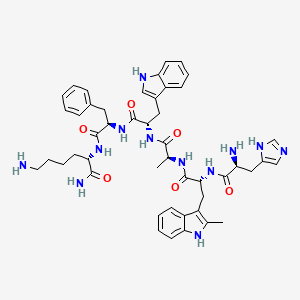
Hexarelin is a synthetic six-amino-acid peptide that makes the pituitary gland release growth hormone (GH). It belongs to the growth hormone-releasing peptides (GHRPs), a family of man-made compounds that also includes GHRP-6, GHRP-2 and GHRP-1.6 It was built as a modified version of GHRP-6 and entered human studies in the 1990s.2
Hexarelin has never been approved as a medicine in the US. Today it is sold mainly as a research chemical and marketed for raising GH, for body composition and, less often, for heart health. It has drawn scientific interest because it appears to act directly on the heart, which most of its relatives do not.
- Anecdotal only
- In vitro only
- Animal models only
- Preliminary human
- Clinical trials
- Regulator approved
How hexarelin works
Your body controls GH with two main signals. One, growth hormone-releasing hormone (GHRH), tells the pituitary to release GH. Another, somatostatin, tells it to hold back. Hexarelin works through a third pathway, the receptor that the hunger hormone ghrelin uses. When hexarelin binds there, the pituitary releases a strong pulse of GH. Because this pathway is separate from GHRH, combining the two gives a bigger response than either alone.
Hexarelin also binds a second receptor called CD36, found on heart cells and immune cells. That is the basis for research on the heart and on fat metabolism.
In more precise terms, hexarelin is a ligand of the growth hormone secretagogue receptor (GHS-R1a) and has no structural similarity to GHRH.6 GHRPs probably act at both the pituitary and the hypothalamus, possibly by countering somatostatin, and their effect is synergistic with GHRH.2 Like other GHRPs, hexarelin also raises prolactin and ACTH, and so cortisol.8 Binding studies found specific hexarelin binding sites in human heart tissue, with the highest levels in the ventricles.7 Separately, hexarelin activates PPAR-gamma through CD36 in macrophages and fat cells, a pathway linked in animal work to cholesterol handling and fat metabolism.4
Growth hormone secretagogues such as ipamorelin, GHRP-2, GHRP-6 and MK-677 act on the ghrelin receptor in the pituitary and hypothalamus, triggering a GH pulse.
What the research shows on hexarelin
The strongest human evidence concerns GH release itself. In short studies, GHRPs including hexarelin produce a marked, dose-related GH rise after injection, nasal spray and even oral dosing.2 The response is the same in men and women but falls with age, though in older adults it remains larger than the response to GHRH.2
Tolerance is the main limit. The GH response partly fades with repeated dosing, more with continuous infusion than with intermittent doses.2 Even so, longer-term GHRP dosing has raised IGF-1 levels in animals and humans.2
In obesity, where GH output is blunted, hexarelin and GHRP-6 produced larger GH responses than GHRH, but still smaller than in lean people.3 That shows the effect, not a weight-loss benefit. No controlled trial has shown that hexarelin reduces body fat.
The heart findings are the most distinctive. In rats, hexarelin protected against damage from reduced blood flow to the heart, and small human studies reported a positive effect on heart muscle contraction in healthy volunteers and in people with GH deficiency.7 These effects appear to be independent of GH.7 Researchers have also proposed roles in diabetes-related heart disease, but that work is mostly in animals and cells.8
The limits are significant. Human studies are small, short and mostly from the 1990s. There are no modern trials of hexarelin for any clinical outcome. A review of GH secretagogues as a class found few long-term, rigorously controlled studies and called for safety data, including on cancer and mortality.5
Studied for: Growth hormone elevation, Cardiac research, Short-cycle GH protocols.
Hexarelin reference data
| Sequence | His-D-2-methyl-Trp-Ala-Trp-D-Phe-Lys-NH2 |
|---|---|
| Molecular weight | 887.04 Da |
| CAS number | 140703-51-1 |
| FDA status | Not approved for any indication. |
| Prohibited in sport | Yes, under the WADA prohibited list |
Hexarelin dosage in published research
1-2x daily, short cycles only · usually run for about 3 weeks. A reference pattern, not a prescription.
Open this in the dosage calculator ↗
How hexarelin is used in practice
Hexarelin has no approved medical use, and it is not part of standard telehealth or compounding practice. US clinics that offer GH-axis peptides tend to choose sermorelin, ipamorelin or tesamorelin, partly because of hexarelin's tolerance problem and its effect on cortisol and prolactin.
Most hexarelin is bought online as "research use only" powder and injected under the skin. Users typically run it in short cycles to work around the fading response. These products are not made to pharmaceutical standards. Purity, sterility and actual peptide content are unverified, and mislabeled or contaminated vials are a known problem in this market.
Hexarelin is prohibited in sport. Athletes who use it risk a doping violation.
Hexarelin risks and side effects
Reported effects include raised cortisol and prolactin, water retention, tiredness and rapid tolerance. The cortisol and prolactin rise is a known class effect.7 Raised prolactin can affect libido and, over time, may cause breast changes.
GH secretagogues as a class can raise blood sugar by reducing insulin sensitivity.5 That matters for anyone with prediabetes or diabetes. Like anything that raises GH and IGF-1, hexarelin is a concern for people with active cancer. It should not be used in pregnancy or by people with existing high prolactin.
Hexarelin also desensitizes the ghrelin receptor. Someone switching to another GHRP soon after may see a blunted response. Stacking it with other GHRPs does not get around this, because they all act on the same receptor.
The biggest unknown is long-term safety. No study has followed people using hexarelin for years. The direct heart effects, which look protective in animals, have not been studied in people with heart disease. Product quality adds a separate layer of risk.
Reported side effects
Alternatives to hexarelin
For diagnosed GH deficiency, recombinant human growth hormone (somatropin) is the approved treatment and has decades of data. Tesamorelin is an FDA-approved GHRH analog for excess abdominal fat in people with HIV. Macimorelin, an oral ghrelin-receptor agonist, is approved only as a diagnostic test.
Among unapproved peptides, ipamorelin acts on the same receptor with less effect on cortisol and prolactin, and sermorelin is a GHRH analog with a longer clinical history. For body composition, resistance training, adequate protein and sleep are the best-evidenced options, and GLP-1 medicines such as semaglutide have strong evidence for fat loss.
The bottom line on hexarelin
Hexarelin reliably raises GH in the short term and has interesting heart effects in animal and early human work. But tolerance develops quickly, it raises cortisol and prolactin, and there are no modern clinical trials or long-term safety data. Grey-market supply adds risk. For most goals, better-studied options exist.
Questions for a clinician
- What evidence applies to my situation, and at what level?
- What established alternatives should I consider first?
- What monitoring would be necessary, and how often?
- Can this be prescribed at all where I live, or only sold for research?
Hexarelin FAQ
What is Hexarelin?
The most potent GH-releasing hexapeptide of the group, with documented cardiac effects and the fastest receptor desensitisation. It is classed as gHRPs & ghrelin mimetics.
Is Hexarelin FDA approved?
No. Hexarelin is not approved by the FDA for any indication. Material sold online is labelled for research use only.
Is Hexarelin legal in the US?
Hexarelin is not FDA approved and is not on FDA’s 503A bulks list. US compounding pharmacies cannot routinely prepare it.
What dose of Hexarelin is used in research?
Published research and practitioner protocols report 100-200 mcg, 1-2x daily, short cycles only, typically for 3 weeks. This is a reference range, not a recommendation; dosing should be set by a licensed clinician.
How is Hexarelin reconstituted?
A 5 mg vial mixed with 2 mL of bacteriostatic water gives 2.5 mg/mL. At that concentration 100 mcg is 4.0 units on a 100-unit insulin syringe.
What are the side effects of Hexarelin?
Reported side effects include elevated cortisol and prolactin, water retention, rapid tolerance, lethargy. Contraindications: active malignancy, pregnancy, hyperprolactinaemia.
What is the half-life of Hexarelin?
The reported half-life of Hexarelin is ~55 minutes.
Is Hexarelin banned in sport?
Yes. Hexarelin falls under the World Anti-Doping Agency prohibited list.
References
Regulatory and primary sources
- FDA: Bulk drug substances that may present significant safety risks (Category 2 and withdrawn nominations) ↗ · content current as of April 22, 2026; checked October 18, 2026
- FDA: Bulk drug substances used in compounding under section 503A ↗ · how the 503A categories work
- PubChem compound record (CID 6918297) ↗ · structure, identifiers, synonyms
- WADA Prohibited List ↗ · current year
- FDA: Unapproved drugs and "research use only" products ↗ · regulatory status of non-approved products
- CAS Registry Number 140703-51-1 ↗ · chemical identity
Published literature
- We are ageing.Biomed Res Int 2014.PubMed 25045704 · doi:10.1155/2014/808307
- Growth hormone-releasing peptides.Eur J Endocrinol 1997.PubMed 9186261 · doi:10.1530/eje.0.1360445
- Growth hormone in obesity.Int J Obes Relat Metab Disord 1999.PubMed 10193871 · doi:10.1038/sj.ijo.0800807
- The CD36-PPARγ Pathway in Metabolic Disorders.Int J Mol Sci 2018.PubMed 29883404 · doi:10.3390/ijms19051529
- The Safety and Efficacy of Growth Hormone Secretagogues.Sex Med Rev 2018.PubMed 28400207 · doi:10.1016/j.sxmr.2017.02.004
- Growth hormone-releasing peptides and their analogs.Front Neuroendocrinol 1998.PubMed 9465289 · doi:10.1006/frne.1997.0158
- Growth hormone-releasing peptides and the cardiovascular system.Ann Endocrinol (Paris) 2000.PubMed 10790589
- Implications of ghrelin and hexarelin in diabetes and diabetes-associated heart diseases.Endocrine 2015.PubMed 25645463 · doi:10.1007/s12020-015-0531-z
Literature retrieved from PubMed on October 16, 2026, favouring human studies and reviews. Numbered markers in the text show which paper supports which statement; uncited entries are background reading.