Is GHRP-6 legal?
FDA Category 2- FDA status
- GHRP-6 is not FDA approved. FDA lists it in Category 2 of its 503A bulk substances review: substances that may present significant safety risks.
- Compounding
- US compounding pharmacies should not prepare it.
- Prescription
- There is no approved US prescription product for GHRP-6.
- Online market
- Products sold online are labelled “for research use only”: not made, tested or labelled for human use, and often mislabelled.
- Sport
- Prohibited in sport under the World Anti-Doping Agency list.
US status checked October 2026 against FDA’s compounding lists. Sources at the foot of the page.
What is GHRP-6?
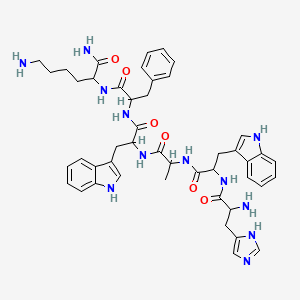
GHRP-6 (growth hormone-releasing peptide 6) is a synthetic six-amino acid peptide that triggers release of growth hormone (GH). It was discovered by the endocrinologist Cyril Bowers, and that discovery set off the search for other GH secretagogues and for the receptor they act on.6 It was the first hexapeptide of its class to be studied extensively in humans.1 In the 1990s, researchers also tested it as a way to measure the pituitary's GH reserve in children and adults.5
GHRP-6 also served as the template for later drugs. Researchers used it to design non-peptide GH secretagogues such as MK-0677, now known as ibutamoren.8
GHRP-6 is not approved as a medicine in the US or elsewhere. Today it is sold as a research chemical, used mostly by bodybuilders and others who want both a GH boost and a strong increase in appetite.
- Anecdotal only
- In vitro only
- Animal models only
- Preliminary human
- Clinical trials
- Regulator approved
How GHRP-6 works
GHRP-6 copies the action of ghrelin, the hunger hormone made mainly in the stomach. Ghrelin acts in the brain to make you hungry and on the pituitary gland to release GH. GHRP-6 does both, and its hunger effect is stronger than that of related peptides such as ipamorelin and GHRP-2. That is why it is chosen for bulking and avoided by people trying to lose fat.
In more detail, GHRP-6 activates the growth hormone secretagogue receptor, a G-protein-coupled receptor first cloned as an orphan with no known natural partner. Ghrelin was later confirmed as its natural full agonist.7 This receptor raises calcium inside the pituitary's GH-making cells, whereas GHRH works through a different receptor that raises cyclic AMP.6 Because the two pathways are distinct, GHRPs and GHRH have a synergistic effect on GH release. GHRPs also act in the hypothalamus and appear to counter somatostatin, the hormone that shuts GH release off.1 Its GH effect is similar in men and women, rises through puberty and declines with age, but it remains marked in people in their sixties.1
Growth hormone secretagogues such as ipamorelin, GHRP-2, GHRP-6 and MK-677 act on the ghrelin receptor in the pituitary and hypothalamus, triggering a GH pulse.
What the research shows on GHRP-6
The best human data concern diagnosis. In a 1996 study, children with GH deficiency had a lower GH response to intravenous GHRP-6 than normal children, but individual results overlapped considerably. Responses were almost completely absent in patients whose pituitary stalk had been cut, and the combination of GHRH plus GHRP-6 looked useful for diagnosing adult-onset GH deficiency.5 A 2008 review of adult GH deficiency testing agreed that GHRH combined with a GH secretagogue such as GHRP-6 has well-defined cut-offs, is reproducible and can separate normal people from those with deficiency.3
In obesity, where GH release is blunted, GHRP-6 produced larger GH responses than GHRH, and GHRH plus GHRP-6 was the strongest GH-releasing stimulus known, though still weaker than in lean people.2
Evidence for outcomes beyond hormone levels is thin. A 2018 review of GH secretagogues in humans found that they might improve growth in children, stimulate appetite, increase lean mass in wasting states and obesity, reduce bone turnover and improve sleep. But it also found that few long-term, rigorously controlled studies exist.4 Most of that evidence involves other secretagogues, especially oral ibutamoren, rather than GHRP-6. Earlier work showed that continuous infusion causes partial loss of effect, less so with intermittent dosing, and that prolonged use raises IGF-1 levels.1
No controlled trial shows that GHRP-6 builds muscle, improves recovery or enhances performance in healthy adults. Its typical bodybuilding use, injected several times a day for months, has never been formally studied.
Studied for: Appetite stimulation, Growth hormone elevation, Recovery research.
GHRP-6 reference data
| Sequence | His-D-Trp-Ala-Trp-D-Phe-Lys-NH2 |
|---|---|
| Molecular weight | 873.01 Da |
| CAS number | 87616-84-0 |
| FDA status | Not approved for any indication. |
| Prohibited in sport | Yes, under the WADA prohibited list |
GHRP-6 dosage in published research
2-3x daily · usually run for about 12 weeks. A reference pattern, not a prescription.
Open this in the dosage calculator ↗
How GHRP-6 is used in practice
GHRP-6 is sold by research-chemical vendors as freeze-dried powder labeled for research use only. Users typically inject it under the skin two or three times a day, on an empty stomach because food and high blood sugar blunt the GH response, and often pair it with a GHRH analog such as CJC-1295. The hunger it causes is usually rapid and strong. Some users take it mainly to make eating large amounts of food easier during a bulking phase, a use with no medical oversight or study behind it.
It is not a standard diagnostic agent in the US, and FDA has restricted it from use in compounding. The legal status box on this page has the details. GHRP-6 is banned in sport.
As with all research peptides, nothing guarantees the identity, dose or sterility of what is in the vial, and products bought from online vendors are not tested by any regulator.
GHRP-6 risks and side effects
The most noticeable side effect is intense hunger. Users also report water retention, a brief head rush or flushing after injection and tingling in the hands. Like other GHRPs, GHRP-6 can raise cortisol and prolactin along with GH.
GH secretagogues are generally well tolerated in studies, but there is concern that they raise blood sugar by reducing insulin sensitivity.4 The same review called for long-term safety studies, including cancer incidence and mortality, which have not been done.4 People with diabetes or prediabetes, active cancer or pregnancy should avoid GHRP-6.
The response partly fades with continued use,1 which can tempt users into higher doses. Combining it with other unregulated hormones, a common pattern in bodybuilding, multiplies the unknowns.
Reported side effects
Alternatives to GHRP-6
For diagnosing GH deficiency, the insulin tolerance test and glucagon stimulation test are established,3 and macimorelin, an oral ghrelin-receptor agonist, is FDA-approved for diagnosing adult GH deficiency. For confirmed deficiency, recombinant growth hormone (somatropin) is the approved treatment.
For poor appetite and weight loss caused by illness, approved options include megestrol acetate and dronabinol for specific conditions, alongside nutrition support. Anamorelin, an oral ghrelin-receptor agonist, is approved in Japan for cancer-related weight loss. For healthy people who want to gain muscle, a consistent calorie surplus, enough protein and progressive resistance training work without hormonal side effects.
Ipamorelin, a newer ghrelin-receptor agonist, is often chosen by people who want GH release without strong hunger. It is also unapproved and has its own thin evidence base, so it is a different trade-off rather than a proven upgrade.
The bottom line on GHRP-6
GHRP-6 is a historically important peptide that opened up the whole field of GH secretagogues, and it reliably releases GH and drives hunger. It has never been approved, there are no trials showing it improves muscle or performance, and its effects on blood sugar and long-term risk are unstudied. For most people, its main practical effect is appetite.
Questions for a clinician
- What evidence applies to my situation, and at what level?
- What established alternatives should I consider first?
- What monitoring would be necessary, and how often?
- Can this be prescribed at all where I live, or only sold for research?
GHRP-6 FAQ
What is GHRP-6?
The original growth-hormone-releasing hexapeptide, now used as much for its pronounced appetite stimulation as for GH release. It is classed as gHRPs & ghrelin mimetics.
Is GHRP-6 FDA approved?
No. GHRP-6 is not approved by the FDA for any indication. Material sold online is labelled for research use only.
Is GHRP-6 legal in the US?
GHRP-6 is not FDA approved. FDA lists it in Category 2 of its 503A bulk substances review: substances that may present significant safety risks. US compounding pharmacies should not prepare it.
What dose of GHRP-6 is used in research?
Published research and practitioner protocols report 100-300 mcg, 2-3x daily, typically for 12 weeks. This is a reference range, not a recommendation; dosing should be set by a licensed clinician.
How is GHRP-6 reconstituted?
A 5 mg vial mixed with 2 mL of bacteriostatic water gives 2.5 mg/mL. At that concentration 100 mcg is 4.0 units on a 100-unit insulin syringe.
What are the side effects of GHRP-6?
Reported side effects include pronounced hunger, elevated cortisol and prolactin, water retention, head rush. Contraindications: active malignancy, pregnancy, uncontrolled diabetes.
What is the half-life of GHRP-6?
The reported half-life of GHRP-6 is ~15-30 minutes.
Is GHRP-6 banned in sport?
Yes. GHRP-6 falls under the World Anti-Doping Agency prohibited list.
References
Regulatory and primary sources
- FDA: Bulk drug substances that may present significant safety risks (Category 2 and withdrawn nominations) ↗ · content current as of April 22, 2026; checked October 18, 2026
- FDA: Bulk drug substances used in compounding under section 503A ↗ · how the 503A categories work
- PubChem compound record (CID 4345065) ↗ · structure, identifiers, synonyms
- WADA Prohibited List ↗ · current year
- FDA: Unapproved drugs and "research use only" products ↗ · regulatory status of non-approved products
- CAS Registry Number 87616-84-0 ↗ · chemical identity
Published literature
- Growth hormone-releasing peptides.Eur J Endocrinol 1997.PubMed 9186261 · doi:10.1530/eje.0.1360445
- Growth hormone in obesity.Int J Obes Relat Metab Disord 1999.PubMed 10193871 · doi:10.1038/sj.ijo.0800807
- Diagnosis of adult GH deficiency.Pituitary 2008.PubMed 18404387 · doi:10.1007/s11102-008-0110-x
- The Safety and Efficacy of Growth Hormone Secretagogues.Sex Med Rev 2018.PubMed 28400207 · doi:10.1016/j.sxmr.2017.02.004
- Growth hormone releasing hexapeptide-6 (GHRP-6) test in the diagnosis of GH-deficiency.J Pediatr Endocrinol Metab 1996.PubMed 8887178
- Physiology of ghrelin and related peptides.Domest Anim Endocrinol 2005.PubMed 15927771 · doi:10.1016/j.domaniend.2005.02.033
- Growth hormone secretagogue receptor family members and ligands.Endocrine 2001.PubMed 11322507 · doi:10.1385/ENDO:14:1:009
- Growth hormone-releasing peptides and their analogs.Front Neuroendocrinol 1998.PubMed 9465289 · doi:10.1006/frne.1997.0158
Literature retrieved from PubMed on October 16, 2026, favouring human studies and reviews. Numbered markers in the text show which paper supports which statement; uncited entries are background reading.