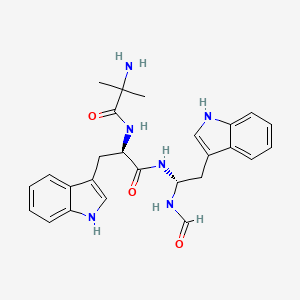
Is Macimorelin legal?
FDA approved- FDA status
- Macimorelin is FDA approved for: Diagnosis of adult growth hormone deficiency (Macrilen).
- Compounding
- It is a prescription medicine. Use outside the approved indication is off-label and a clinician’s decision. Compounded copies are restricted when the approved product is available.
- Prescription
- A licensed US clinician can prescribe Macimorelin.
- Sport
- Prohibited in sport under the World Anti-Doping Agency list.
US status checked October 2026 against FDA’s compounding lists. Sources at the foot of the page.
What is macimorelin?
Macimorelin is an oral drug that makes the pituitary gland release growth hormone (GH). Unlike most compounds in this group, it is taken by mouth and is FDA approved. Its approval is narrow, though. It is not a treatment. It is a one-time diagnostic test used to find out whether an adult has growth hormone deficiency.
Macimorelin was developed by the company Aeterna Zentaris, under the code name AEZS-130, and was approved by the FDA in 2017 under the brand name Macrilen. It is a small peptide-like molecule designed to mimic ghrelin, the hunger hormone that also triggers GH release.4 It is not marketed for muscle, fat loss or anti-aging, and it is not used as an ongoing therapy.
- Anecdotal only
- In vitro only
- Animal models only
- Preliminary human
- Clinical trials
- Regulator approved
How macimorelin works
Adult growth hormone deficiency is hard to diagnose. GH is released in bursts, so a single random blood test says little.6 Doctors instead use stimulation tests. They give something that should make a healthy pituitary release GH, then measure how much comes out over the next hour or two. A low peak points to deficiency.
Macimorelin is one of those stimuli. The patient drinks a single dose mixed in water after an overnight fast. Blood is drawn several times over the following 90 minutes. A healthy pituitary releases a clear GH pulse. A damaged one does not.
In more precise terms, macimorelin is an orally active agonist at the growth hormone secretagogue receptor (GHSR1a), the ghrelin receptor.4 It is absorbed from the gut and acts on the hypothalamus and pituitary to trigger GH release. It is broken down mainly by the liver enzyme CYP3A4, which is why drugs that speed up that enzyme can blunt the response and make a test falsely abnormal. The approved dose is 0.5 mg per kilogram of body weight.
Growth hormone secretagogues such as ipamorelin, GHRP-2, GHRP-6 and MK-677 act on the ghrelin receptor in the pituitary and hypothalamus, triggering a GH pulse.
What the research shows on macimorelin
The key study was a multicenter, randomized crossover trial that compared macimorelin with the insulin tolerance test (ITT), the long-standing reference test. It included 114 adults with high, intermediate or low likelihood of GH deficiency, plus 25 healthy matched controls.5 After the first test, 99% of macimorelin tests could be evaluated, compared with 82% of ITTs. Using the cutoffs in the trial, macimorelin had 87% sensitivity and 96% specificity against the ITT, and it gave the same result 97% of the time on retesting.5 No serious side effects were reported.5 A post hoc analysis suggested a higher GH cutoff might detect more cases without losing specificity, but post hoc results are less reliable than prespecified ones.
Expert bodies now accept the test. In a 2025 Delphi survey by the Growth Hormone Research Society, adult endocrinologists still called the ITT the gold standard but reached consensus to recommend the macimorelin test.2 Reviews of adult GH deficiency, including in patients treated for Cushing's disease, list macimorelin alongside insulin, glucagon and GHRH-arginine as accepted stimulation tests.36
Research on other uses is limited. A one-week pilot trial in 15 patients with cancer cachexia found macimorelin safe, with numerical but not statistically significant improvements in weight and quality of life.7 As a test for a different pituitary problem, vasopressin deficiency, macimorelin did not provide enough stimulus to be useful.1 Its use in children has been studied less than in adults.
Studied for: Diagnosis of adult growth hormone deficiency.
Macimorelin reference data
| Molecular weight | 574.68 Da |
|---|---|
| CAS number | 381231-18-1 |
| FDA status | Diagnosis of adult growth hormone deficiency (Macrilen) |
| Prohibited in sport | Yes, under the WADA prohibited list |
Macimorelin dosage in published research
How macimorelin is used in practice
Macimorelin is used by endocrinologists, usually in a clinic or hospital setting. Testing is meant only for adults at real risk of pituitary problems, such as people who have had pituitary tumors, pituitary surgery or radiation, serious head injury, or GH deficiency in childhood.6 Other pituitary hormone deficits should be tested and treated first.6
Its main practical advantage over the ITT is safety and convenience. The ITT deliberately drives blood sugar down, which is unpleasant, needs close supervision and is unsafe for people with heart disease or seizures.4 Macimorelin avoids that. The test takes about 90 minutes, needs only an oral drink and a few blood draws, and is easier to schedule. Its main drawback is cost. One review predicted that the glucagon test will become the most widely used alternative to the ITT, partly because macimorelin is expensive.8
Macimorelin is not a telehealth or compounding product, and it is not used for ongoing GH support. Anyone offered it for muscle, fat loss or anti-aging is being offered an off-label use with no supporting evidence. Like other GH secretagogues, it is prohibited in sport.
Macimorelin risks and side effects
Because it is given once, side effects are usually brief. The most common are a change in taste, dizziness, headache, tiredness, nausea and hunger.
The most important safety issue is heart rhythm. Macimorelin can prolong the QT interval on an ECG. It should be avoided in people with congenital or acquired QT prolongation and in people taking other drugs that prolong the QT interval.
Several things can distort the result. Strong CYP3A4 inducers, such as some seizure medicines and rifampin, can lower GH response and produce a false diagnosis of deficiency. Recent GH treatment should be stopped well before testing. Results are less certain in people with severe obesity, and accuracy has not been established in every group.
Reported side effects
Alternatives to macimorelin
For diagnosing adult GH deficiency, the main alternatives are the insulin tolerance test, which remains the reference standard, and the glucagon stimulation test, which is cheaper and widely available.8 The GHRH-arginine test is also validated, but GHRH is unavailable in many countries.8 In adults with three or more other pituitary hormone deficiencies, a low IGF-1 level alone may be enough to make the diagnosis.6
For people whose interest is raising GH rather than diagnosis, macimorelin is not the right tool. Diagnosed deficiency is treated with recombinant growth hormone, including daily somatropin or weekly long-acting forms such as somapacitan.
The bottom line on macimorelin
Macimorelin is a well-validated, FDA-approved oral test for adult growth hormone deficiency, with accuracy close to the insulin tolerance test and fewer safety concerns. It is a diagnostic tool, not a performance or anti-aging drug. Its main limits are cost and a heart rhythm warning.
Questions for a clinician
- What evidence applies to my situation, and at what level?
- What established alternatives should I consider first?
- What monitoring would be necessary, and how often?
Macimorelin FAQ
What is Macimorelin?
An orally administered ghrelin-receptor agonist and the only compound in this class with a current FDA approval. It is classed as gHRPs & ghrelin mimetics.
Is Macimorelin FDA approved?
Yes. Macimorelin is FDA approved for: Diagnosis of adult growth hormone deficiency (Macrilen).
Is Macimorelin legal in the US?
Macimorelin is FDA approved for: Diagnosis of adult growth hormone deficiency (Macrilen). It is a prescription medicine. Use outside the approved indication is off-label and a clinician’s decision. Compounded copies are restricted when the approved product is available.
What dose of Macimorelin is used in research?
Published research and practitioner protocols report 500 mg, single 0.5 mg/kg diagnostic dose. This is a reference range, not a recommendation; dosing should be set by a licensed clinician.
What are the side effects of Macimorelin?
Reported side effects include dysgeusia, dizziness, headache, fatigue, qt prolongation. Contraindications: congenital or acquired qt prolongation, concomitant qt-prolonging drugs.
What is the half-life of Macimorelin?
The reported half-life of Macimorelin is ~4 hours.
Is Macimorelin banned in sport?
Yes. Macimorelin falls under the World Anti-Doping Agency prohibited list.
References
Regulatory and primary sources
- FDA: Bulk drug substances that may present significant safety risks (Category 2 and withdrawn nominations) ↗ · content current as of April 22, 2026; checked October 18, 2026
- FDA: Bulk drug substances used in compounding under section 503A ↗ · how the 503A categories work
- PubChem compound record (CID 9804938) ↗ · structure, identifiers, synonyms
- DailyMed: FDA-approved labeling for Macimorelin ↗ · indications, dosing, warnings as approved
- FDA Drugs@FDA database ↗ · approval history
- WADA Prohibited List ↗ · current year
- CAS Registry Number 381231-18-1 ↗ · chemical identity
Published literature
- New insights on diagnosis and treatment of AVP deficiency.Rev Endocr Metab Disord 2024.PubMed 38087160 · doi:10.1007/s11154-023-09862-w
- Consensus and controversies about diagnosing GH deficiency: a Delphi survey by the GH research society.Pituitary 2025.PubMed 40335774 · doi:10.1007/s11102-025-01526-z
- Growth hormone deficiency in adults with Cushing's disease.Best Pract Res Clin Endocrinol Metab 2021.PubMed 33272904 · doi:10.1016/j.beem.2020.101474
- The macimorelin-stimulated growth hormone test for adult growth hormone deficiency diagnosis.Expert Rev Mol Diagn 2014.PubMed 24834478 · doi:10.1586/14737159.2014.915746
- Macimorelin as a Diagnostic Test for Adult GH Deficiency.J Clin Endocrinol Metab 2018.PubMed 29860473 · doi:10.1210/jc.2018-00665
- Current concepts of the diagnosis of adult growth hormone deficiency.Rev Endocr Metab Disord 2021.PubMed 32959175 · doi:10.1007/s11154-020-09594-1
- Pilot clinical trial of macimorelin to assess safety and efficacy in patients with cancer cachexia.J Cachexia Sarcopenia Muscle 2023.PubMed 36860137 · doi:10.1002/jcsm.13191
- Once upon a time: the glucagon stimulation test in diagnosing adult GH deficiency.J Endocrinol Invest 2024.PubMed 38461479 · doi:10.1007/s40618-024-02322-5
Literature retrieved from PubMed on October 16, 2026, favouring human studies and reviews. Numbered markers in the text show which paper supports which statement; uncited entries are background reading.