Is Ipamorelin legal?
FDA Category 2- FDA status
- Ipamorelin is not FDA approved. FDA lists it in Category 2 of its 503A bulk substances review: substances that may present significant safety risks.
- Compounding
- US compounding pharmacies should not prepare it.
- Prescription
- There is no approved US prescription product for Ipamorelin.
- Online market
- Products sold online are labelled “for research use only”: not made, tested or labelled for human use, and often mislabelled.
- Sport
- Prohibited in sport under the World Anti-Doping Agency list.
US status checked October 2026 against FDA’s compounding lists. Sources at the foot of the page.
What is ipamorelin?
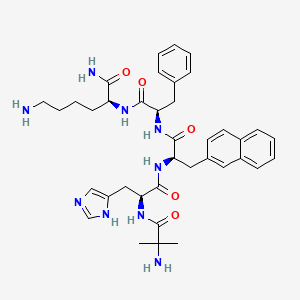
Ipamorelin is a synthetic five-amino-acid peptide that makes the pituitary gland release growth hormone (GH). It belongs to the growth hormone secretagogues, a group that also includes GHRP-2, GHRP-6 and hexarelin. Novo Nordisk developed it in the 1990s, and its developers described it as the first selective compound of its kind, because it released GH without much effect on other pituitary hormones.
Ipamorelin was never approved as a medicine. Its main clinical test was as a treatment for slow gut recovery after bowel surgery, and it did not beat placebo.7 Today it is one of the most popular peptides in wellness and anti-aging clinics and on research-chemical sites. It is often paired with CJC-1295 and marketed for recovery, sleep, body composition and muscle growth.5
- Anecdotal only
- In vitro only
- Animal models only
- Preliminary human
- Clinical trials
- Regulator approved
How ipamorelin works
Growth hormone is released in pulses, controlled mainly by two signals from the brain. Growth hormone-releasing hormone (GHRH) says go, and somatostatin says stop. A third signal comes from ghrelin, the hunger hormone, which also boosts GH release through its own receptor. Ipamorelin mimics ghrelin at that receptor and triggers a GH pulse.
What sets it apart from older peptides in the group is selectivity. Earlier compounds such as GHRP-6 and hexarelin also raise cortisol and prolactin. In early studies ipamorelin did not do this to a meaningful degree. That is the main reason clinics favor it.
In more precise terms, ipamorelin is an agonist at the growth hormone secretagogue receptor (GHS-R1a). In healthy men given intravenous infusions at five dose levels, it produced a single GH pulse that peaked about 40 minutes after the start of the infusion and then faded to negligible levels.6 Its terminal half-life was about two hours, and blood levels rose in proportion to dose.6 Because GHRH and ghrelin-receptor agonists act through different pathways, combining them gives a larger GH pulse than either alone. That is the logic behind pairing ipamorelin with CJC-1295 or sermorelin.
Growth hormone secretagogues such as ipamorelin, GHRP-2, GHRP-6 and MK-677 act on the ghrelin receptor in the pituitary and hypothalamus, triggering a GH pulse.
What the research shows on ipamorelin
The human evidence is limited to a small number of studies, and none tested the uses ipamorelin is marketed for.
The pharmacology study in healthy volunteers is solid but narrow. It included eight men at each of five dose levels and showed that ipamorelin reliably raises GH at every dose tested.6 Individual GH responses varied more than drug levels did.6 It did not measure body composition, sleep or any long-term outcome.
The largest clinical trial was a phase 2, placebo-controlled study in 117 patients having bowel surgery. Intravenous ipamorelin twice daily for up to seven days was well tolerated. Median time to tolerating a solid meal was 25.3 hours with ipamorelin and 32.6 hours with placebo, a difference that was not statistically significant.7 The authors noted that the study was small and enrolled a broad mix of patients.7 Clinical development for that use did not continue.
For muscle, recovery and sleep, the evidence is mostly animal work. In mice with steroid-induced muscle loss, CJC-1295 combined with ipamorelin improved muscle force, but this has not been tested in people.1 Recent reviews in sports medicine agree that ipamorelin and related GH secretagogues remain investigational, with uncertain safety and unknown dosing for these uses.81
No published trial has measured sleep quality, lean mass or injury healing in people taking ipamorelin, alone or with CJC-1295. In short, ipamorelin does raise GH in humans. Whether that pulse translates into meaningful changes in body composition, recovery or sleep has not been shown in controlled trials.
Studied for: Growth hormone elevation, Recovery, Sleep quality, Body composition.
Ipamorelin reference data
| Sequence | Aib-His-D-2-Nal-D-Phe-Lys-NH2 |
|---|---|
| Molecular weight | 711.85 Da |
| CAS number | 170851-70-4 |
| FDA status | Not approved for any indication. |
| Prohibited in sport | Yes, under the WADA prohibited list |
Ipamorelin dosage in published research
1-3x daily, on an empty stomach · usually run for about 12 weeks. A reference pattern, not a prescription.
Open this in the dosage calculator ↗
How ipamorelin is used in practice
Ipamorelin is widely offered by anti-aging, men's health and telehealth clinics, usually as a nightly injection under the skin, often in a blend with CJC-1295. Some clinics prescribe it for sleep or recovery, others for fat loss. The dosing table on this page shows commonly used ranges, but none of them come from outcome trials.
Access through pharmacies has been unstable. In 2023 the FDA placed ipamorelin in a category of bulk substances that compounding pharmacies should not use while safety concerns are reviewed, and availability through clinics has varied since.
Much ipamorelin is bought online as "research use only" powder. Reviews of this market describe products that are often mislabeled or contaminated.5 A 2026 review called it a "gray market" operating largely outside regulatory oversight, with scarce human safety data.3 Ipamorelin is prohibited in sport.
Ipamorelin risks and side effects
In clinical studies ipamorelin was well tolerated over short periods.7 Users commonly report a head rush or flushing after injection, brief hunger, water retention and tiredness. Food blunts the GH response, so it is usually taken on an empty stomach. Because it acts on the ghrelin receptor, it can also increase appetite, which works against people using it for fat loss.
Raising GH and IGF-1 carries known risks. Over time they can reduce insulin sensitivity and raise blood sugar. Reviews of peptide use in sport flag insulin resistance and lipid changes as emerging concerns.5 Anyone with active cancer should avoid compounds that raise GH and IGF-1. It should not be used in pregnancy.
The biggest gap is long-term data. No study has followed people using ipamorelin nightly for months or years. Interactions with other GH-axis drugs are additive, and stacking several compounds makes side effects harder to predict. Product quality adds a separate risk, from wrong doses to bacterial contamination.
Reported side effects
Alternatives to ipamorelin
For diagnosed adult GH deficiency, recombinant growth hormone (somatropin) is the approved treatment. Tesamorelin (Egrifta), a GHRH analog, is FDA approved for excess abdominal fat in people with HIV. Macimorelin is an approved oral ghrelin-receptor agonist, but only as a diagnostic test.
For sleep, cognitive behavioral therapy for insomnia has strong trial support. For body composition and recovery, resistance training, protein intake and sleep remain the best-supported tools, and GLP-1 medicines such as semaglutide and tirzepatide have strong evidence for fat loss.
The bottom line on ipamorelin
Ipamorelin is a cleaner GH-releasing peptide than its older relatives, and it does raise GH in humans. But its one real clinical trial missed its goal, and its popular uses rest on animal data and anecdote. Short-term use appears well tolerated. Long-term safety and benefit are unknown, and product quality varies widely.
Questions for a clinician
- What evidence applies to my situation, and at what level?
- What established alternatives should I consider first?
- What monitoring would be necessary, and how often?
- Can this be prescribed at all where I live, or only sold for research?
Ipamorelin FAQ
What is Ipamorelin?
The most receptor-selective of the growth-hormone-releasing peptides, notable for leaving cortisol and prolactin essentially unchanged. It is classed as gHRPs & ghrelin mimetics.
Is Ipamorelin FDA approved?
No. Ipamorelin is not approved by the FDA for any indication. Material sold online is labelled for research use only.
Is Ipamorelin legal in the US?
Ipamorelin is not FDA approved. FDA lists it in Category 2 of its 503A bulk substances review: substances that may present significant safety risks. US compounding pharmacies should not prepare it.
What dose of Ipamorelin is used in research?
Published research and practitioner protocols report 200-300 mcg, 1-3x daily, on an empty stomach, typically for 12 weeks. This is a reference range, not a recommendation; dosing should be set by a licensed clinician.
How is Ipamorelin reconstituted?
A 5 mg vial mixed with 2 mL of bacteriostatic water gives 2.5 mg/mL. At that concentration 200 mcg is 8.0 units on a 100-unit insulin syringe.
What are the side effects of Ipamorelin?
Reported side effects include head rush on injection, transient hunger, water retention, lethargy. Contraindications: active malignancy, pregnancy.
What is the half-life of Ipamorelin?
The reported half-life of Ipamorelin is ~2 hours.
Is Ipamorelin banned in sport?
Yes. Ipamorelin falls under the World Anti-Doping Agency prohibited list.
References
Regulatory and primary sources
- FDA: Bulk drug substances that may present significant safety risks (Category 2 and withdrawn nominations) ↗ · content current as of April 22, 2026; checked October 18, 2026
- FDA: Bulk drug substances used in compounding under section 503A ↗ · how the 503A categories work
- PubChem compound record (CID 9831659) ↗ · structure, identifiers, synonyms
- WADA Prohibited List ↗ · current year
- FDA: Unapproved drugs and "research use only" products ↗ · regulatory status of non-approved products
- CAS Registry Number 170851-70-4 ↗ · chemical identity
Published literature
- Injectable Peptide Therapy: A Primer for Orthopaedic and Sports Medicine Physicians.Am J Sports Med 2026.PubMed 41476424 · doi:10.1177/03635465251357593
- Therapeutic Peptides in Orthopaedics: Applications, Challenges, and Future Directions.J Am Acad Orthop Surg Glob Res Rev 2026.PubMed 41490200 · doi:10.5435/JAAOSGlobal-D-25-00236
- Safety and Efficacy of Approved and Unapproved Peptide Therapies for Musculoskeletal Injuries and Athletic Performance.Sports Med 2026.PubMed 41966639 · doi:10.1007/s40279-026-02437-0
- Therapeutic Peptides in Aesthetic, Metabolic and Endocrine Conditions: Effects, Safety, Clinical Applications, and Future Perspectives.Int J Mol Sci 2026.PubMed 42123471 · doi:10.3390/ijms27093890
- A new era of doping? Use of peptide and peptide-analog drugs in recreational and professional sport and bodybuilding: a critical review.J Sports Med Phys Fitness 2026.PubMed 41880199 · doi:10.23736/S0022-4707.26.17773-1
- Pharmacokinetic-pharmacodynamic modeling of ipamorelin, a growth hormone releasing peptide, in human volunteers.Pharm Res 1999.PubMed 10496658 · doi:10.1023/a:1018955126402
- Prospective, randomized, controlled, proof-of-concept study of the Ghrelin mimetic ipamorelin for the management of postoperative ileus in bowel resection patients.Int J Colorectal Dis 2014.PubMed 25331030 · doi:10.1007/s00384-014-2030-8
- Injectable Peptides in Sports Medicine: A Structured Narrative Review of Evidence, Safety, and Antidoping Implications.JBJS Rev 2026.PubMed 42160466 · doi:10.2106/JBJS.RVW.26.00027
Literature retrieved from PubMed on October 16, 2026, favouring human studies and reviews. Numbered markers in the text show which paper supports which statement; uncited entries are background reading.